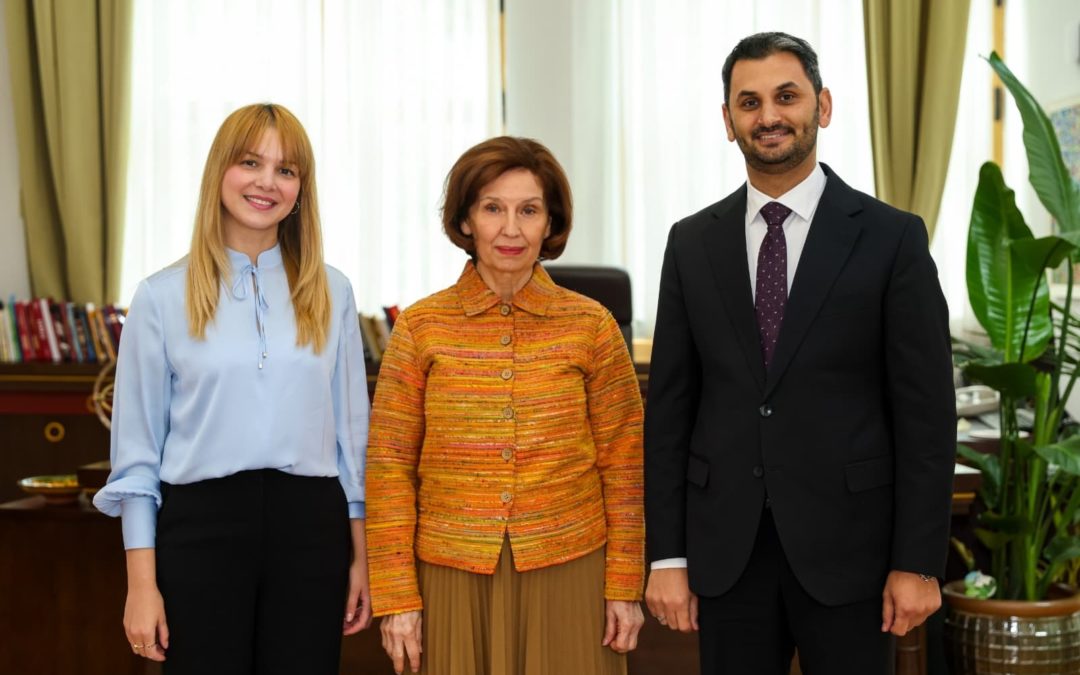
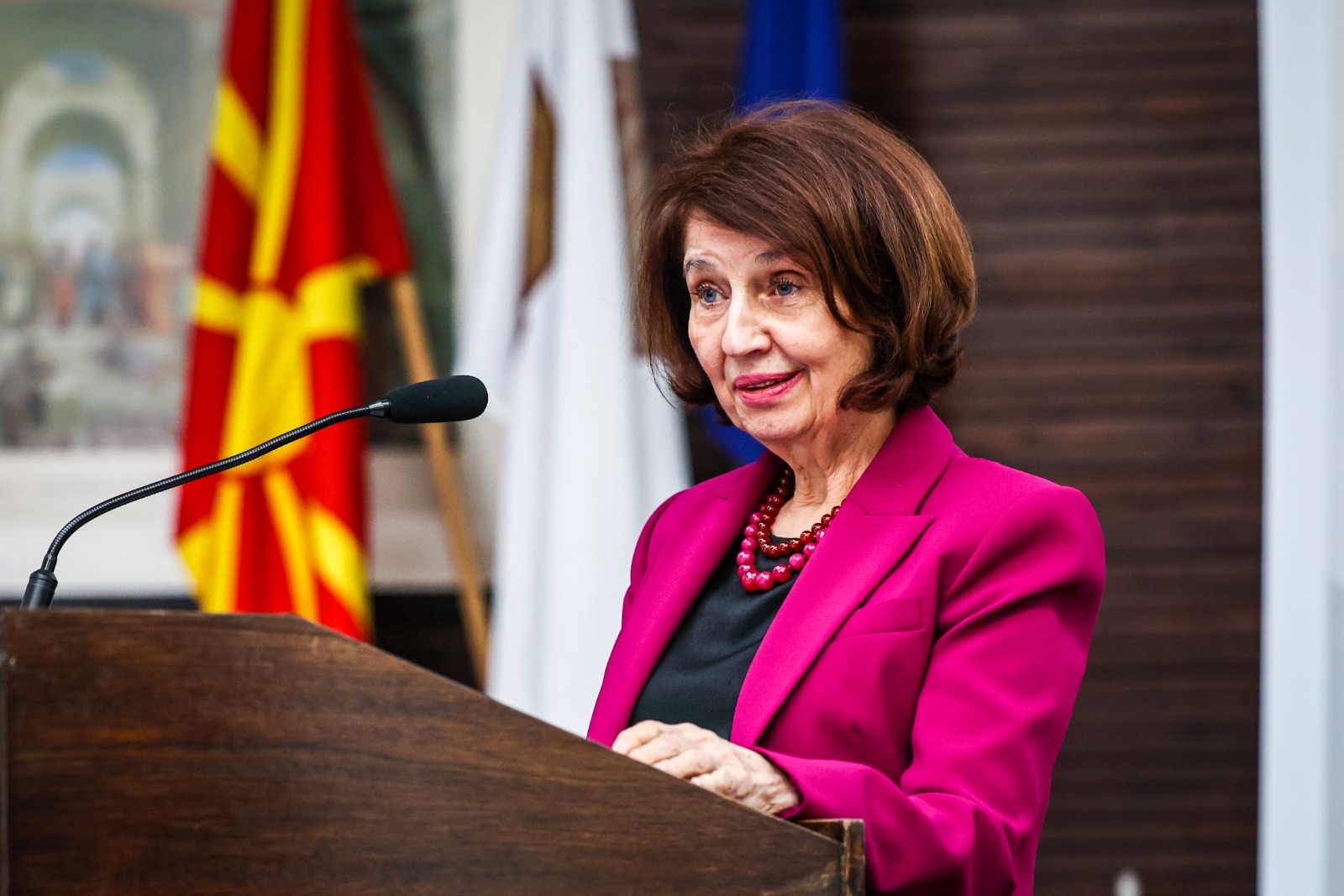
On the occasion of International Human Rights Day, President Gordana Siljanovska-Davkova addressed the Solemn Session at the Faculty of Law “Iustinianus Primus” in Skopje.
She pointed out that December 10 is a symbol of the modern culture of human rights, but without respect there is no legal state, nor democracy.
For her, the paradoxical gap between the huge number of legal documents and institutions, on the one hand, and the alarming increase in conflicts, refugees and new forms of rights violations such as digital surveillance and algorithmic discrimination to climate injustices that directly affect the right to life, health and dignity, on the other, is paradoxical.
According to her, the climate crisis and modern wars expose the vulnerability and inefficiency of the international legal system and order.
She said that International Human Rights Day should not only be a day of commemoration, but a moment to confront difficult questions such as:
‒ Do our institutions guarantee fairness, equality and dignity or do they only describe and list them?
‒ Has our judiciary the strength to say “no” when politics says “yes”?
‒ Is the media given space to investigate corruption without fear?
‒ Are vulnerable groups visible in our policies?
“Human rights are always the result of a constant and daily struggle, of institutional courage and of civic awareness and conscience. Each generation must conquer, defend and interpret them anew through the prism of contemporary challenges”, she concluded.
The ceremonial session was also addressed by Prof. Dr. Sasho Georgievski, Dean of the Faculty of Law, and Oleg Soldatov, Head of the Council of Europe Programme Office in Skopje.
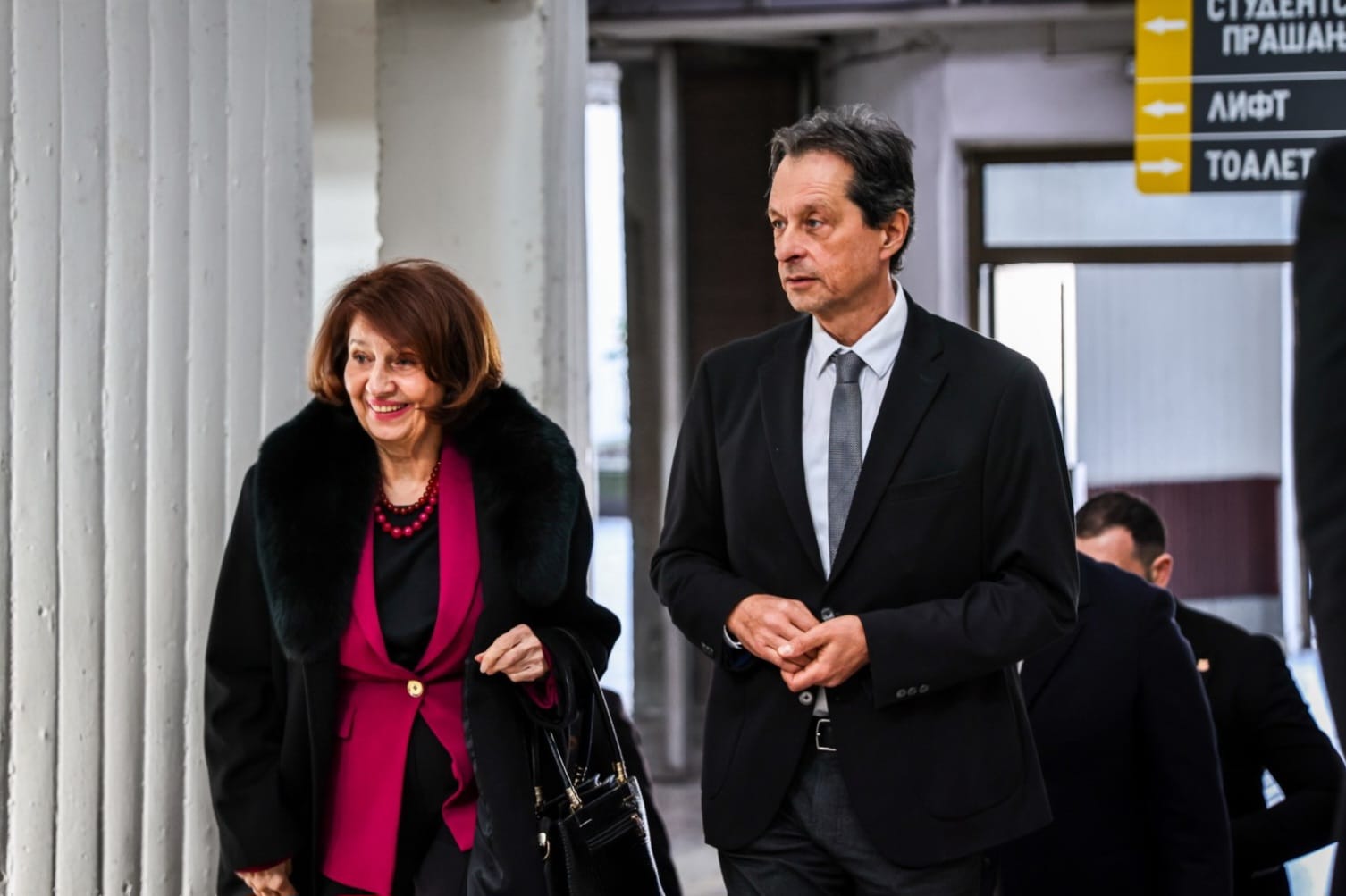
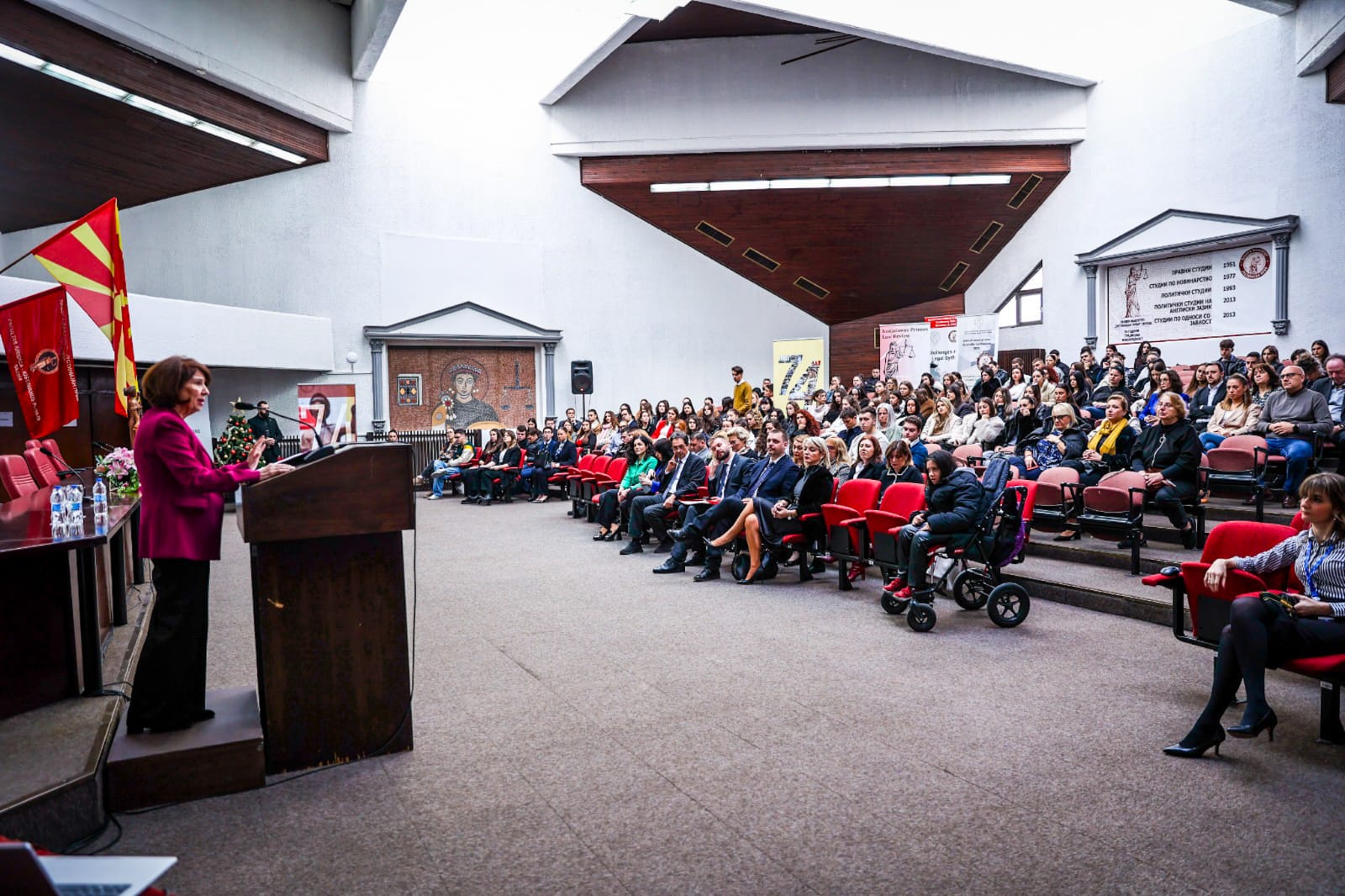
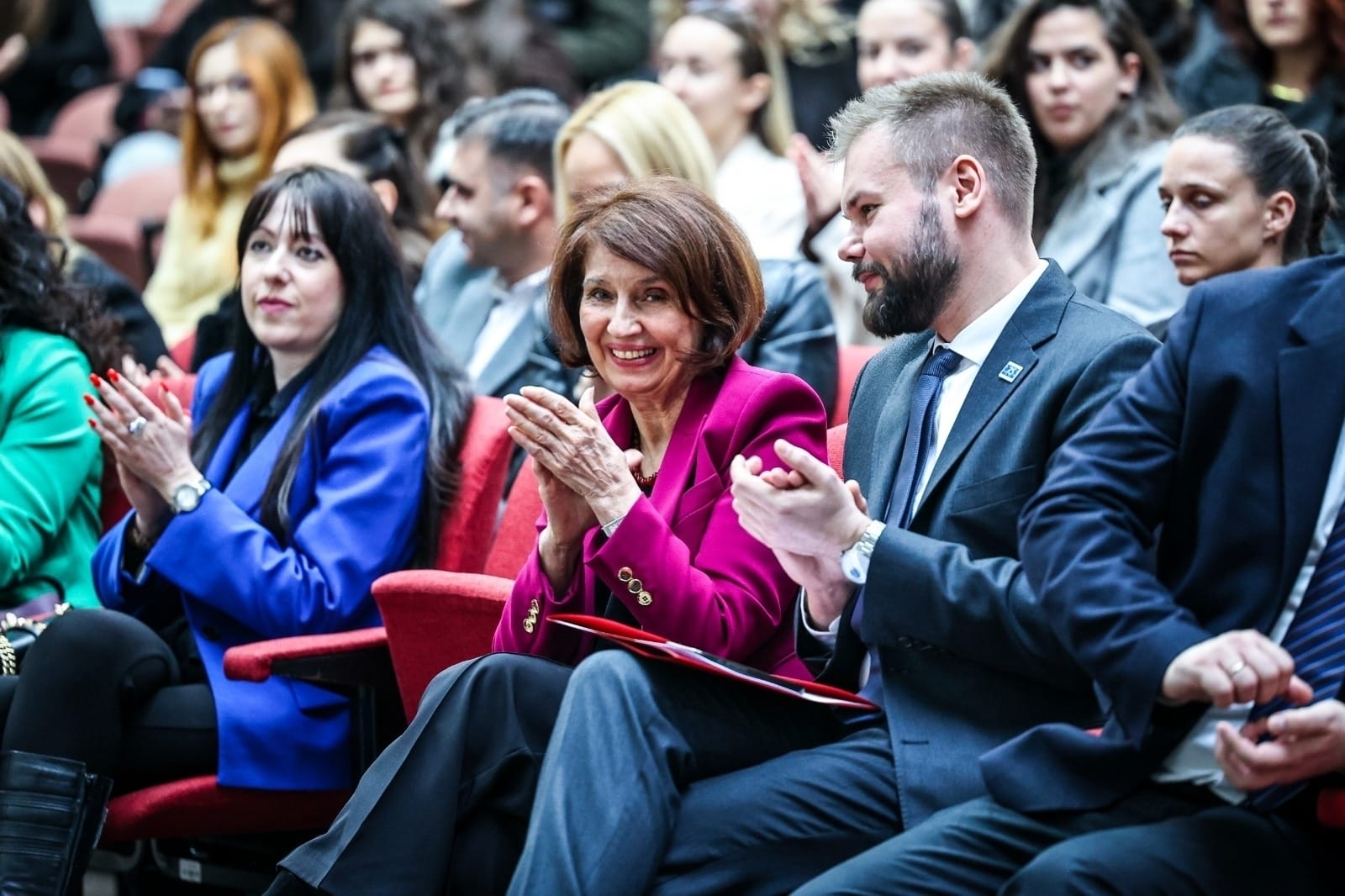
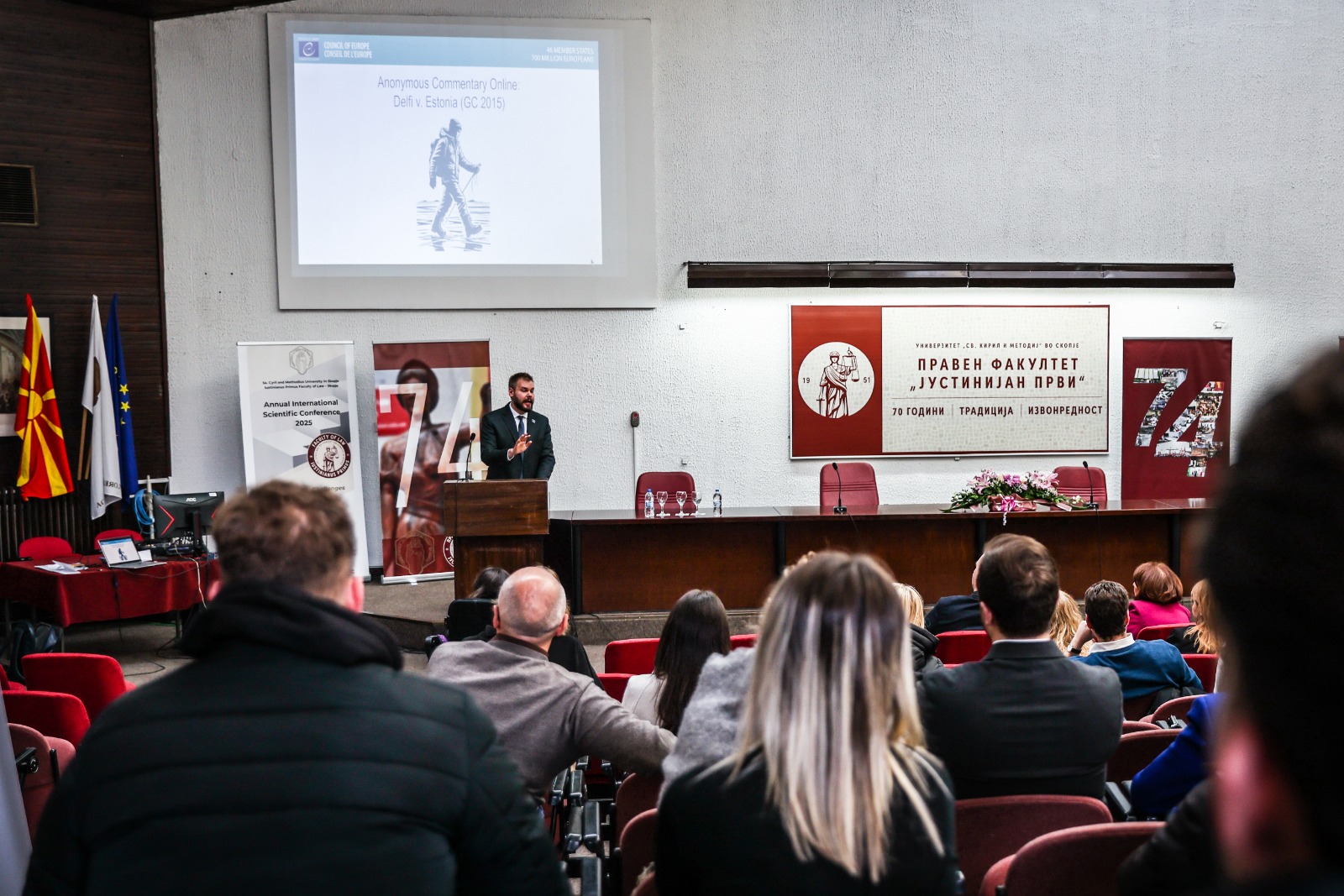
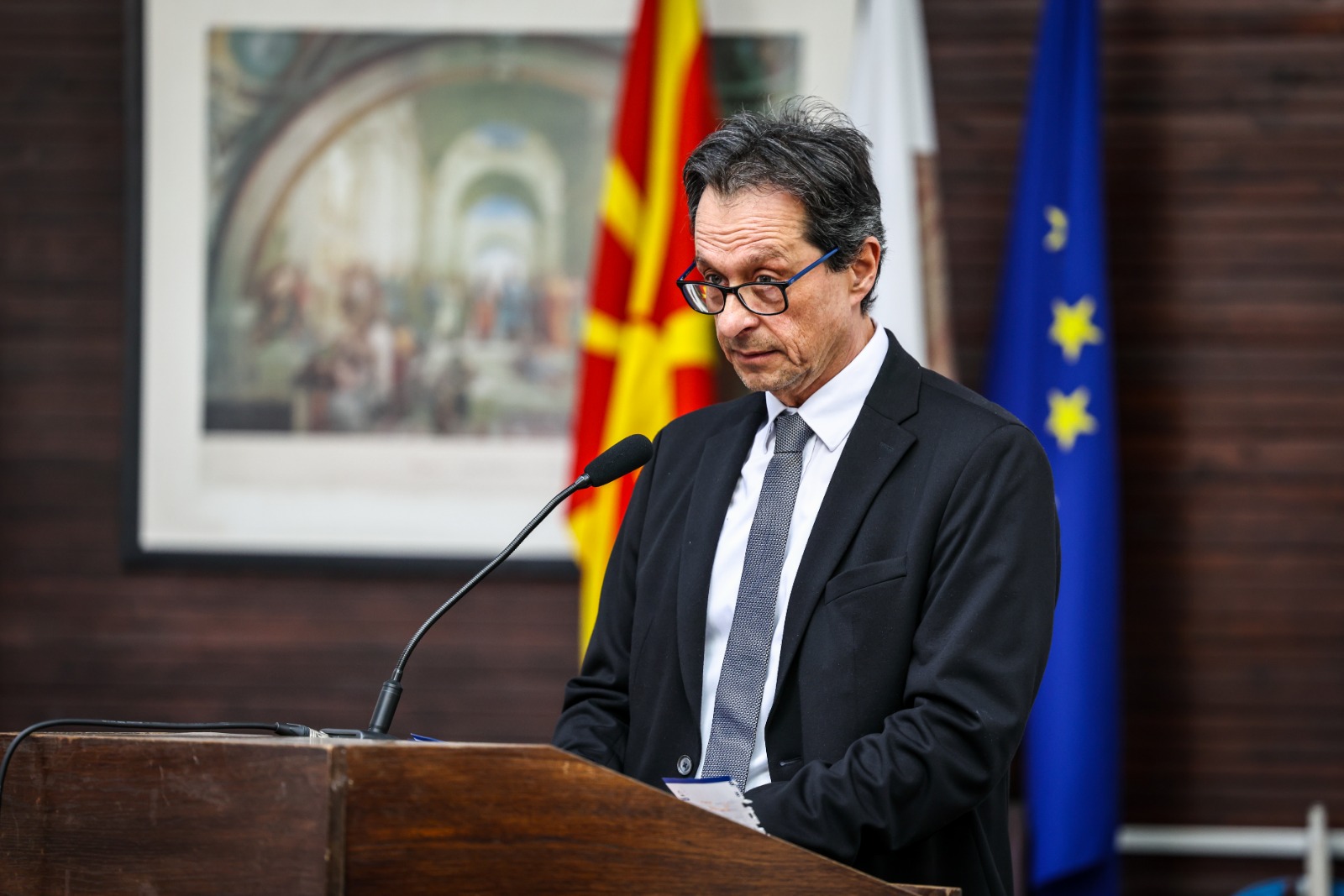
Below is the integral address of President Siljanovska-Davkova:
Distinguished Dean,
Respected Mr. Oleg Soldatov,
Respected Judge of the Constitutional Court, my colleague, Ana Pavlova Daneva,
Respected professors,
I am very happy to be with you on this important day. Let me first remind you:
December 10 is a symbolic legal and civilizational turning point, the day when, after the horrors of World War II, the states agreed that there are rights that belong to every person simply because he is a human being, not because he belongs to a particular state, nation, religion or group. The 1948 Universal Declaration of Human Rights marked the birth of the modern culture of rights and laid the foundation for what we call today a legal state and the rule of law.
Over the past seven and a half decades, a complex legal architecture has been built: the covenants on civil and political rights, on economic, social and cultural rights, the conventions on elimination of racial discrimination, on the rights of women, children, persons with disabilities; regional systems such as the European Convention on Human Rights; specialized committees, courts, high commissioners, ombudsmen. What was once a declarative hope is now a binding right, a legal guarantee and a fundamental value of modern constitutional orders.
But, at this point we face the paradox of our time.On the one hand, humanity has never had such developed legal instruments dedicated to human rights: conventions, courts, monitoring mechanisms, standards. On the other hand, the number of conflicts, refugees, displaced persons and victims of mass violations is alarmingly high. Over a hundred million people in the world live outside their homes due to persecution, wars, violence and systemic violations of rights. This is not a statistic; it is an indictment of our collective conscience.
Therefore, today, when we talk about human rights, we must not be satisfied with the formula that “since there are more mechanisms, the situation is better”. We need objective analysis, not just beautiful rhetoric.
Violations of human rights are not only a question of quantity, “more” or “less”, but they are also a question of quality. Traditional forms of repression: imprisonment of political opponents, press bans, harsh censorship… are today complemented by new, more sophisticated threats: mass digital surveillance, profiling through algorithms, hate speech and disinformation in the online space, abuse of big data, climate injustice that affects the most vulnerable communities.
At the same time, the climate crisis is not just an environmental issue; it is a question of the right to life, the right to health, the right to a home, the right to development. When entire communities become climate refugees, when farmers lose their sources of livelihood, when pollution directly shortens life expectancy, then we are talking about a violation of basic human rights, and not just an “environmental problem”.
Modern wars exacerbate this context to the point of bizarreness. The devastated Ukrainian cities, the suffering of civilians in the Middle East, the crises in Sudan, Myanmar and other hot spots clearly show how quickly human rights collapse to the point of denial when war is treated as a “new normality”, not an abnormality.
The Geneva Conventions, the principle of distinguishing between combatants and civilians, the prohibition of torture, the protection of children, are paper guarantees, torn in the ugly reality. In many modern conflicts, civilians are the first at blow and displacement is becoming a long-term reality, not a temporary state.
In the meantime, the concept of the very term “human rights” is changing. If earlier we spoke of the first generation: civil and political rights; the second: economic, social and cultural; the third generation: collective and solidarity rights: the right to peace, the right to development, the right to a healthy environment, today we are already talking about digital rights: the right to the protection of personal data, the right to transparent algorithms, protection against algorithmic discrimination, access to the Internet as a prerequisite for the exercise of a number of other rights.
This development shows that human rights are not a static list from 1948, but a dynamic, living system, which responds to the new risks and new technologies.
At the global level, the United Nations remains the central house, supported by the Human Rights Council, the High Commissioner, special rapporteurs, treaty bodies. But at the same time, the UN is beginning to resemble the League of Nations, burdened by geopolitical divisions, selective application of law and blockages in the Security Council through the use of the veto. This creates the impression of a powerless giant: an important institution, with enormous potential, but limited in its action by the most powerful and their political calculations.
In the European context, the European Court of Human Rights in Strasbourg is the European guardian of the European Convention on Human Rights and a corrector of national courts. The Strasbourg judgments are not an academic exercise, they mean changing laws on torture, freedom of expression, discrimination, electoral rights, media freedoms, the rights of LGBTI people, refugees and asylum seekers. Where national mechanisms are powerless or under pressure, Strasbourg remains the last instance for protection.
But even this system is not immune to the crisis expressed through the huge number of cases, complex procedures, delays in the execution of judgments, resistance of states when the judgment is not “politically convenient”. Therefore, today we must talk not only about the need for international bodies, but also about the real implementation of their decisions and judgments, real accountability and real political will.
Ladies and gentlemen,
For states aspiring to European Union membership, human rights are not decorative rhetoric, but an essential condition. The Copenhagen criteria clearly require: stable institutions that guarantee democracy, the rule of law, human rights and protection of minorities. This is not political “advice”, but a legal and political obligation.
For our country, this means that judicial reforms, fight against corruption, protection of media freedoms, advancement of the position of vulnerable groups and minorities are barely a condition for a European perspective and a valid European orientation.
But let me clarify:
Human rights are not a “projection” that leads us to Brussels, but a domestic documentary about a decent society. A country does not become modern because it has harmonized its laws with the EU-acquis, but because its citizens believe that justice is accessible, the judiciary is independent, the administration is professional, and discrimination is inadmissible, not on paper, but in reality.
In this context, let me point out a few key guidelines:
First, the rule of law is not expressed through the number of laws, but in their equal validity for all: for the powerful and the weak. When there is selective justice, when corruption goes unpunished, when court proceedings take too long, then human rights are declarative, decorative “paper rights.”
Second, technology and artificial intelligence are opening up new frontiers. Without clear rules for digital privacy, for limiting mass surveillance, for transparency of algorithms, we risk new forms of discrimination and control, which are no less dangerous than classic forms of repression.
Third, climate change must enter our legal thinking and reasoning as a human rights issue. The right to a healthy environment, to clean air, to water, to sustainable development, is not a luxury for wealthy societies, but a prerequisite for a dignified life for every person.
Fourth, young people. The future of human rights is not decided in conference rooms, but in the answer to the question: will young people remain passive observers or active participants: in civil society organizations, in local initiatives, in the media, in all institutions. If democracy is perceived as a “theater” by the new generations, and not as a space for real participation and decision-making, then even the most perfect legal mechanisms will remain empty.
Dear friends,
We must not succumb to the cynicism that human rights are a “tired” or even a worn-out idea. On the contrary, they are experiencing transformation: from the time when law was supposed to limit absolute power, i.e. the monarchs, to today, when law must protect individuals and citizens from the state, corporations, algorithms, and climate threats.
Therefore, on the International Human Rights Day, it is not enough to quote the Declaration. We need to ask ourselves difficult questions:
– Do our institutions really guarantee fairness, equality and dignity, or do they only formally lament with a vocabulary that contains them?
– Has our judiciary strength to say “no” when politics says “yes”?
– Is the media given space to investigate corruption without fear?
– Are vulnerable groups: the poor, people with disabilities, minorities, refugees… visible in our policies, or are they just statistics on the margins?
There is no simple answer to these questions. But there is a simple truth:
Without an independent judiciary, without transparent and accountable institutions, without an active civil society and without courageous individuals who are ready to speak out against injustice, human rights will remain love poetry, not reality.
Allow me to conclude with an observation that is both legal and profoundly human:
Human rights are the result of daily struggle, institutional courage, and civic conscience. Each generation must win them anew, defend them anew, and reinterpret them anew in light of emerging challenges.
Our duty, as jurists and as citizens, is to ensure that human rights do not become a mere “legal folklore,” but remain vibrant, effective, and accessible to every individual, especially to those who have no voice.
If we achieve this, then 10 December will not be only a commemoration, but a testament to the fact that law, conscience, and human dignity still advance hand in hand.
Thank you.