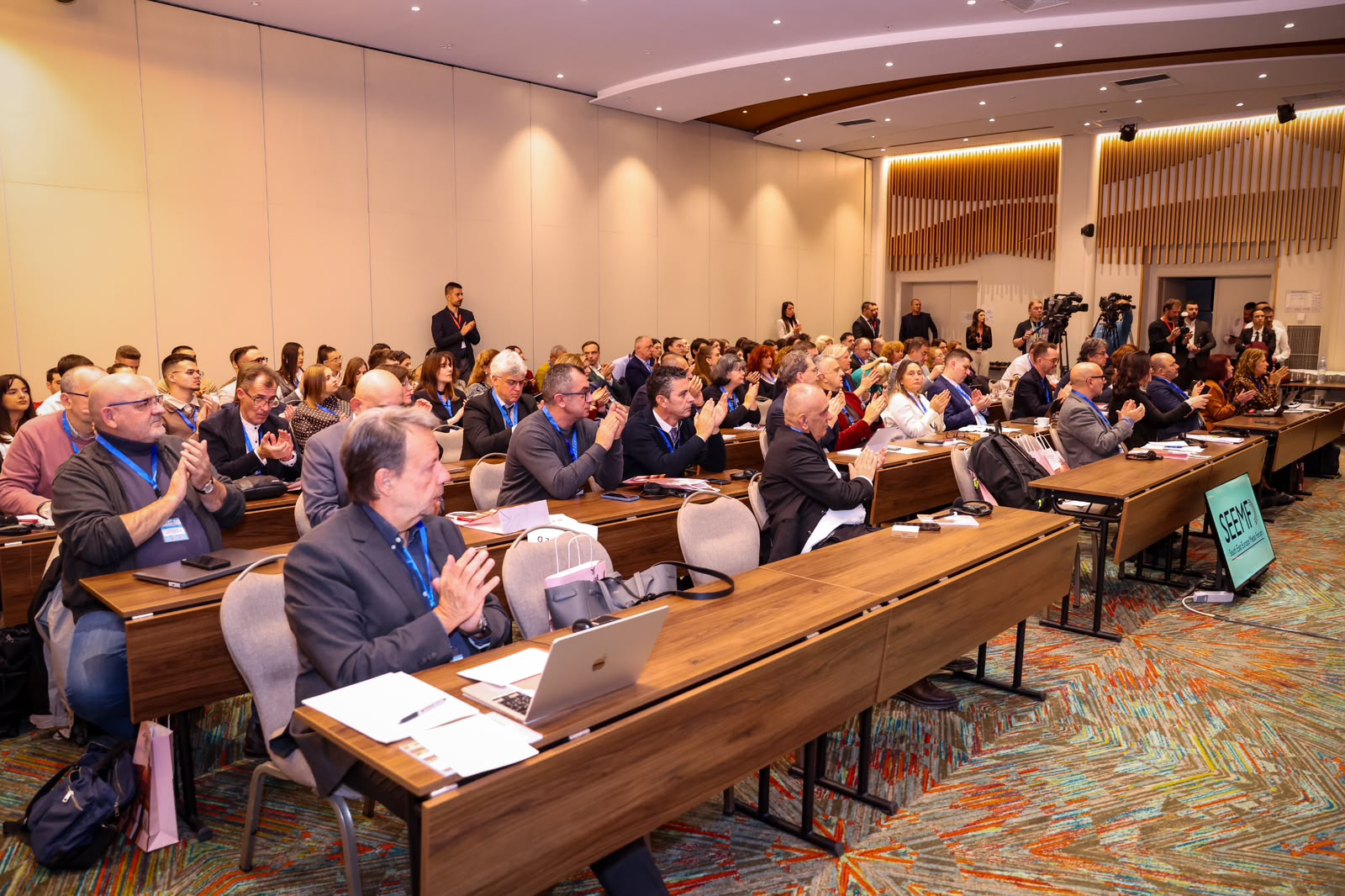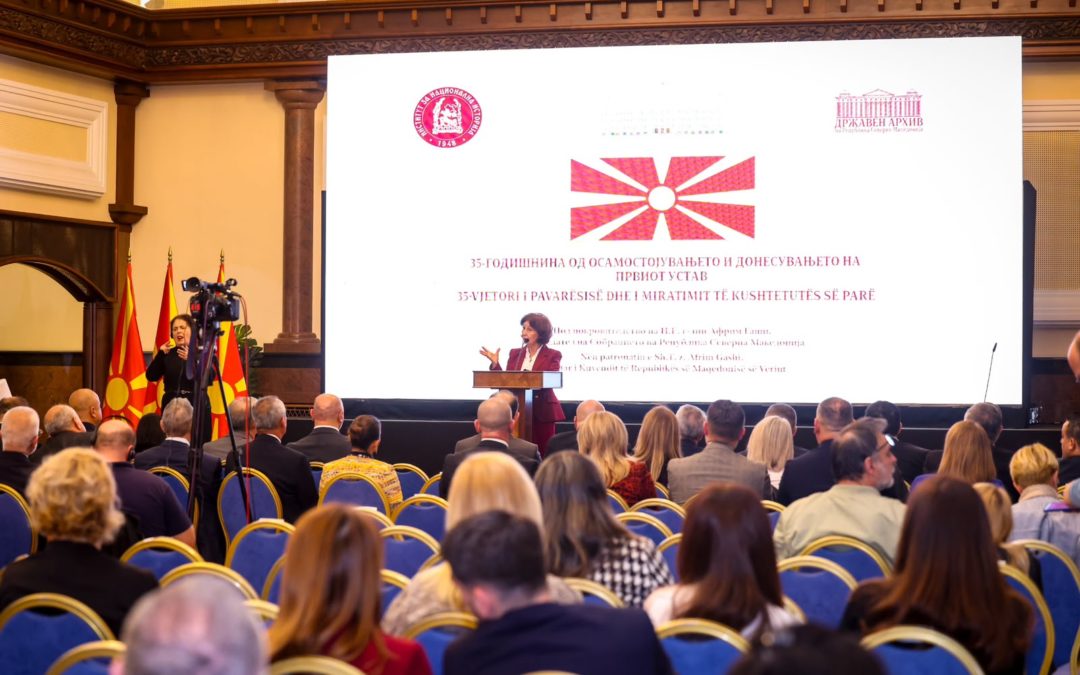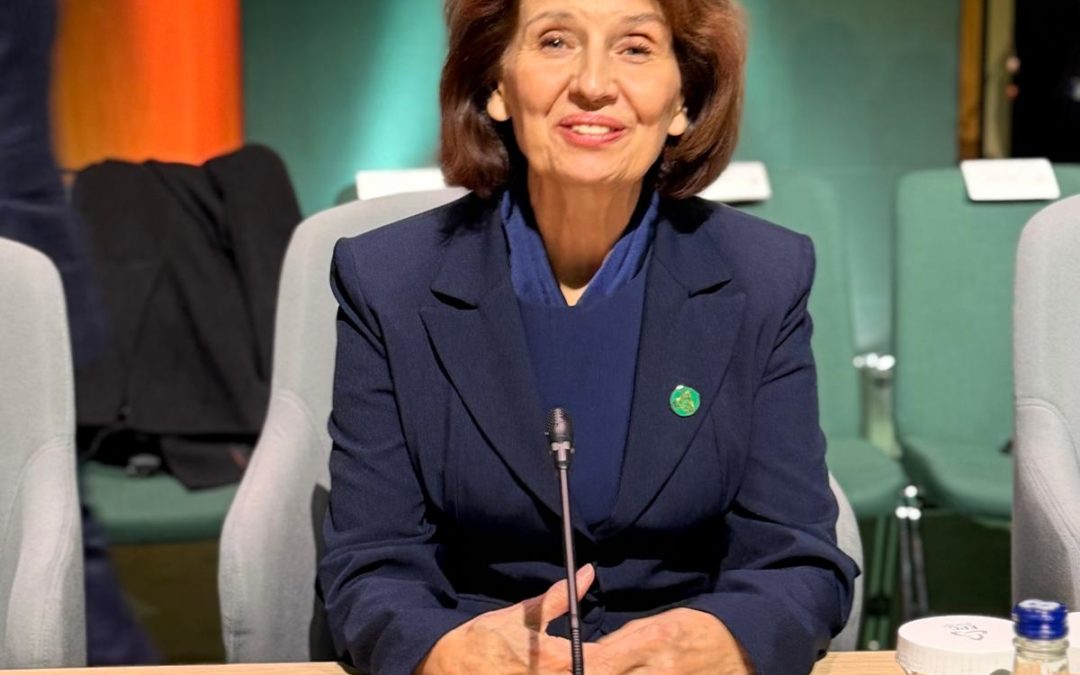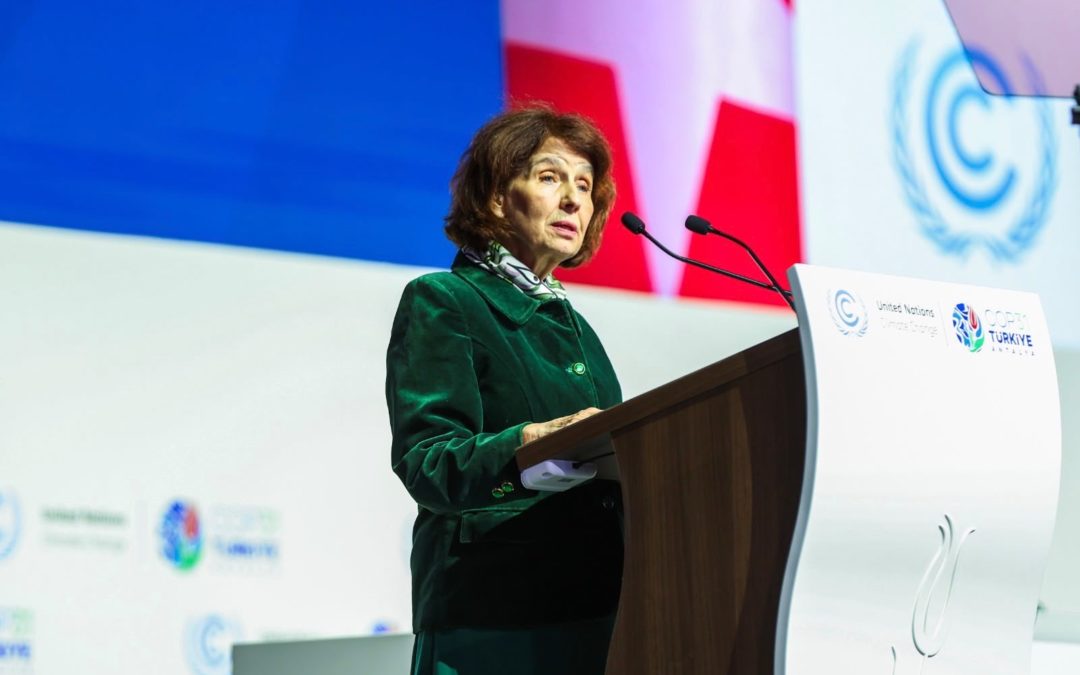
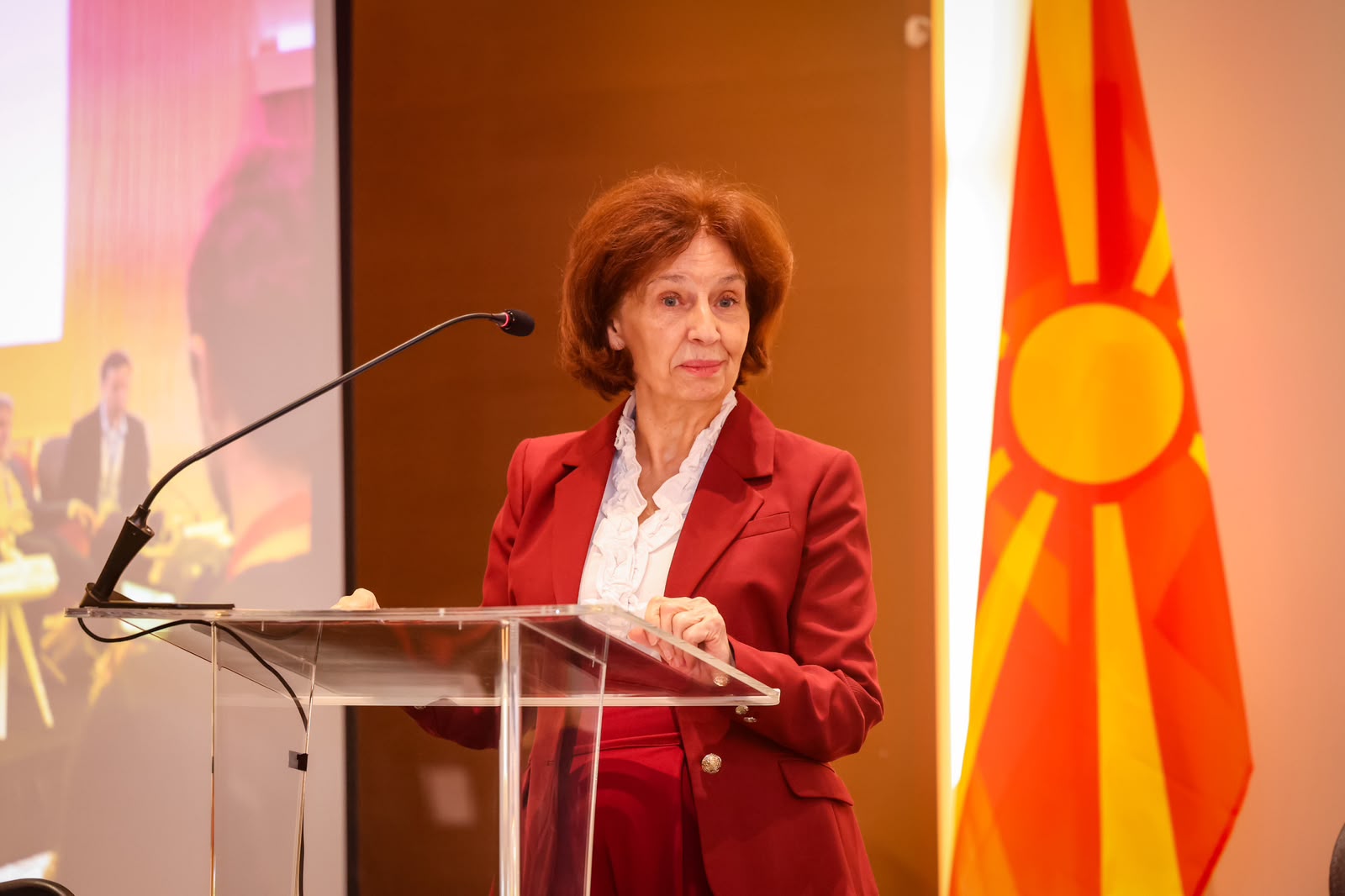
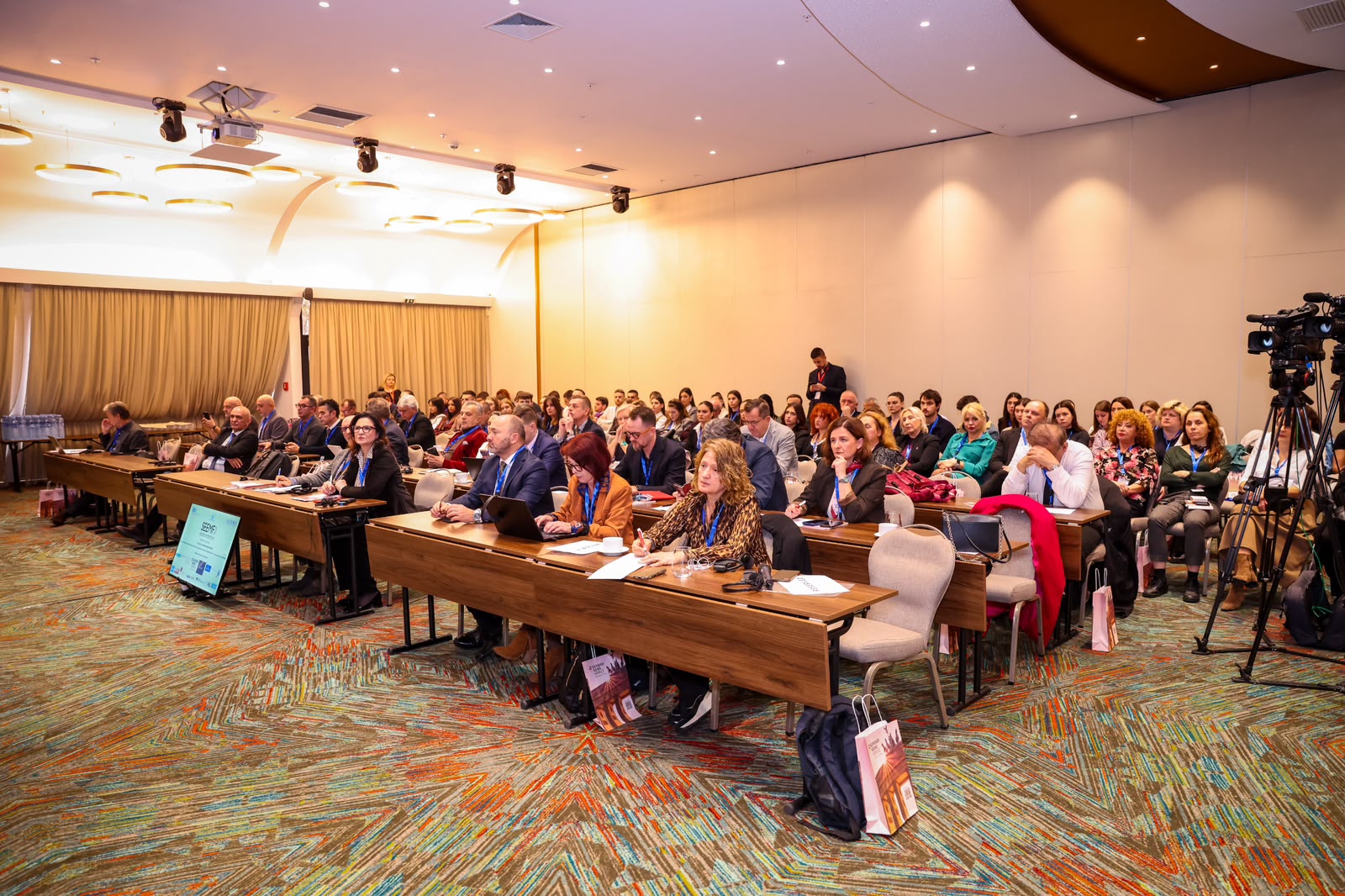
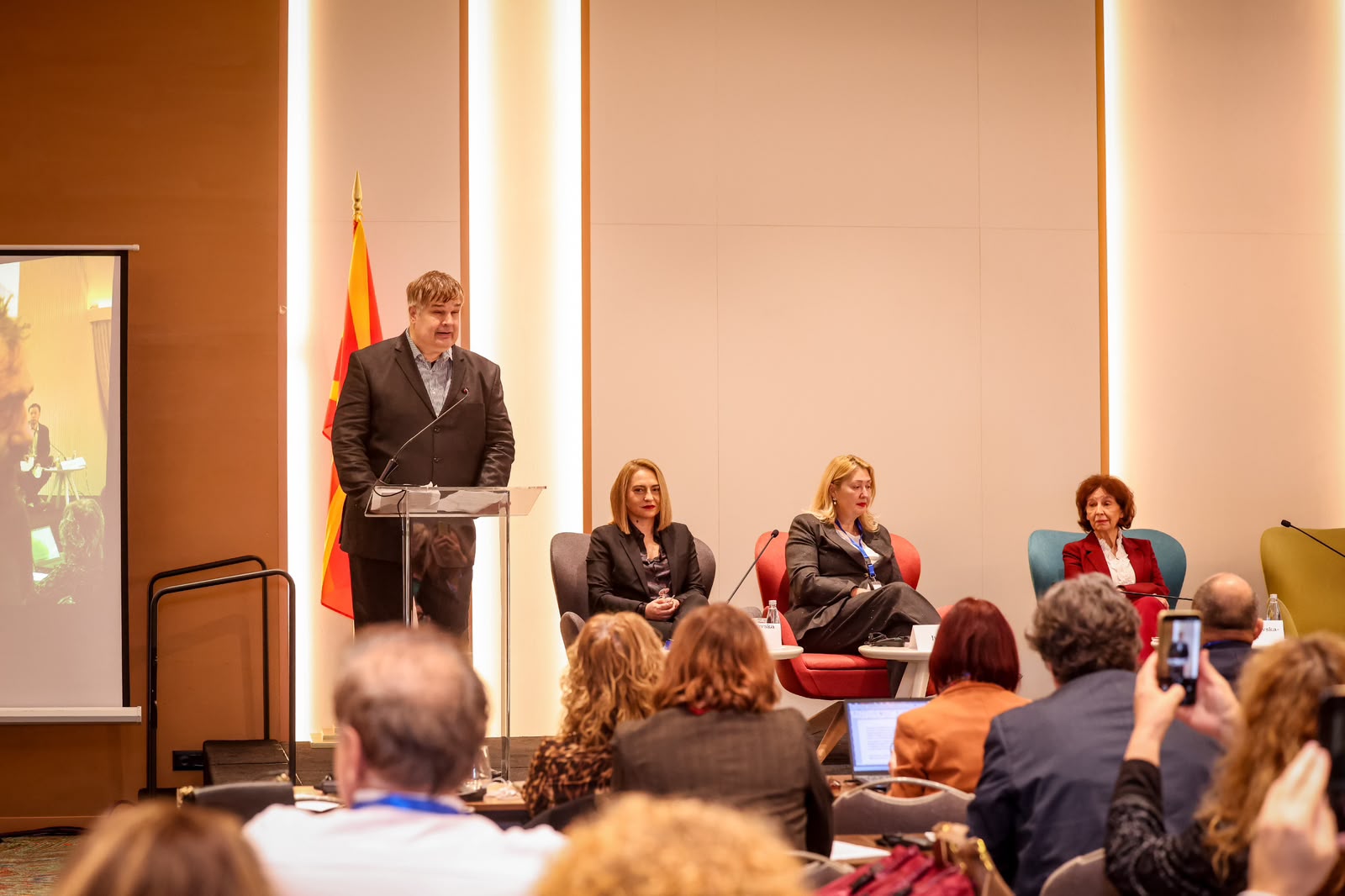
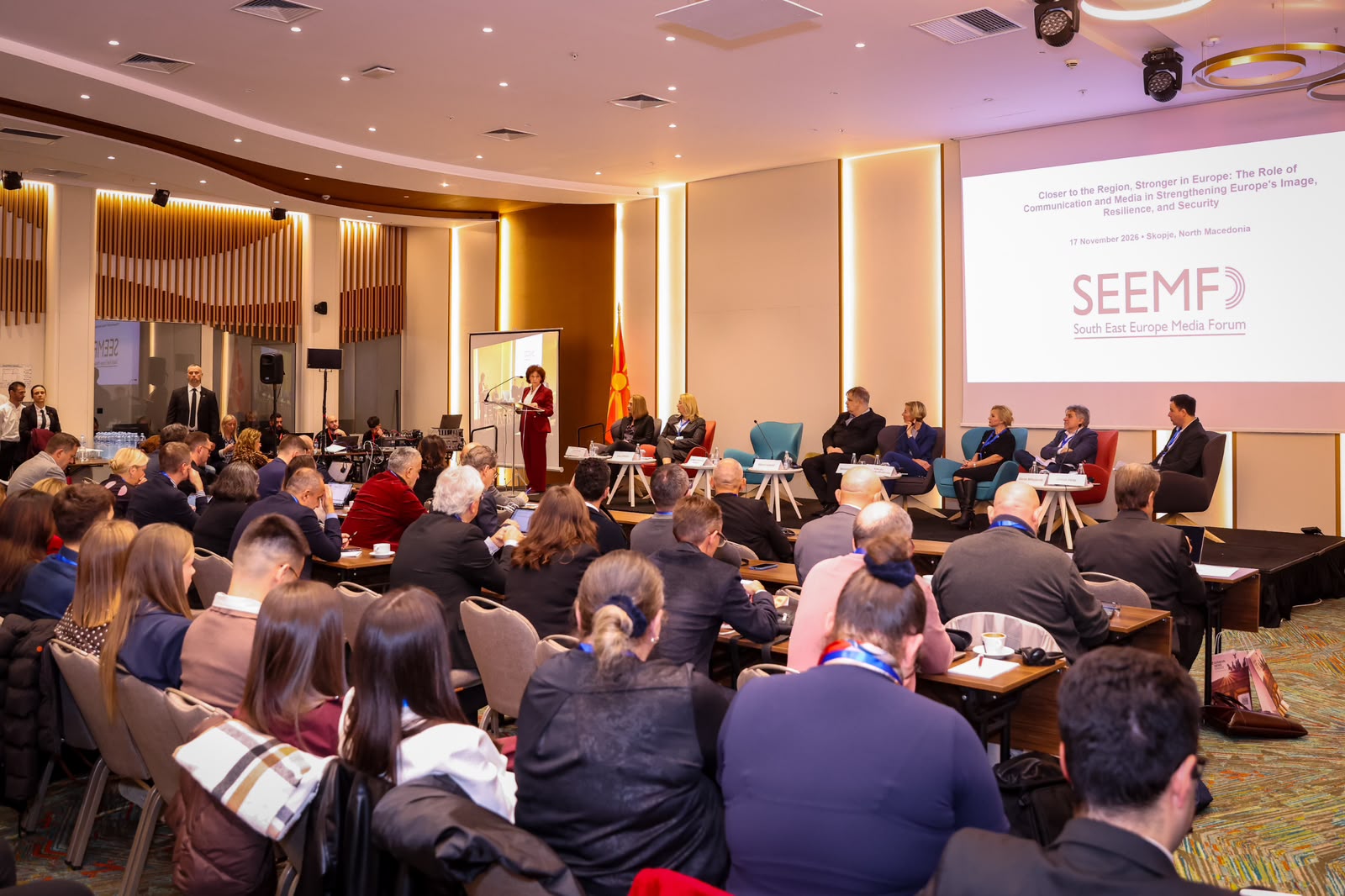
President Gordana Siljanovska-Davkova delivered the opening address at the 20th South East Europe Media Forum (SEEMF), held yesterday in Skopje, under the theme: “Closer in the Region, Stronger in Europe: The Role of Communications and Media in Strengthening Europe’s Image, Resilience and Security”.
She began her speech by paying tribute to the journalistic profession, describing it as a respected and courageous profession – one prepared to defend ethical principles and values, even at the cost of freedom or life itself.
In her view, journalists are not merely chroniclers of the times; rather, they form a steadfast human pillar of the democratic order and serve as indispensable architects of the “res publica”.
Noting that politics is, by nature, a dialogue rather than a monologue, she emphasized that the media are not just intermediaries between the government and the citizens, but active participants in shaping public consciousness, constructing political perceptions and facilitating the dispersion of societal power.
According to her, a free press is a vital democratic factor – a litmus test that fosters an informed citizenry, a critical public and continuous oversight of those in power. She said that journalism must be neither an extension of the government nor its predetermined adversary, but rather an independent guardian of the public interest.
Addressing the topics of digital transformation, videocracy and artificial intelligence, Siljanovska-Davkova warned that greater access to information does not equate to greater trust in it.
Citing research from the Reuters Institute which indicates that trust in news stands at 37%, she highlighted a paradox of modern society: there has never been more information available, yet trust in it has never been lower.
She underscored the importance of the human element and dimension within the journalistic profession, noting that media freedom entails not only freedom of expression but also safety, dignity, professional autonomy and economic independence of journalists.
The President reminded the audience that while speed is a technological advantage, accuracy remains a professional obligation for journalists; they serve as witnesses, interpreters and custodians of public memory. A society that fails to preserve the truth about its own era risks losing the capacity to shape its future.
The full text of the President’s address is below:
Distinguished journalists,
Distinguished members of SEEMO,
Ladies and gentlemen,
Dear friends of the free word,
Why I am here? For generations, journalism has been practiced by honorable people who have lost jobs, gone to jail and suffered numerous other hardships in defense of their principles.
Journalist’s commitment to ethical principles is neither dead, nor a new one.
Journalism requires a commitment to truth and a sympathy for res publica.
Politics is always a dialogue, never a monologue, with disagreement and communication at its heart. Democracy is a form of political communication between government and demos. Even authoritarian leaders pretend that they communicate with their people. In democratic states, politics is not possible without complex processes of communication. We all know that it is mostly indirect and mediated, because our understanding of politics rarely comes directly from politicians, but from television, newspapers, radio and, most of all, from internet and social networks.
Mass media constitute much more than a channel of communication. As an important part of political process, they are affecting and not merely reflecting the distribution of power in society.
Thus, you are rather part of the news than just reporters. Most of you elect to act rather than watch. So, whenever we speak about journalism, we are, in fact, speaking about the way through which human beings attempt to create the Good Society.
The media have accumulated so much economic and market power so that no government can ignore them.
Indeed, rival theories/concepts offer different views of the media’s political impact: pluralist model that portrays the media as formally independent from government in insuring an ‘informed citizenry; dominant – ideology model, which portrays the mass media aligned to the interests of social and economic elites; the elite values model that shifts attention from ownership to mechanism through which media output is controlled; the market model, by which private media are foremost profit oriented and concerned.
For me, free press has been one of the key features of democracy: by fostering public debate and political engagement; by acting as a ‘public watch dog’; by redistributing power; as a mechanism through which democracy can operate.
You are agents of political education, enabling political debate and providing civic forum among academics, business leaders, trade unions, representatives of interest groups, lobbyists or the public itself, which can express opinions through phone – in programmes, ‘chat rooms’, internet blogs and so on.
The ‘watch dog’ role can be performed effectively if the journalists are properly independent and not dominated by the government. Then, you can scrutinize its activities and expose abuses of power.
The media and YOU- the journalists promote democracy by widening the distribution of power and political influence in society. How? Through ‘new’ media capacity to enlarge access to information and information exchange. Easier access to information empowered nonstate actors, nongovernmental organizations and think-thanks, thus challenging government actions.
The new technology offers expanding citizen participation through ‘e -democracy’, cyber democracy, electronic democracy.
But we must not forget or neglect some reservations about the capacity of the mass media to deliver effective democracy. Far from providing citizens with wide and balanced range of political views, the content of the mass media is tainted by political biases. Moreover, the mass media is not subject to public accountability. They are classic example of ‘power without responsibility’. Well informed, knowledgeable the views of journalists may be, even as the ‘voice of the people’, media professionals represent only themselves.
And, there are reasons to doubt the independence of the media from government. There is often a symbiotic relationship between media professionals and political elite.
We have to remind that the government and the mass media are not always opposing forces. The second have often been controlled, directly or indirectly and used as a form of propaganda machine.
The favorable presentation of information and policies, or what has come to be called ‘spin’ has become a major preoccupation of modern governments.
The art of spin, practiced by spin doctors, has many facets: careful vetting of information, control of sources of information, the use of leaks….
Media have not been reluctant or passive players in the development of news management.
The mass media need government as much as government needs mass media. Government has always been an important source of news and information. Its role became more vital.
In some cases, publishers, editors and journalists conspire with spin doctors to manage the news for mutual benefit.
But can there be a genuine public life without an informed citizen? Can democracy be more than a formal procedure if citizens do not have access to verified information, if they cannot distinguish fact from construction, argument from propaganda, truth from appearance? This, to my mind, is where the very essence of journalism lies, in its indispensable role in making the public space accessible to knowledge, criticism and free judgement.
Digital technologies transformed the very way in which we perceive the world. The means have changed, but the democratic need has remained the same: for human beings to know, to understand and to form their own judgement. Journalism, therefore, is not merely a chronicle of events, but also a testimony to the civilizational development of the public’s right to be informed.
Yet information has never been merely a matter of transmission. It also entails choice: what will be considered important, who will be given the opportunity to speak, which event will be placed in the foreground and which will remain at the margins. Media do not create reality, but participate in shaping its public image. They influence the issues we think about, the importance we attach to them and the way in which we interpret social processes. It is no coincidence that political power has always sought to influence the media sphere at times through control, at times through pressure, and today, increasingly, by bypassing traditional journalism and addressing the public directly. But journalism must be neither an extension of government nor its predetermined adversary. Its duty is to scrutinize every form of power, including its own influence.
In the age of videocracy, spectacle democracy, this responsibility acquires an even deeper dimension. Images increasingly replace explanation; fleeting impressions displace broader context and algorithms become intermediaries between events and citizens. Artificial intelligence opens extraordinary possibilities, but also raises new questions about authenticity, authorship and the credibility of information. According to the Reuters Institute’s 2026 research, social media and video platforms have, for the first time, become the most widely used global source of news, while trust in news stands at 37 per cent. Is this not one of the great paradoxes of our time that information has never been more accessible, while trust in it has perhaps never been more fragile?
But behind every piece of information there is also a human being who creates it. Journalists report from scenes of accidents, fires, armed conflicts and human tragedies, often exposed to risks that cannot be predicted or controlled. According to the International Federation of Journalists, 128 journalists and media workers were killed in 2025, including 9 deaths classified as accidental. However, statistics cannot fully capture the invisible consequences of the profession: the psychological burden of constant exposure to traumatic events, threats, exhaustion, precarious employment and relentless deadlines. We must not romanticize the journalistic calling to such an extent that we overlook the conditions in which it is carried out. Media freedom also means safety, dignity, professional autonomy and economic independence for journalists.
That is why I would emphasize that responsible journalism is not recognized merely by its ability to expose the mistakes of others, but also by its willingness to question itself. Speed may be a technological advantage, but accuracy remains a professional obligation. Critical journalism is not synonymous with bias, just as freedom of expression does not abolish responsibility for what is spoken or published.
Today, when the public sphere is exposed to political, economic and technological pressures, journalism needs courage, but also knowledge; independence, but also self-criticism; freedom, but also professional standards. For without free and responsible media, there can be no informed demos; and without informed demos, democracy risks becoming an empty form, deprived of its very substance.
In the end, perhaps the most important question is not merely what kind of media we want, but what kind of society we wish to be. A society in which information is an instrument of manipulation, or one in which it is a prerequisite for free judgement? A society in which volume replaces argument, or one in which truth takes precedence over sensation?
I believe that the answers to these questions will also determine the future of journalism. For journalists are observers of the time in which we live. They are its witnesses, interpreters and, to a great extent, custodians of public memory. And a society that fails to preserve the truth about its own time, risks losing its ability to shape its future.
Thank you.