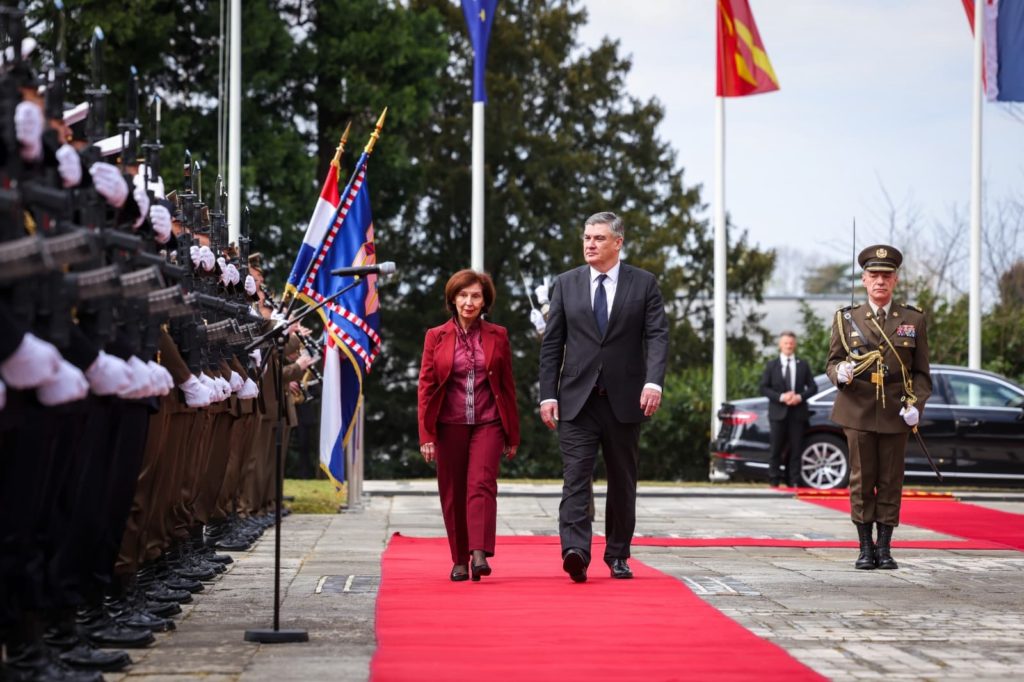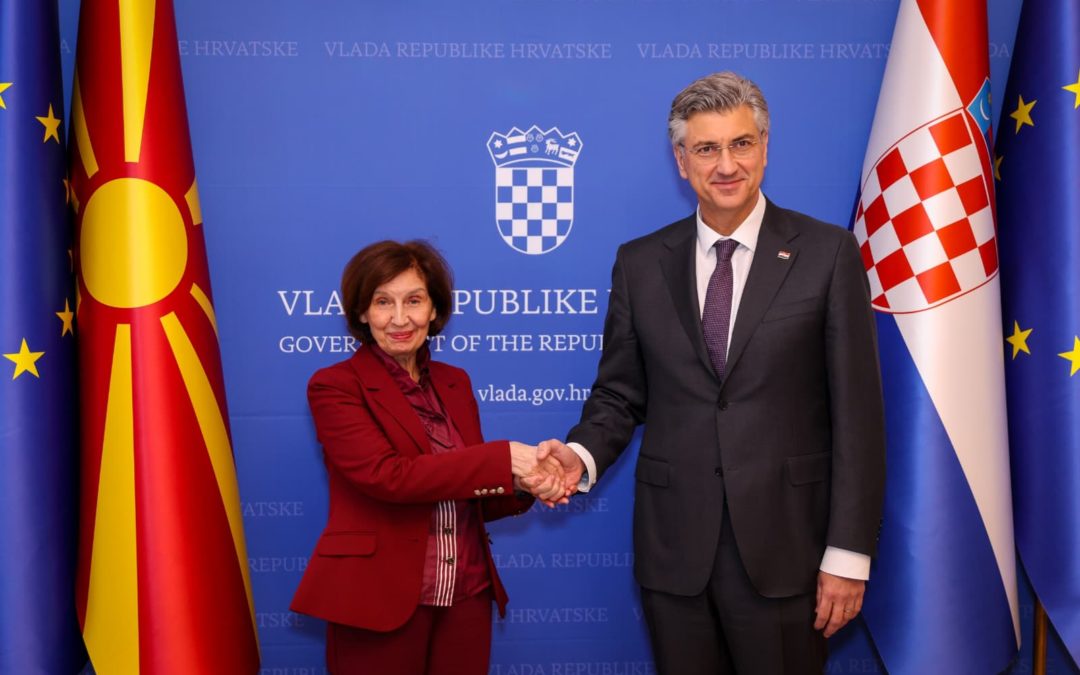
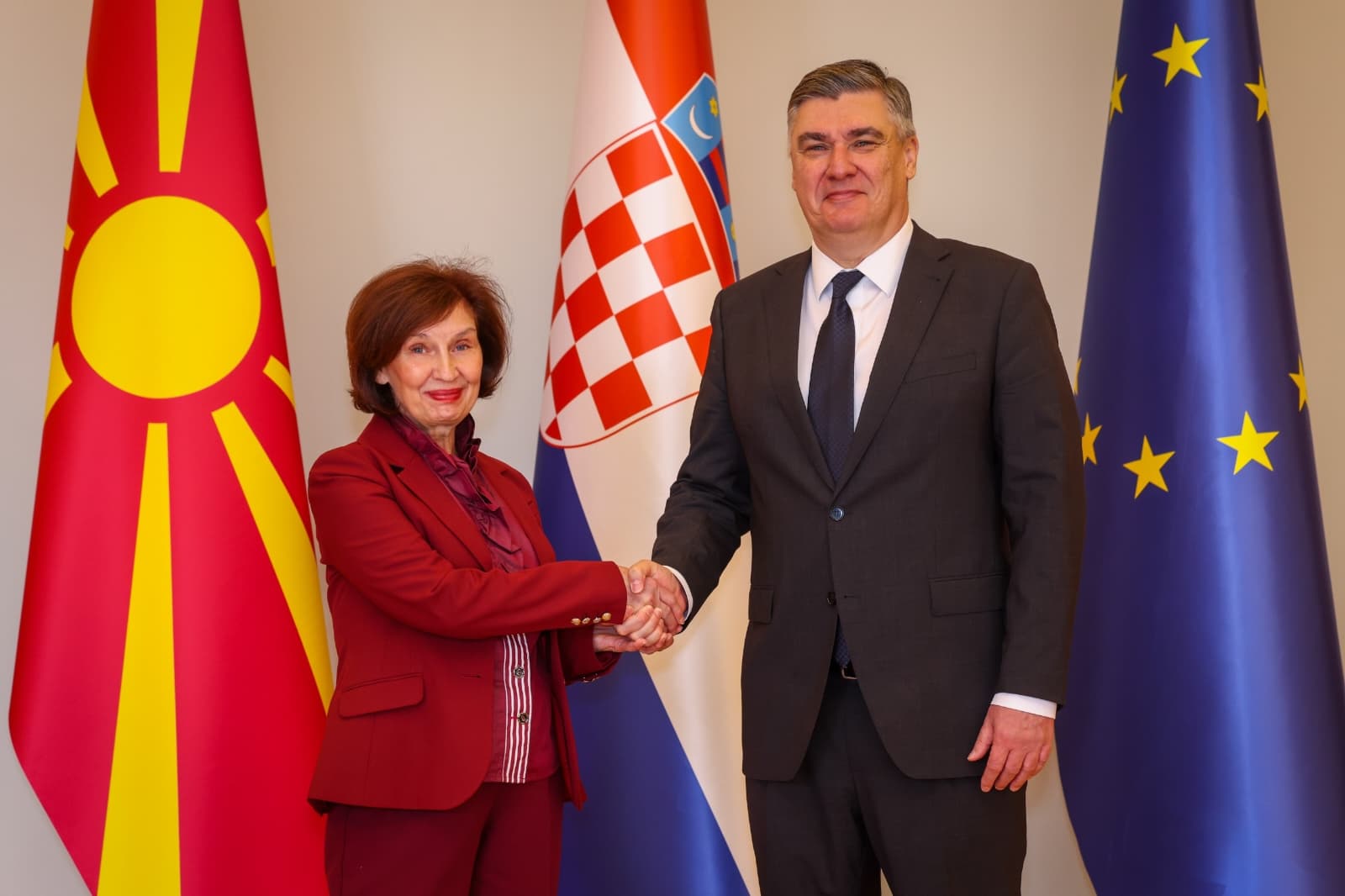
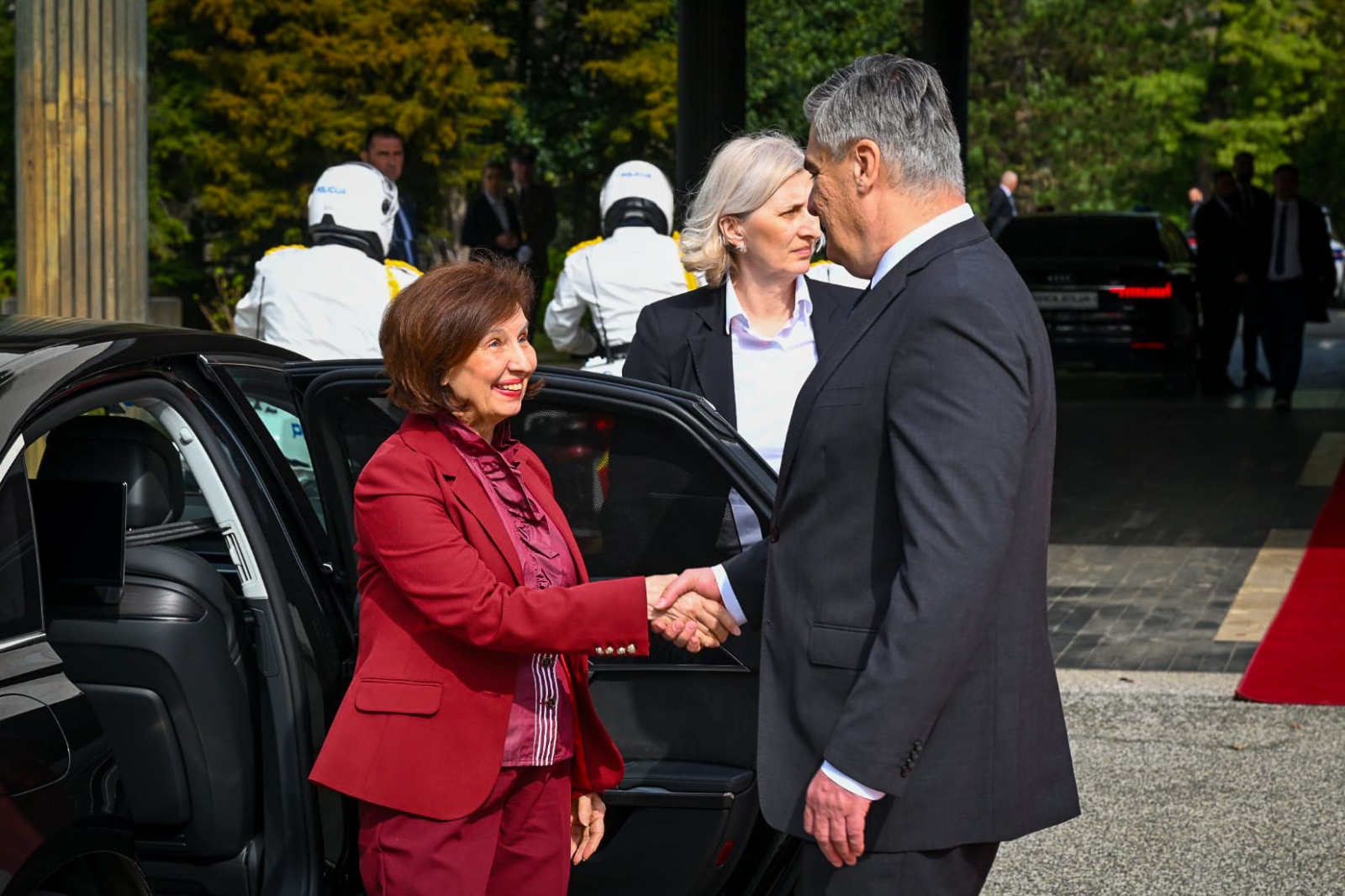
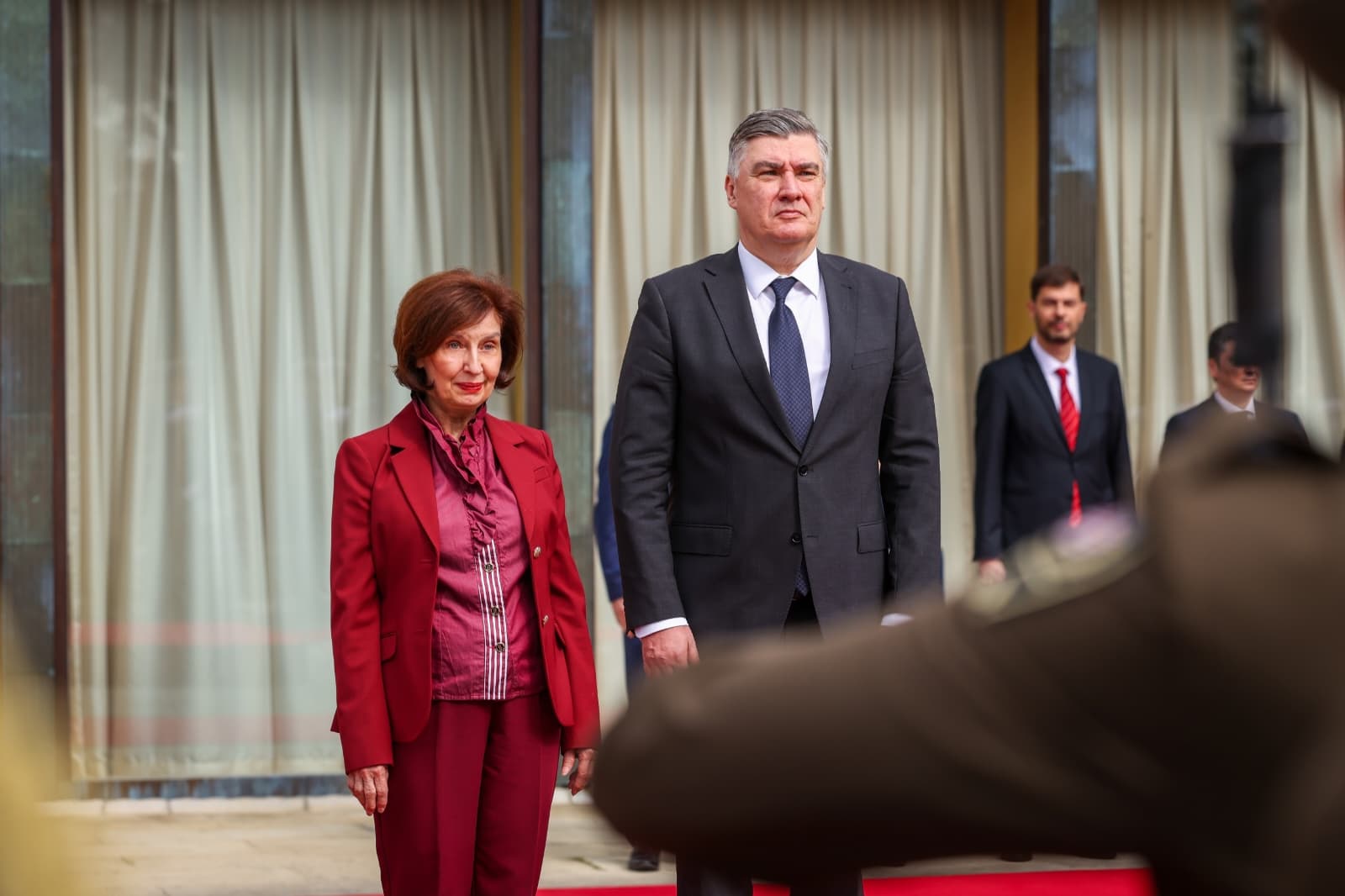
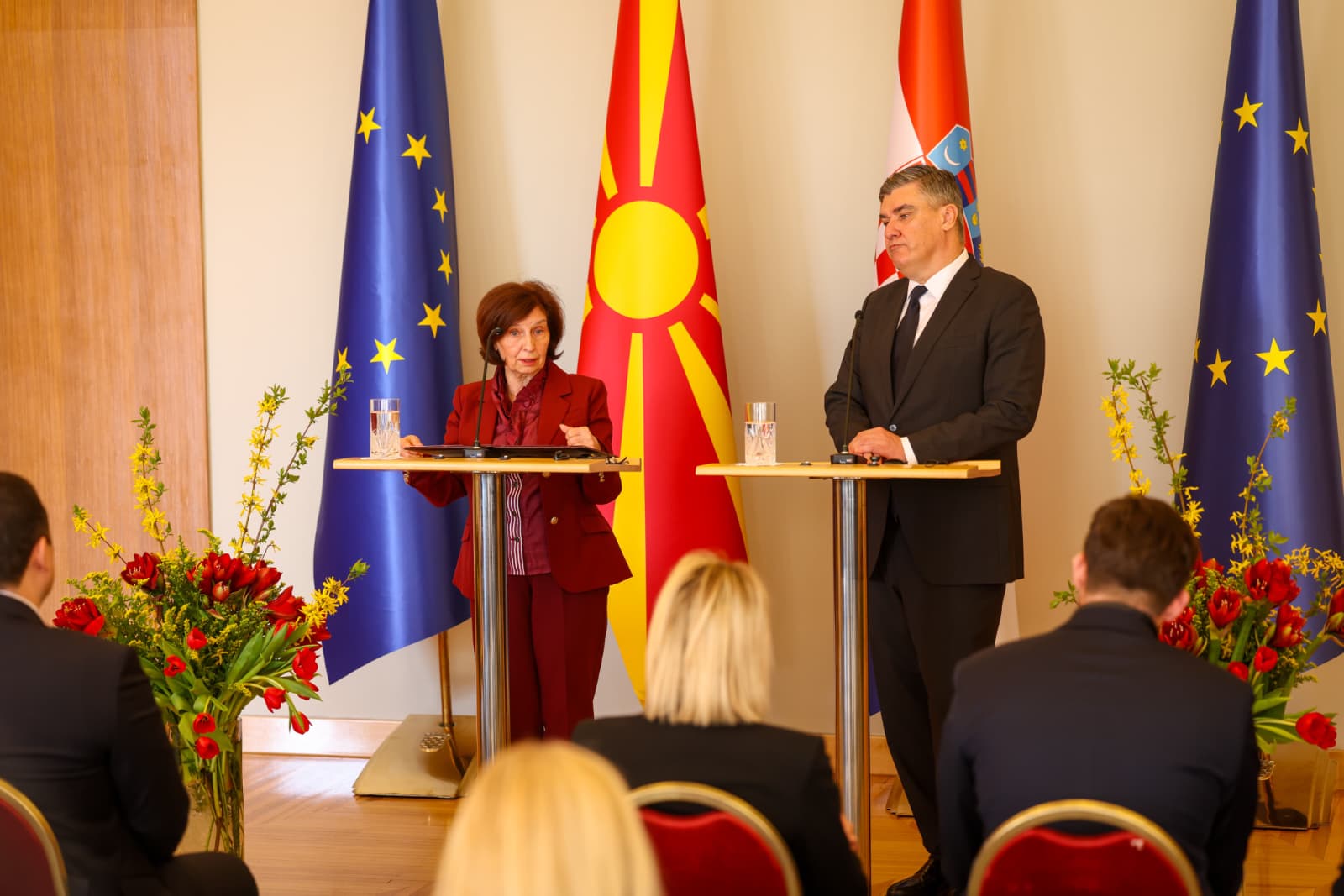
At an official ceremony with the highest state and military honors, President Gordana Siljanovska-Davkova was welcomed today in Zagreb by the President of the Republic of Croatia, Zoran Milanovic, thus marking the beginning of her two-day official visit to the country.
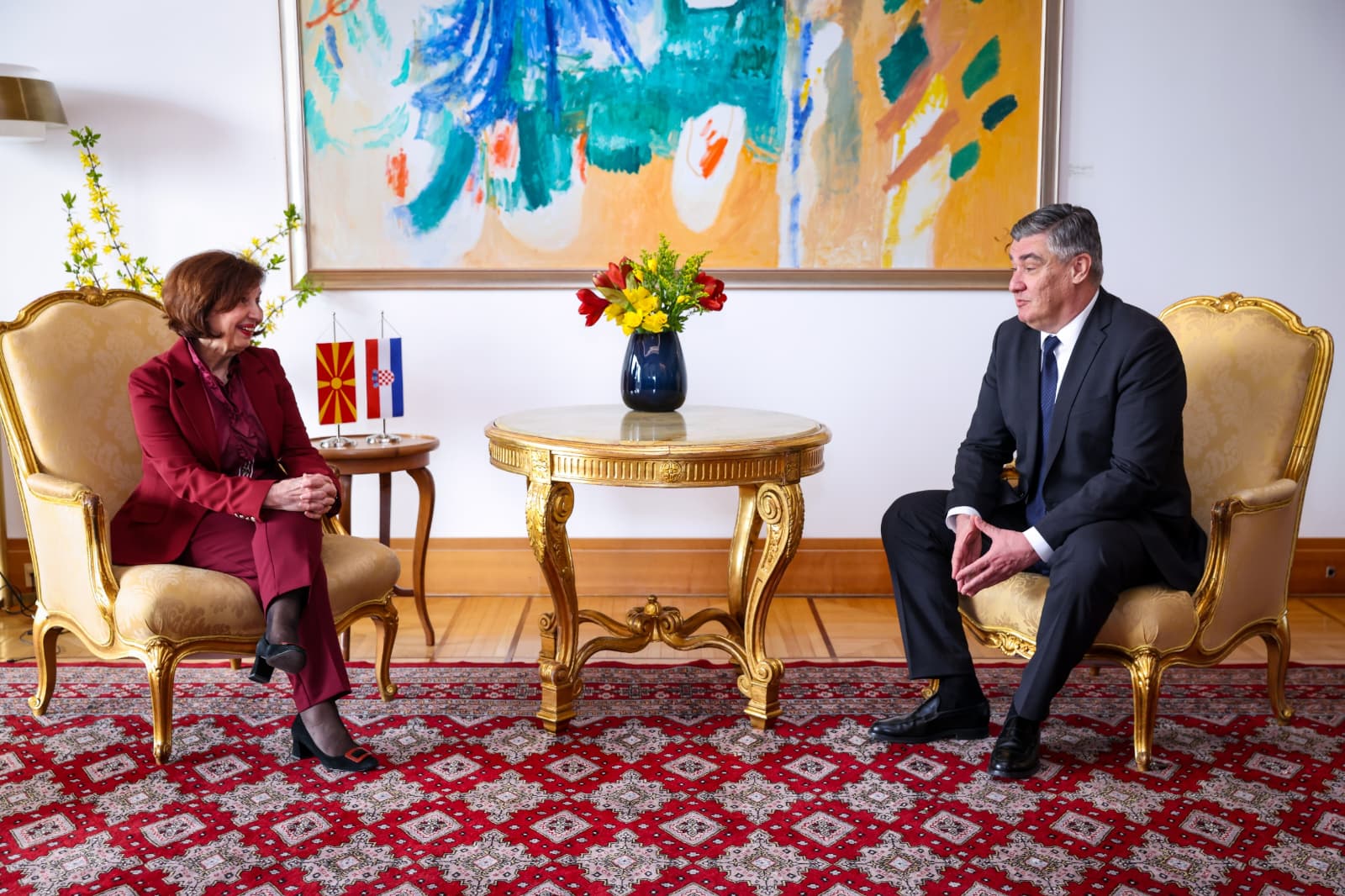
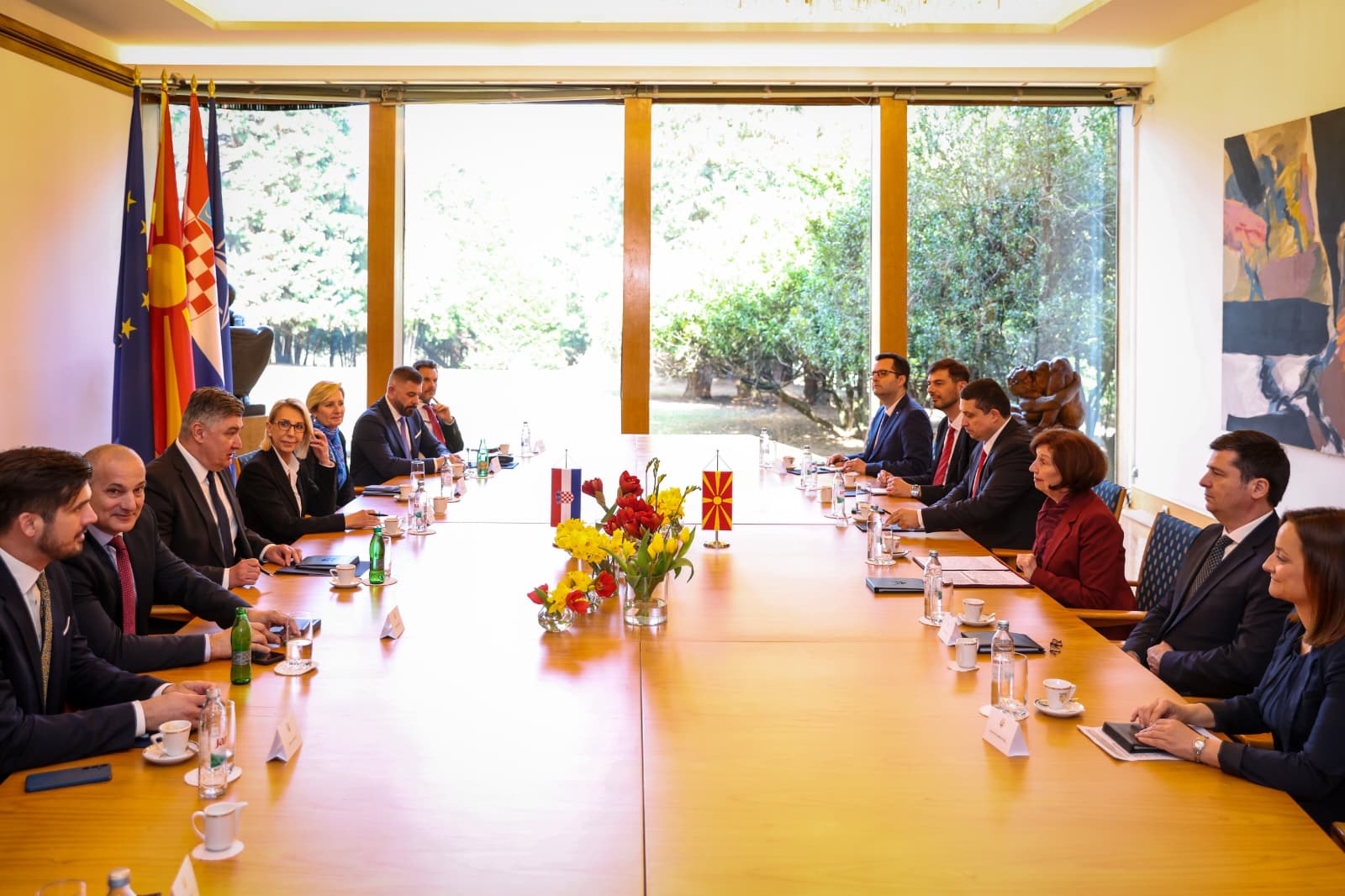
Both presidents held a tete-a-tete meeting, followed by a plenary meeting of the Macedonian and Croatian delegations, which focused on the traditionally friendly bilateral relations.
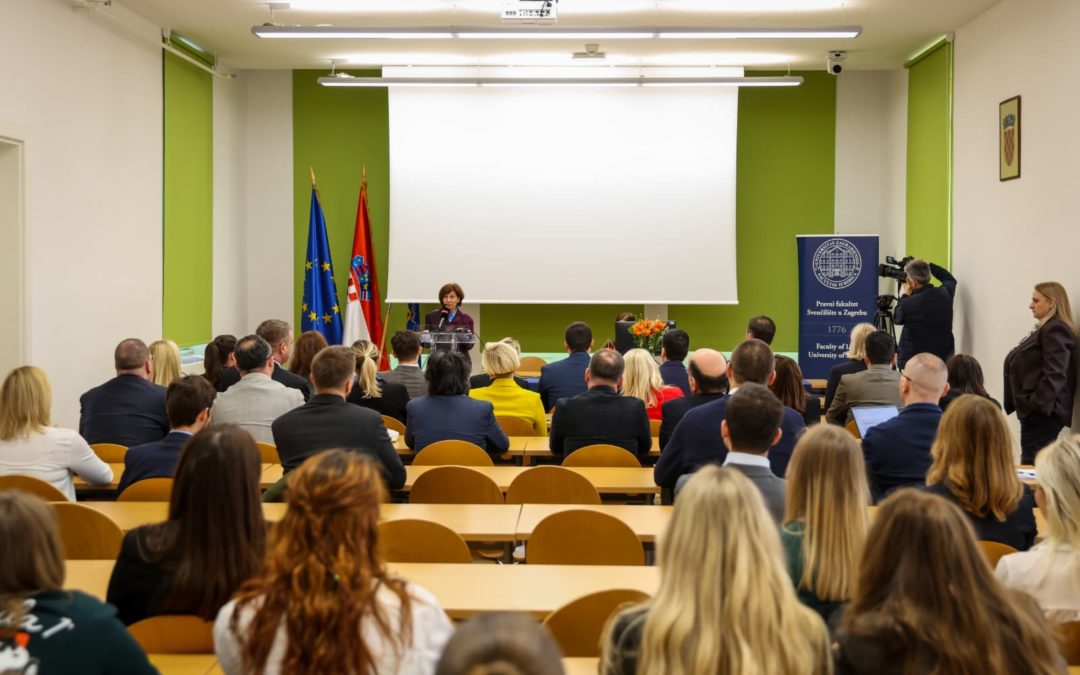
At the joint press conference, Siljanovska-Davkova emphasized that membership in the European Union remains one of the country’s strategic commitments and thanked Croatia for the friendly relations, support and understanding, as well as for its assistance in opening new perspectives and possible solutions in the European integration process.
The President stressed that the country consistently follows the Copenhagen Criteria, in order to build a functional and democratic system, compatible with the European standards.
According to her, the European integration process must remain based on merit, reforms and fulfillment of European criteria, and not be burdened with bilateral historical, cultural, linguistic and identity issues.
She said that we expect equal treatment and application of the same standards as for the other candidate countries, with the assurance that in the European institutions there is still a sense for the arguments, for the right and for the dignified place of every European nation in the Union.
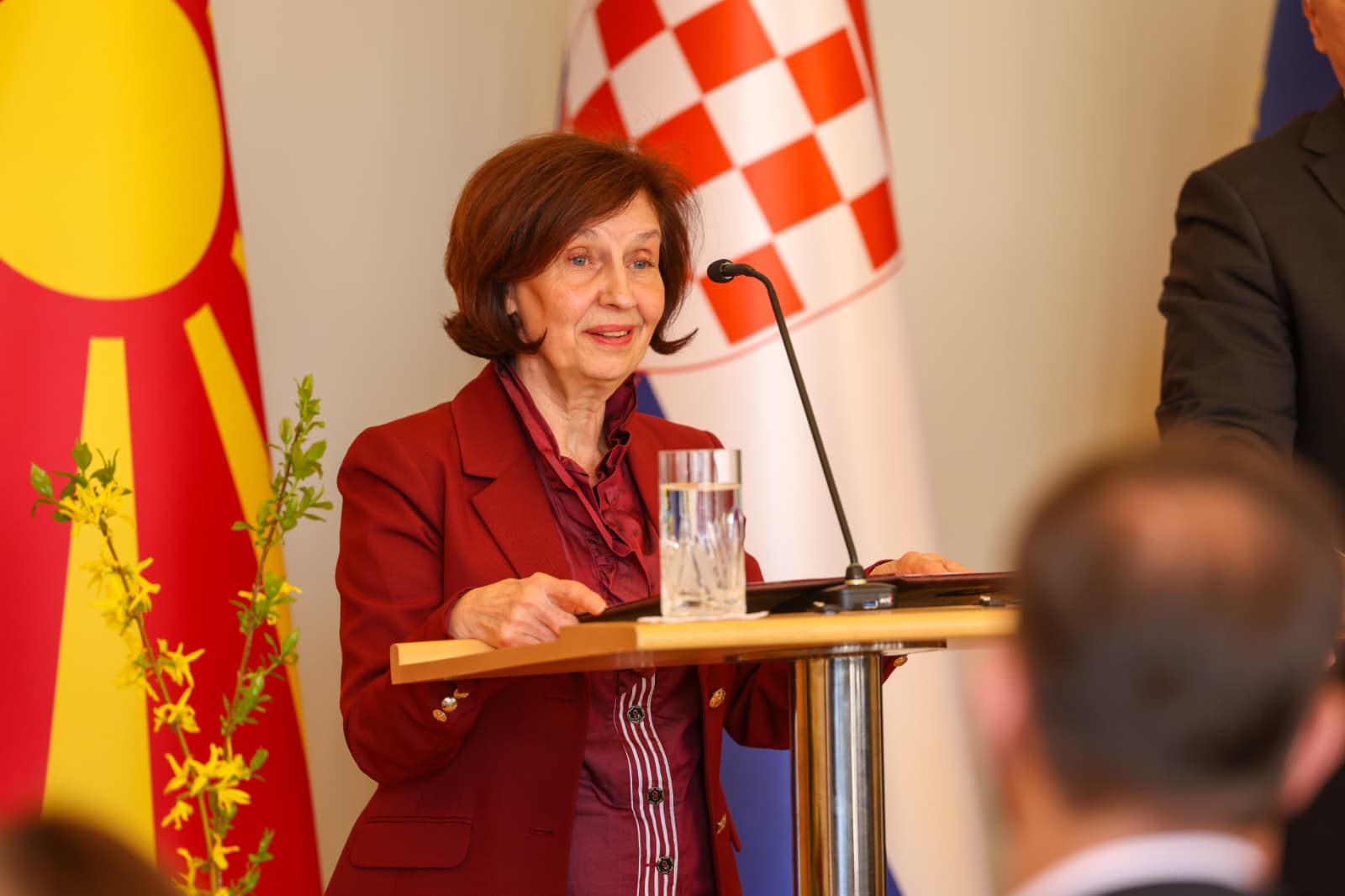
Below is the integral statement of President Siljanovska-Davkova:
First of all, sincere gratitude to the President not only for the warm welcome, but for the open, constructive, lucid and, above all, friendly debate. You mentioned important issues when we, as in one of the strategic challenges, determined EU membership. We were guided by a notorious fact that we have always been part of Europe geographically, historically and culturally and that it is quite logical to crown this unity with another, namely with a political one.
Of course, politics is far from the art of the possible today, but rather what the government calls who, when and how wins. Unfortunately, our path to the EU has transformed into a marathon. You can imagine: we got the candidate status in 2005 and in that strange syntagm of the Western Balkans, and today I don’t know what it means, well I know actually – a geopolitical syntagm, the periphery of the periphery, and now it is strange, the former Yugoslav states, minus Slovenia, and then the former Yugoslav states, minus Slovenia and minus Croatia, plus Albania, and that is what the English would say changing.
At one point it will become empty. The determination was that the EU political system, through the prism of the Copenhagen criteria, established back in the distant 1993, can make us compatible with the region, but also compatible within the European framework. And truly, dedicatedly, we set out on that path.
Just a piece of information. 20 or more positive annual reports and recommendations from both the European Parliament and the European Commission to start negotiations. The most common requests from us are the strangest – a change to the Constitution, imagine, the act of sovereignty- the Constitution, the highest legal act – the law above the laws, the social charter of citizens, needs to be changed. As in every Constitution, it is stated that an initiative for change can be initiated by the president, 30 members of parliament or 150,000 citizens and the government, it does not say the European Union, much less that one of the neighbors can do it. That is a huge challenge. The European Union has sometimes admitted members to whom both the Parliament and the European Commission said no, and they took a good step because it helped in democratization. On this occasion, the president already said, we are thinking about all possible solutions, however, in all political parties in their programs, one of the strategic determinations is the European Union as a common home, right? And we, the citizens here, are also united around this phrase, around this request. What we are asking for is very simple – the same standards that were asked of you, or of all other members. Those are the Copenhagen criteria. However, we are receiving requests that relate to history, culture and language, or identity. In the preamble of the Treaty on European Union, it is clearly written that the EU recognizes, because it is a unity of diversity and respects history, culture, language of other peoples, and even constitutional and political structures, and especially the dignity and integrity of citizens. I am asking for advice and opinions that are based on my own experience, I am also asking for the same from those who are already moving forward in the region, such as Montenegro and Albania, and again I notice differences. The differences are related to the veto and the consensual decision-making within the European Union. Of course, to me, it is clear that this cannot be changed overnight, because constitutional documents need to be changed, but what we modestly ask for, as a state, as a nation, is that there should be no double standards and that what is valued in others should be valued for us, too.
I thank you for the friendly relationship, for the support, for the help in opening new perspectives or pointing out different solutions and possibilities, especially today in this strange world in which there is at least the rule of law, real politics has turned into Darwinian, Kant’s eternal peace has become Thucydides’ world in which the strong do what they can and the weak what they must. We are in this second category. However, there are issues that really cannot and should not be discussed, but here, I am currently saying that if enlargement is not only a political, economic, cultural issue, but a security issue today, because somehow whenever there were major turbulences in the world, they were violated in the Balkans, I also thought and still believe that there are still bona fide approaches, still opportunities to enable us to compete like everyone else in winning the rule of law, the separation of powers, democracy, respect for human rights, including minority rights, so that we can truly recognize our place in the European family. I do not recognize it at the moment, but I am comforted by the fact that the EU is still not a community of polities of the European demos, there is no European demos, and there is no democracy without demos, it is a political system sui generis, with serious democratic problems. However, I am saying that at the moment we still, perhaps naively, expect an understanding of our role. There is a one hundred percent aligned common foreign and security policy with the EU, so that is somehow compatible with your thesis about Bergman and the film, but I think that in this real world of pragmatic politicians, we expect perhaps a step forward.
I will quote the French President Macron, who, perhaps, like me, when he finds himself in front of students, at the Sorbonne, thinks differently, claimed that the EU is not a bureaucratic and political machine, but it is a community, a philosophy. There is no philosophy without principles and values.
I still hope that in the European Council, in the European Commission, in the European Parliament, there are truly Europeans who believe in the power of arguments and that they believe in the right of every people and every nation, especially those for whom you do not need to prove that they are European, so that they can find their place among them. Of course, in the meantime, like this, based on advice, based on conversations, based on experiences, we are looking for common, but in any case, European solutions.
Once again, thanks to the President, but especially thanks to the Croatian people for their friendship, for their understanding, for the well-being of the Macedonian citizens, who have found a second home in Croatia, for their support, and I think I learned a lot again today by listening.
Thank you.