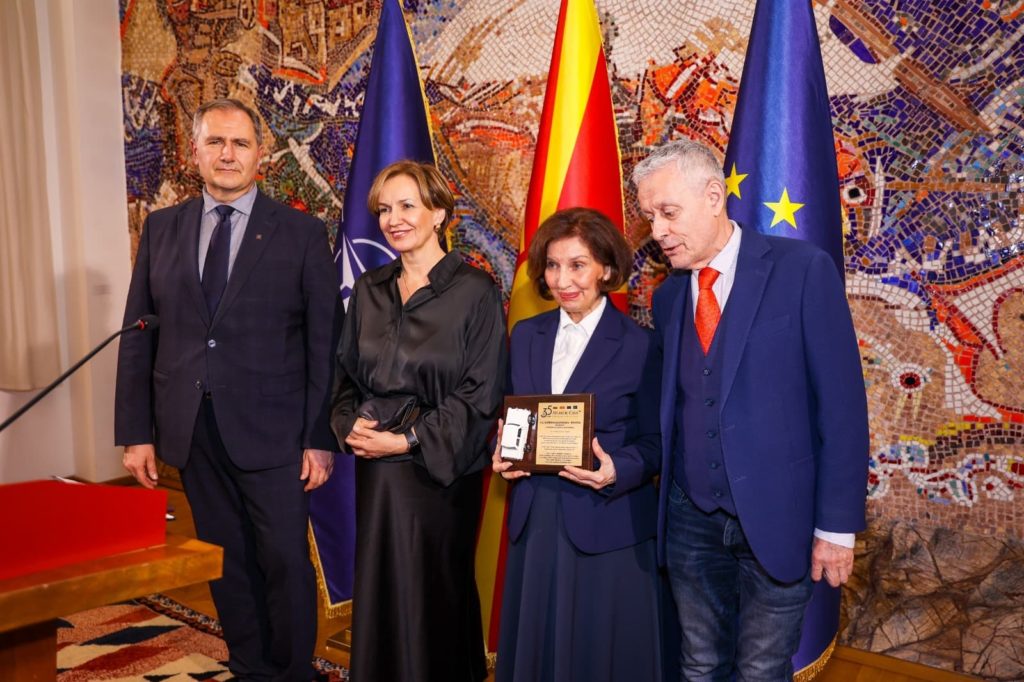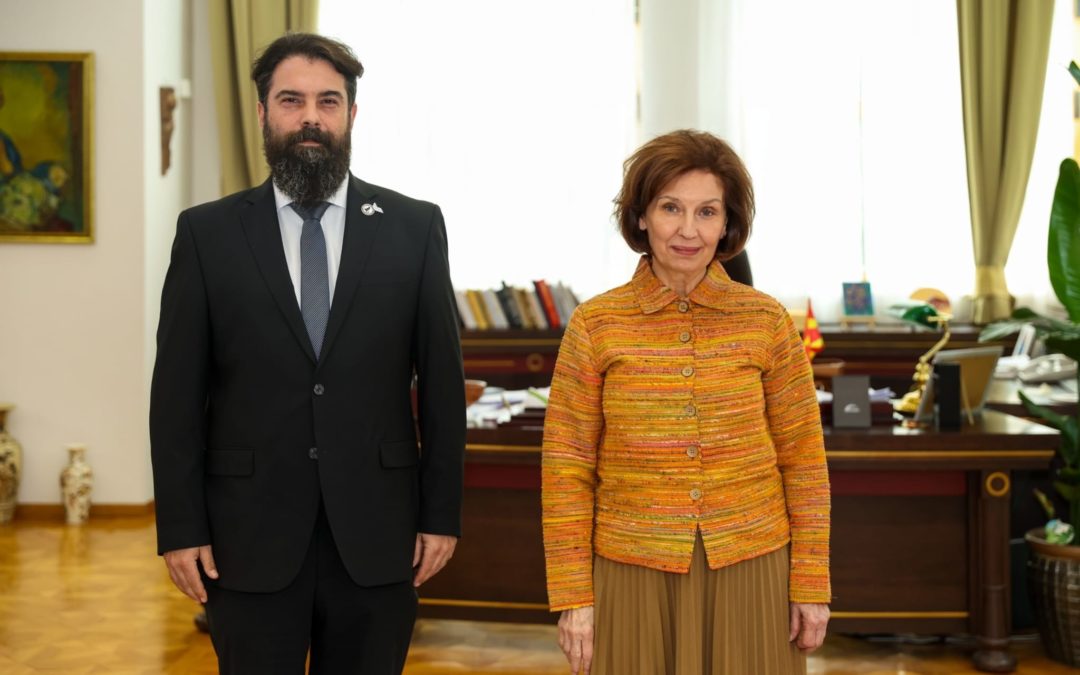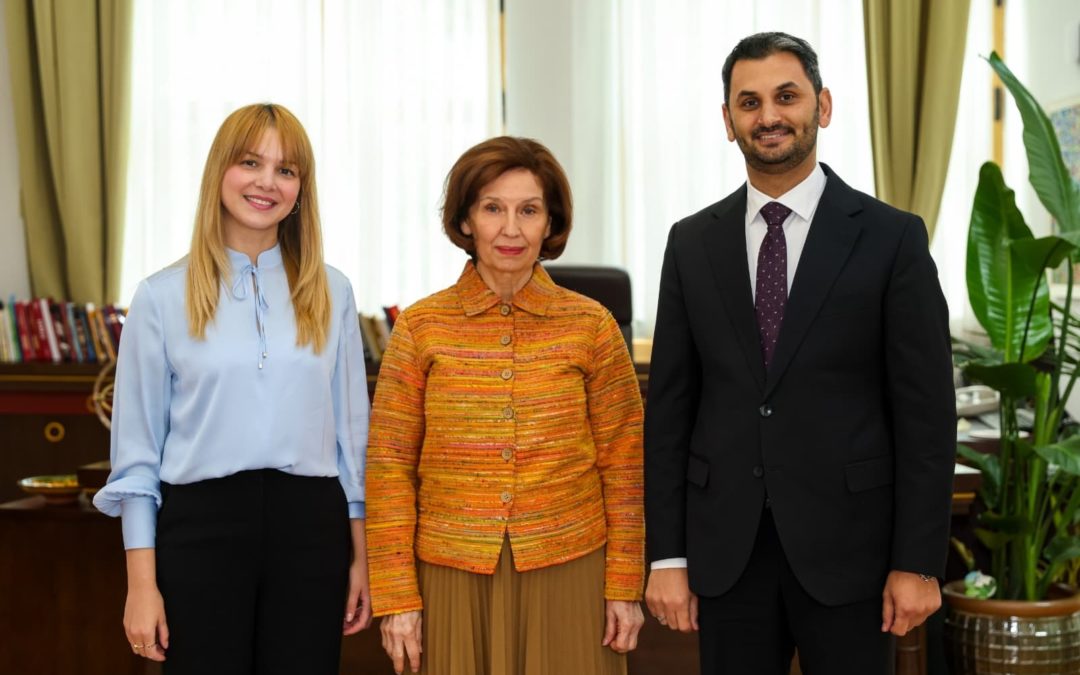
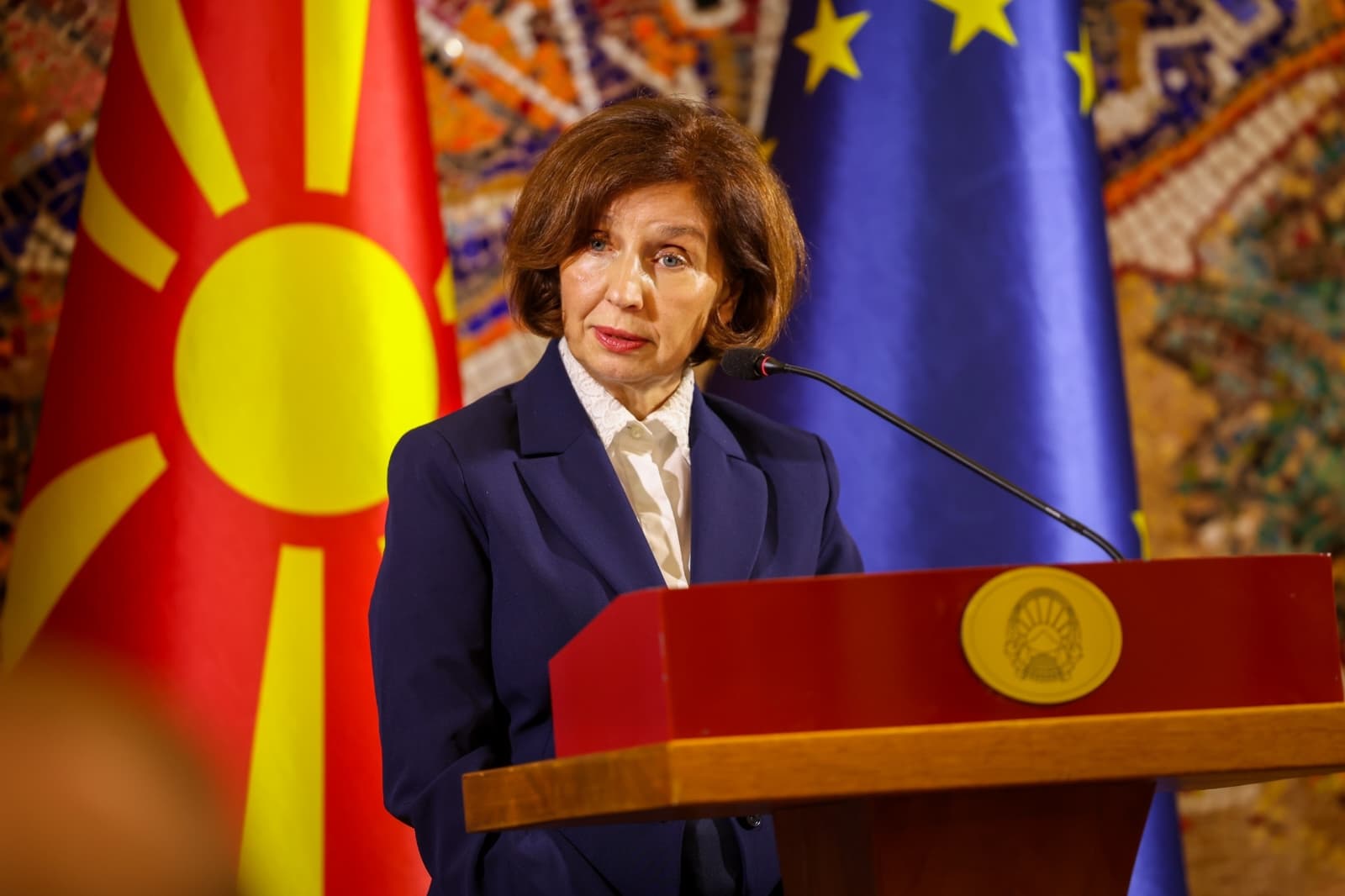
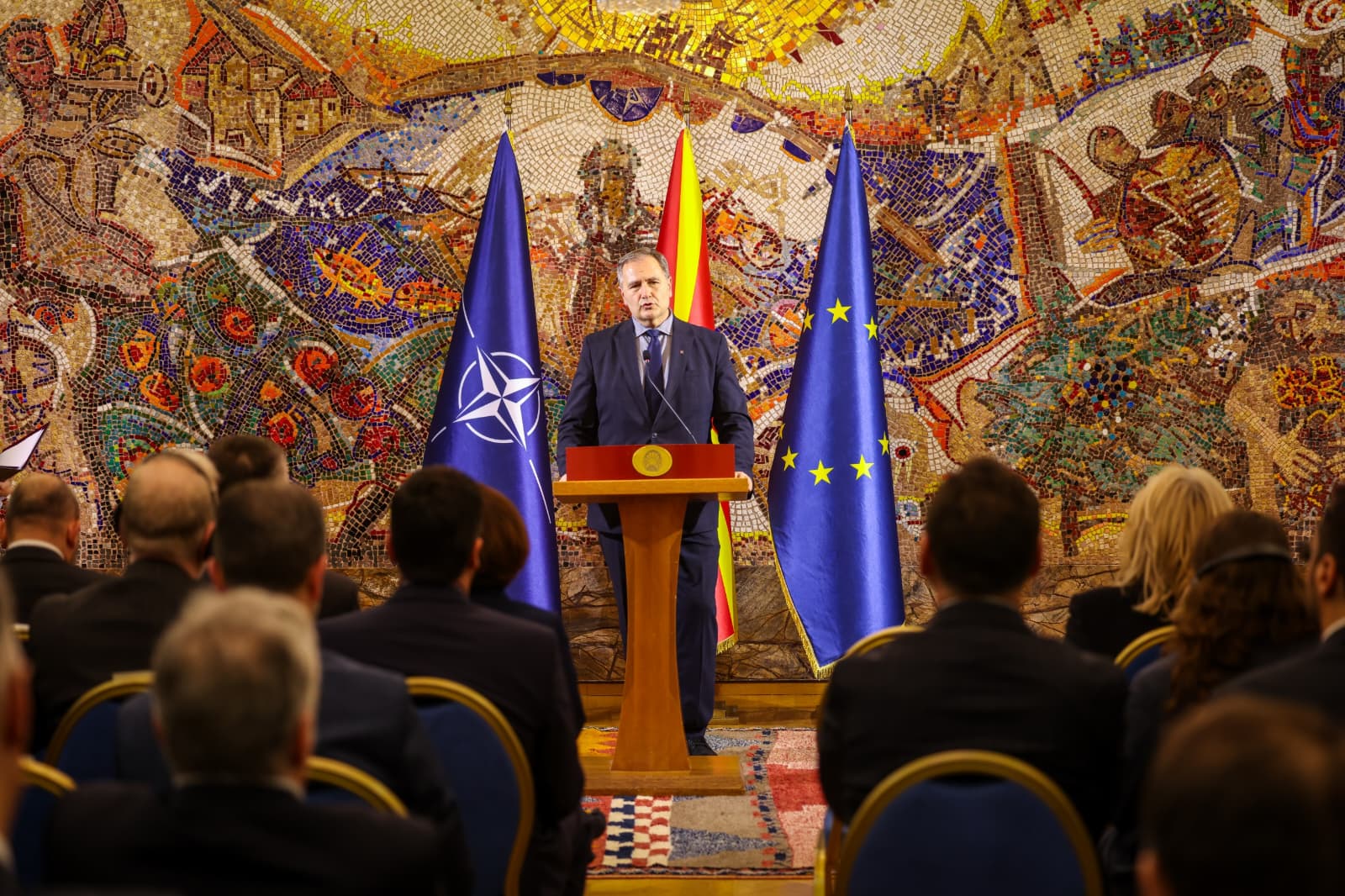
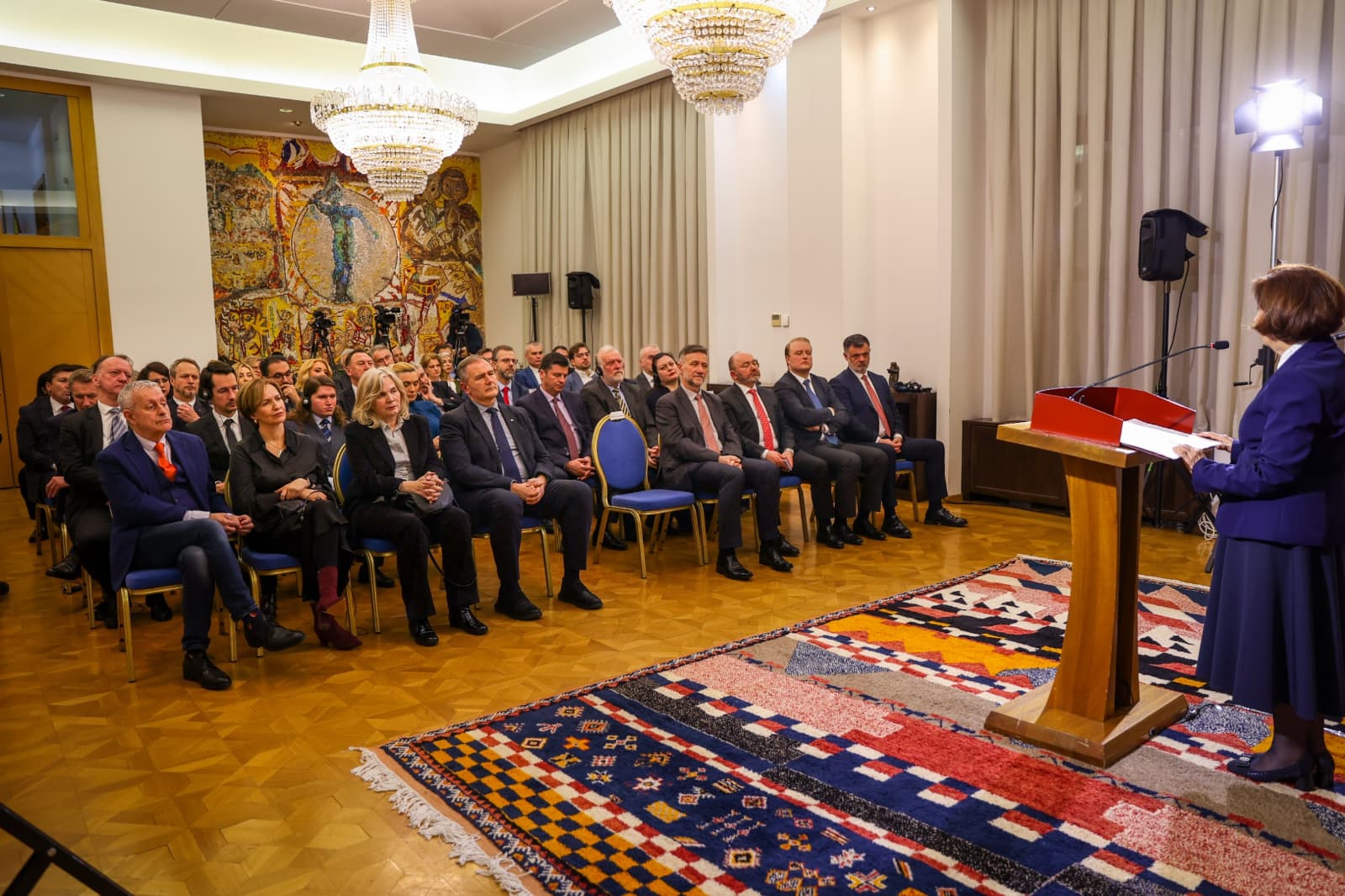
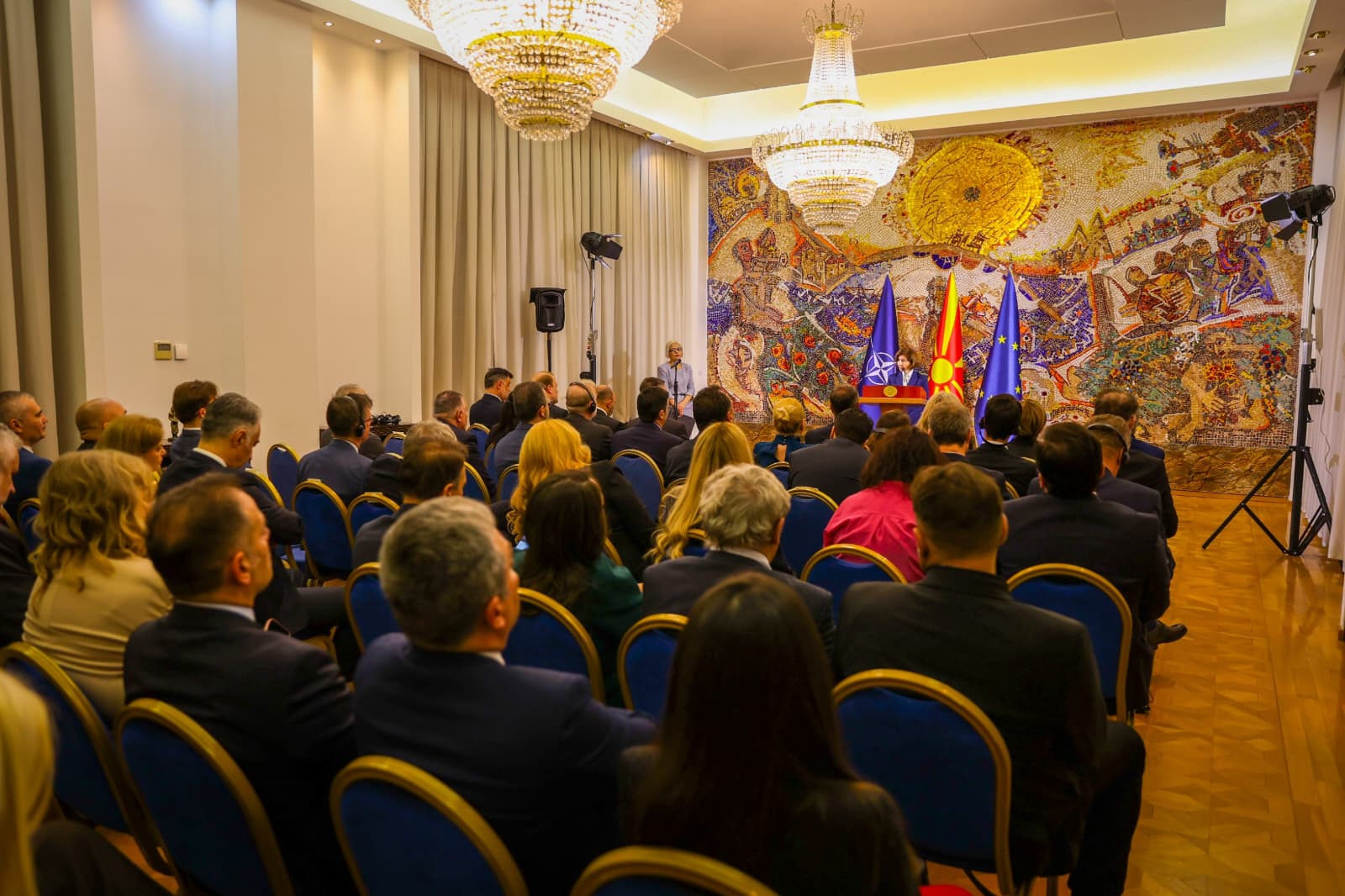
Without a stronger and more determined EU, the Balkans remain a space where external forces continue to test their power, President Gordana Siljanovska-Davkova said at the opening of the International Conference of the Pan-European Union of Macedonia, which was held at the Presidential Cabinet in the presence of numerous diplomatic representatives and foreign guests.
Speaking among the magnificent mosaics of Gligor Cemerski that testify to the historically rooted Macedonian share in the European culture and civilization, Siljanovska-Davkova said that just as every stone is necessary for the stability of the mosaic, the Western Balkans are an indispensable part of the European whole, without which the EU remains vulnerable in the face of geopolitical challenges, wars and hybrid threats.
In her address, she recalled Richard Coudenhove-Kalergi’s vision of a united Europe built on values, as well as Otto von Habsburg’s efforts to overcome divisions and integrate the peoples of Central, Eastern and Southeastern Europe.
The President pointed out that today there are new political barriers that keep the country in a state of prolonged uncertainty despite decades of reforms and difficult compromises made.
According to her, Macedonian citizens have long shown their firm commitment to a European future and do not need regrets and post-festum apologies, but timely, ex-ante solutions to unblock European integration.
She called for renewed political will and leadership that will complete the enlargement process.
The President of the Pan-European Union of Macedonia, Andrej Lepavcov, the President of the International Pan-European Union, Pavo Barisic, the Austrian Ambassador, Martin Pamer, and Stefan Habek, a representative of the Pan-European Union of Austria and the Institute of the Regions of Europe also addressed the audience.
The Pan-European Union of Macedonia was established in 1993 and advocates for promotion of the European values and international lobbying for the country’s integration into the European Union.
Respected Dr. Pavo Barisic, President of the International Pan-European Union,
Respected Dr. Andrej Lepavcov, President of the Macedonian Pan-European Union,
Esteemed Presidents and Representatives of the National Branches of the Pan-European Union,
Your Excellencies,
Dear Friends,
It is my great pleasure to welcome you to my Presidential Office. I thank the Pan-European Union of Macedonia and Austria, the Otto von Habsburg Foundation and the Institute for the Regions of Europe in Salzburg for organizing this international conference dedicated to the European future of the Western Balkan countries.
This evening, we are gathered here, among the magnificent mosaics of the top Macedonian artist Gligor Cemerski. These mosaics bear witness to the Macedonian contribution to the European culture and civilization, from the Neolithic time, through the ancient and early Christian eras, to the medieval exploits of the Slavic enlighteners, Saints Cyril and Methodius and their disciples Clement and Naum of Ohrid.
Each stone in the mosaic has not only an aesthetic, but also a structural function. Even without just one stone, the mosaic is not only incomplete, but also becomes unstable. If you take out one stone, the others will begin to separate, and the mosaic will slowly begin to fragment. My country, together with the Western Balkans, is the missing piece in the European mosaic. Without us, not only is the European Union incomplete, but it is also vulnerable, exposed to risks. We saw this during the migrant crisis, and we are seeing it now with the war in Ukraine and the hybrid threats that our continent faces.
The Pan-European movement is the work of the greatest European mosaicist, the conceptual author of European reunification, Richard Coudenhove-Kalergi. As a visionary, he spoke of a United States of Europe at a time when Europe was still just a geography and believed that the continent could not be united by the destructive force of arms, but by the attractive force of values. From the ranks of his Pan-European movement emerged some of the fathers of Europe, Adenauer, Monnet, Schuman, De Gasperi, who, creating European organizations and institutions, built the European peace project.
During the Cold War, Otto von Habsburg continued Kalergi’s work. As a long-time MEP, von Habsburg earned the nickname “Mr. Europe” for his opposition to the artificial ideological division of the continent and his efforts to tear down the Iron Curtain and integrate the peoples of Central, Eastern, and South-Eastern Europe into a common European home. His battle was not only against physical barriers, but also against mental barriers in the consciousness of the European political elites who had come to terms with Yalta. As a member of the parliamentary committee on foreign policy, von Habsburg argued for an “empty chair” in the European Parliament for each of the Eastern Bloc countries as a reminder that their place was in a united Europe.
Living to a ripe old age, he lived to see many of those empty chairs filled. But not all. On several occasions, as a great Macedonian friend, Von Habsburg clearly stressed that, I quote, “Europe will not be complete without Macedonia in it” and that one of his wishes was to see our country in the European Union.
Today, unfortunately, my country is still hostage to historical narratives and identity denials that go against the European spirit. It is as if a new “Iron Curtain” of protocols and conditions that have not been demanded of any other candidate country for membership is being erected around us, which are contrary to the fundamental principles and constitutive documents of the European Union.
As former president of the International Pan-European Union, Mr. Alain Terenoire, noted, the slowed-down enlargement leaves the countries of South-Eastern Europe in an “unjustified state of uncertainty” and undermines regional and European security.
Distinguished guests,
Last week, at the Munich Security Conference, the High Representative of the European Union for Foreign Affairs and Security Policy, Ms. Kallas, defended the idea of Ukraine’s integration, saying that “enlargement is always a geopolitical decision. Although the process is based on merit and many reforms need to be made, the geopolitical factor is still crucial in making the decision”. My esteemed Latvian colleague, President Rinkevicius, followed up on this, stressing that the Union must turn its attention to the Western Balkans because the EU has lost all credibility in our region. He recalled that in return for reforms and compromises, including changing the name of our country, we were promised many things that remained unfulfilled. The next enlargement should be the largest enlargement, but under different rules.
Although the Western Balkan countries are surrounded by EU member states, this does not mean that they are protected from attempts at influence by third centers of power. Recently, even Francis Fukuyama assessed that the world is not moving towards a stable order, but towards an unstable distribution of spheres of influence. According to him, the Western Balkans, which are often treated as a periphery, in such conditions become a testing ground for the clash of interests. The European Union can be a stabilizing factor, but only if it overcomes its own institutional paralysis. Without a stronger and more determined European Union, the Balkans remain a space where external powers will continue to test their power.
Our message is clear. Europe cannot be fully secure as long as the Western Balkans are outside the European Union. Our vulnerabilities are Europe’s vulnerabilities.
Especially after the war in Ukraine, the EU cannot seriously claim to be fighting hybrid threats and external interference, leaving the Western Balkans outside. If the European Union wants to be a geopolitical union, it must not leave the Western Balkans in a geopolitical vacuum.
Distinguished attendees,
In a recent lecture I gave to students at Columbia University, I pointed out that the European integration of my country and the Western Balkans resemble the drama of the absurd “waiting for Godot”.
That wait has been going on for too long. This 2026, we celebrate 35 years of independence. 25 years since the Stabilization and Association Agreement with the EU, 21 years of candidate status, many positive reports/recommendations for the start of negotiations, a high level of harmonization with the European legislation and 100% compliance with the EU’s common foreign and security policy. Not to mention the difficult compromises we have made as a country, beyond the Copenhagen criteria, including our latest offer for constitutional amendments that would enter into force with our membership in the European Union. And yet, we are told that this is not enough.
We are tired of listening to the apologies of former European officials and politicians for how unfairly we were treated during their time. Macedonian citizens do not need pity and post-festum apologies, but timely, ex-ante solutions to unblock our European integration. Macedonian citizens have long deserved to be European citizens. Only in this way will the Union clear its conscience towards Macedonian citizens and the Western Balkan region.
Instead of Mr. Godot, who never comes, we need a new Mr. Europe or Mrs. Europe, a new Pan-European man or woman who will complete the vision started more than a century ago.
Many of you come from European Union member states, which are among the greatest supporters and friends of the Macedonian European integration. Your countries have invested great economic, political and diplomatic capital in the Macedonian European integration. Think of the numerous projects for implementing European reforms, for the rule of law and the fight against corruption, for supporting civil society and training the public administration. Think also of the numerous investments and companies that connect the Macedonian economy with the European market. But if the voices opposing our integration and the enlargement of the Union are allowed to prevail, then there is a risk that this capital of yours will be threatened. Slow integration accelerates the emigration of young people from our region. Look at what is happening with the latest Schengen rules and how they negatively affect the work of our carriers and trade with the EU.
Your pan-European generation should help integrate my country and the Western Balkans into the European Union and thus complete the work begun more than a century ago. We need your efforts, so that the empty seats for my country and the countries of the Western Balkans can finally be filled.
Dear friends,
I will conclude with the following. In 1923, Coudenhove-Kalergi wrote: “Many have dreamed of a united Europe, but only a few have the determination to create it. As an object of longing, the dream remains barren, but as an object of will, the dream bears fruit. The only force that can bring about Pan-Europe is the will of Europeans, but the only force that can stop the creation of Pan-Europe, again, is the will of the Europeans”.
My country and the Macedonian citizens have that strong will.
Thank you.