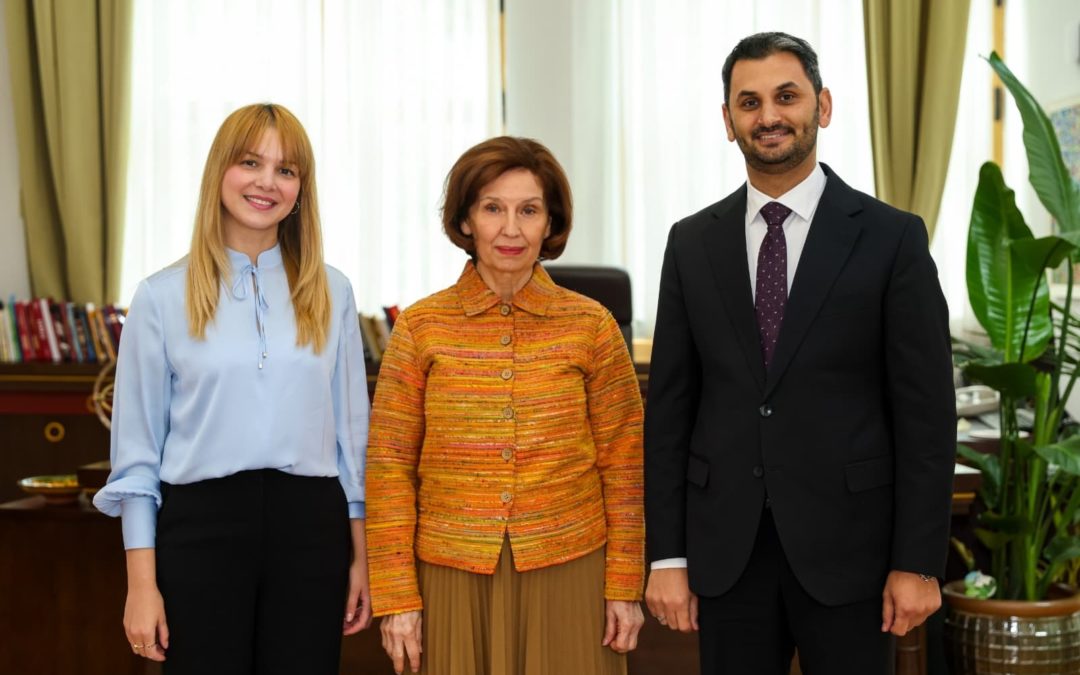
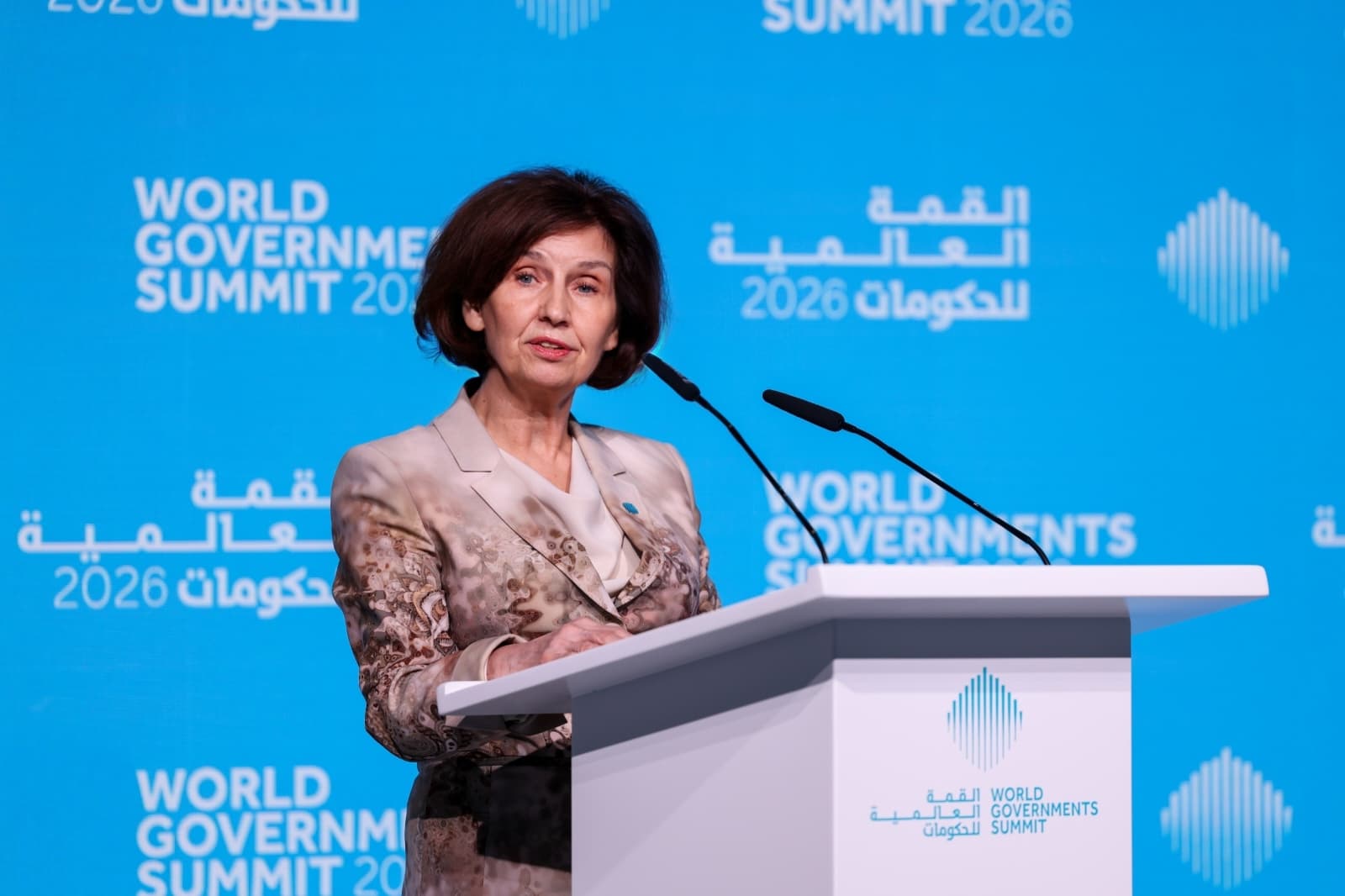
President Gordana Siljanovska-Davkova addressed the World Government Summit in Dubai today, as the keynote speaker at a session dedicated to demographic change.
Speaking about the decline in population, she said that our country and the region are facing a triple pressure: low birth rate, high emigration and rapid population aging, and shared projections, according to which the Macedonian population could decrease from the current 1.8 to 1.2 million by 2070, a loss of 33% of the current population.
This triad of declining birth rate, emigration and aging, according to the President, reduces the number of working-age population and increases the burden on the health, social and pension systems.
This, according to Siljanovska-Davkova, puts pressure on a small and open economy like ours.
She called for reforming institutions, i.e. reforms in the judiciary and public administration, but also for accelerated digitalization of public services.
She pointed out the need for young people to gain the deserved role of drivers of change, by placing them at the forefront of digital and economic transformation, but also through their inclusion in policymaking.
According to her, the inclusion of the diaspora is also important, as an engine of intellect, innovation and investment.
She called for building a demographically resilient society, by creating a society in which people will remain to live and form families.
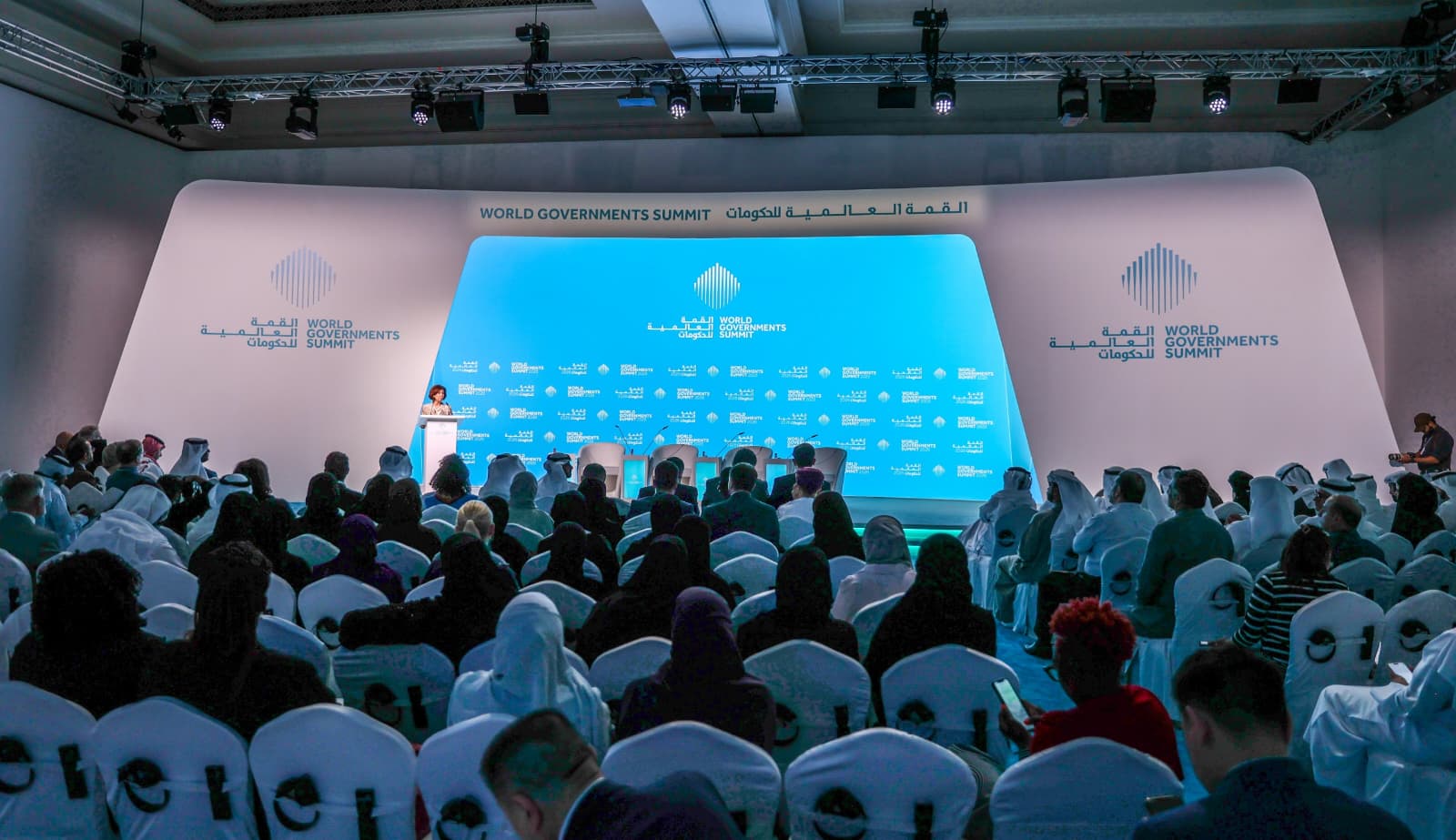
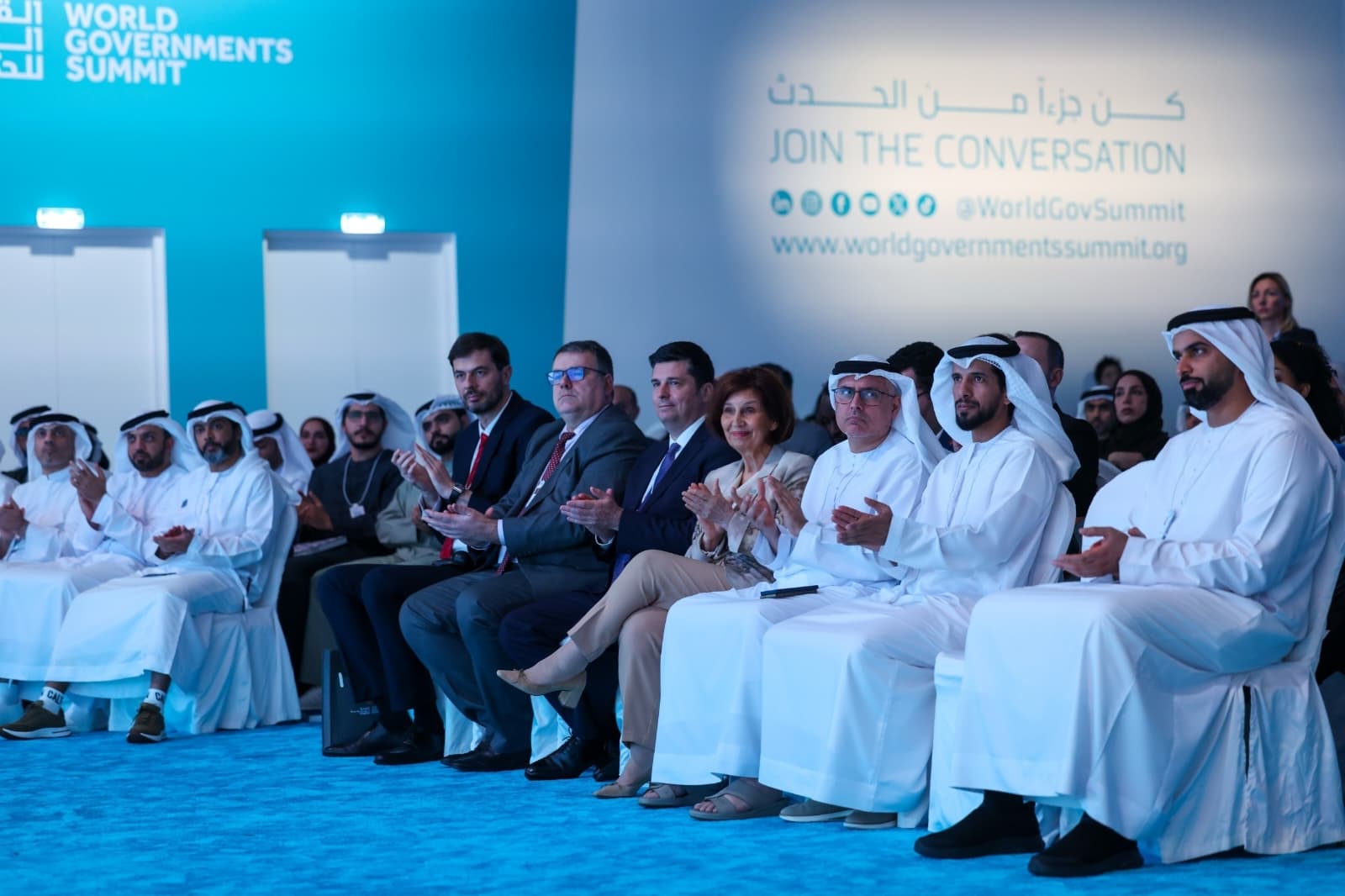
The integral text of President Siljanovska-Davkova’s address is below.
Your Excellences,
Ladies and gentlemen,
Thank you for inviting me to address this World Governments Summit, here in Dubai. I am glad to be here for at least two reasons. First, this year we mark 30 years since the establishment of the diplomatic relations with the United Arab Emirates, and, secondly, because I believe that this Summit and today’s topic concern us all.
On July 11 1987, the five-billionth person was born in former Yugoslavia. On that occasion, the UN Secretary General flew to the capital city of Belgrade with a special gift for the Macedonian diplomat Lazar Mojsov, who, at that time was the President of the Federation. The gift was a population clock that counted the populations of the world and that of Yugoslavia.
Fast-forward 39 years.
To the best of my knowledge, the population clock is still ticking, and, according to the UN projections from the 1980s, by now, the world population should have reached around 10 billion people. The now non-existent Yugoslavia should have counted around 30 million, while my own country, around 2.5 million.
However, the recently conducted Macedonian census showed that we are actually down to 1.8 million residents. Even if we combine the populations of all former Yugoslav countries, we will be at least 10 million short from the UN projections. All that while the world population is 8.3 billion.
Critical junctures, such as the end of the Cold War, the violent breakup of Yugoslavia, the prolonged democratic transition and consolidation, and the postponed EU integration have drained not only my country, but the entire region of its population. In addition to that, globalization of individualism and consumerism resulted in a change of lifestyles and preferences.
As a result, my country, and the entire region of South Eastern Europe face the triple pressure of low birth rates, high emigration and rapid ageing of the populations. According to the latest projections, the Macedonian population might be reduced from the current 1.8 to 1.2 million by 2070. That’s a loss of 33% of the current population.
This is not the exception, but the rule. Many of your countries experience similar demographic challenges. We see this across continents, regardless of religious and cultural traditions or development status and income levels. For the first time in human history, we have more citizens over 65 than under 5. This is not just a statistic, but a fundamental demographic shift in the human story. Data scientist Stephen J. Shaw called this a worldwide birth gap crisis.
Ladies and gentlemen,
This triad of birth gap, emigration and ageing is decreasing the number of working-age population and increasing the burden on the health, social and pension systems. This puts pressure on a small and open economy as ours.
The former Financial Times journalist Giles Merritt rightly noted that “there are no examples of a thriving economy with a shrinking workforce.” So, this brings us to the questions:
What measures can we take to increase the birth rate, decrease emigration and slow down the ageing of the overall population?
How can we achieve sustainable growth and development in spite of these challenges? What can we do so that demography does not become our destiny?
On one hand, some Western European countries rely on importing migrants. That’s where many of the best and brightest from my country and my region go to fulfill their potential. On the other hand, some Eastern Asian countries are hopeful that robotics and AI will eventually bridge the gap. The global market size of Dark Factories is expected to grow from 42 to 76 billion US dollars by 2032.
As for us, we are not rich enough to attract migrants nor to afford robots. Instead, we have to rebuild social trust, to renew the social contract in a Rousseauan sense, by reforming the institutions, responding to the needs of young people, and reaching out to the diaspora. And, I believe, this is relevant for the entire Balkan region.
Recent Oxford Analytica research shows that, in the long run, financial support itself is not enough to encourage reluctant adults to have more children. What is needed is a combination of policies that relieve the tensions between work and family life. As a country, we have combined pro-natal policies, such as work-life balance, support for children, parents and families. We have tax incentives for starting families and having children. The country financially supports up to six in vitro fertilization attempts for every family trying to have children. We are opening child care facilities and schools. But, in order to deliver results, these measures must be supported by a change of the overall environment.
Through a transparent and inclusive process across all sectors of society, we developed and adopted the National Development Strategy 2024-2044. One of its goals is demographic revitalization and social development. We established the Ministry of Social Policy, Demography, and Youth and we have appointed a National Coordinator for Demography and Youth.
First, reforming the institutions. Without people nothing happens, but without institutions nothing lasts. The long democratic transition and the prolonged EU integration alienated Macedonian citizens from the institutions, that came to be perceived as slow, inefficient, and corrupt. To change this, we are implementing the EU Reform Agenda, with the aim to create a home where young families can thrive. We are focusing on three institutional pillars.
First, judiciary reforms. Justice is the foundation of trust and predictability. Our goal is to have rule of law instead of rule of men. That is why we are creating a professional, independent and efficient judiciary and rooting out corruption and other distortions of justice.
Second, we are reforming our public administration. By adopting a modern human resources management system, our Government aims at transforming the civil service from a barrier that drives people away into a credible and accountable partner that serves the citizens.
Finally, we are accelerating the digitalization of public services, making them transparent and accessible to every Macedonian citizen.
Through these, and many other, reforms, we are renewing the trust in the institutions, so that our youth can confidently choose to stay, form families, and raise the next generation.
This brings me to the second aspect of that social contract, and that is responding to young people. Polls show that over 40% of young people consider leaving the country. Emigration has become a trend. The entire Balkans is facing a mass exodus that is causing a serious demographic and democratic crisis.
In order to keep young people in the country and the region, we must stop viewing them merely as a demographic statistic and start treating them for what they really are, drivers of change. There is no progress without the favorite word of young people: “why?”. There is no authentic democracy without their rebellious voice, creativity and cry for social justice.
If we want young people to stay, we need to give them a challenge and put them in charge of the digital and economic transformation. This effort begins with realignment of education with the real needs of the labor market. STEM, high-tech skills and lifelong learning must take the place of old-fashioned curricula.
But not only that. We need to include them in policymaking. The purpose of the Law on Youth Participation and Youth Policies, and the Youth Council I established, is to place young voices at the very center of policymaking, ensuring they actively shape the country’s future. By doing this, we are renewing the intergenerational trust and rebuilding another part of the social contract.
Finally, reaching out to the diaspora. We are no longer treating the Macedonian diaspora as a mere source of remittances, but as an engine of intellect, innovation, and investment. As our greatest strategic resource, the diaspora can be a key driver of the Macedonian economy, a guardian of Macedonian identity, a promoter of Macedonian culture and the best ambassador in the world.
Physical return is not always possible. But, by adopting the new National Diaspora Strategy we encourage brain circulation through digital infrastructure by allowing professionals to contribute to Macedonian society and economy while working globally. The Macedonian diaspora is the second wing of the nation. And we need both wings in order to fly.
Speaking of wings, let me conclude this speech with a story. Recently, National Geographic came out with an award-winning documentary inspired by a Macedonian folk tale called “Silyan the Stork”. This is where my first surname, Siljanovska, comes from as well.
The storks don’t bring babies, but their symbolism is that they return to their nest, to bring up a new generation. Demography does not have to be destiny. In order to stop the exodus, revert emigration and to increase birth rates we need to build a demographically resilient society. This means creating a society in which people will remain to live and form families. And we hope that, with all the measures, with a changed perspective, we will have a revival.
Thank you.