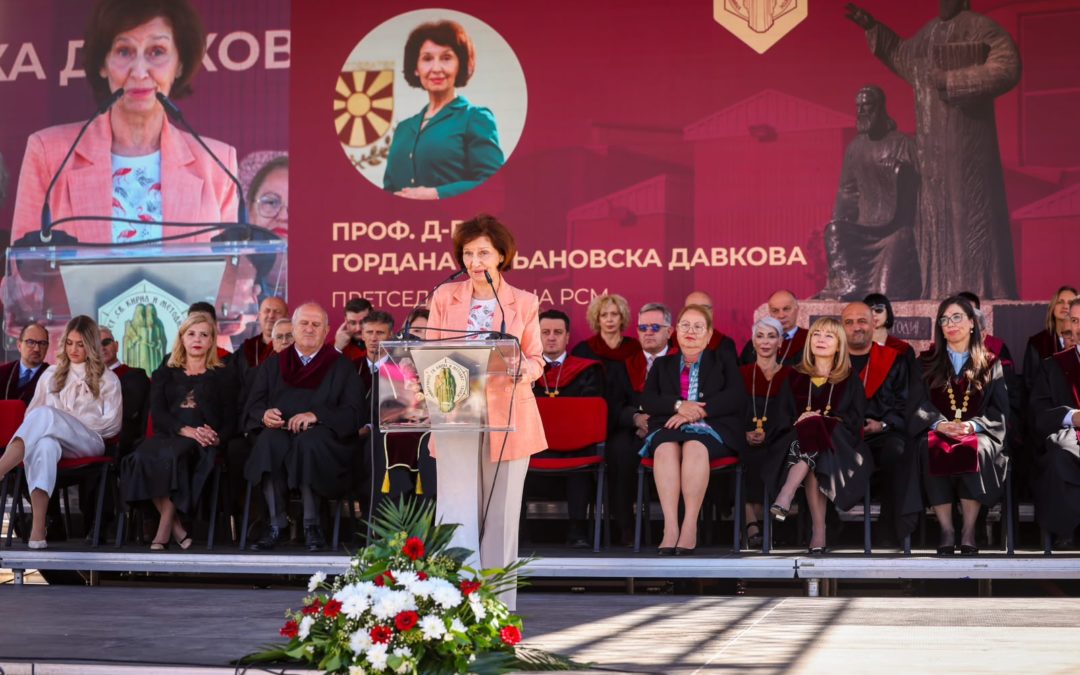
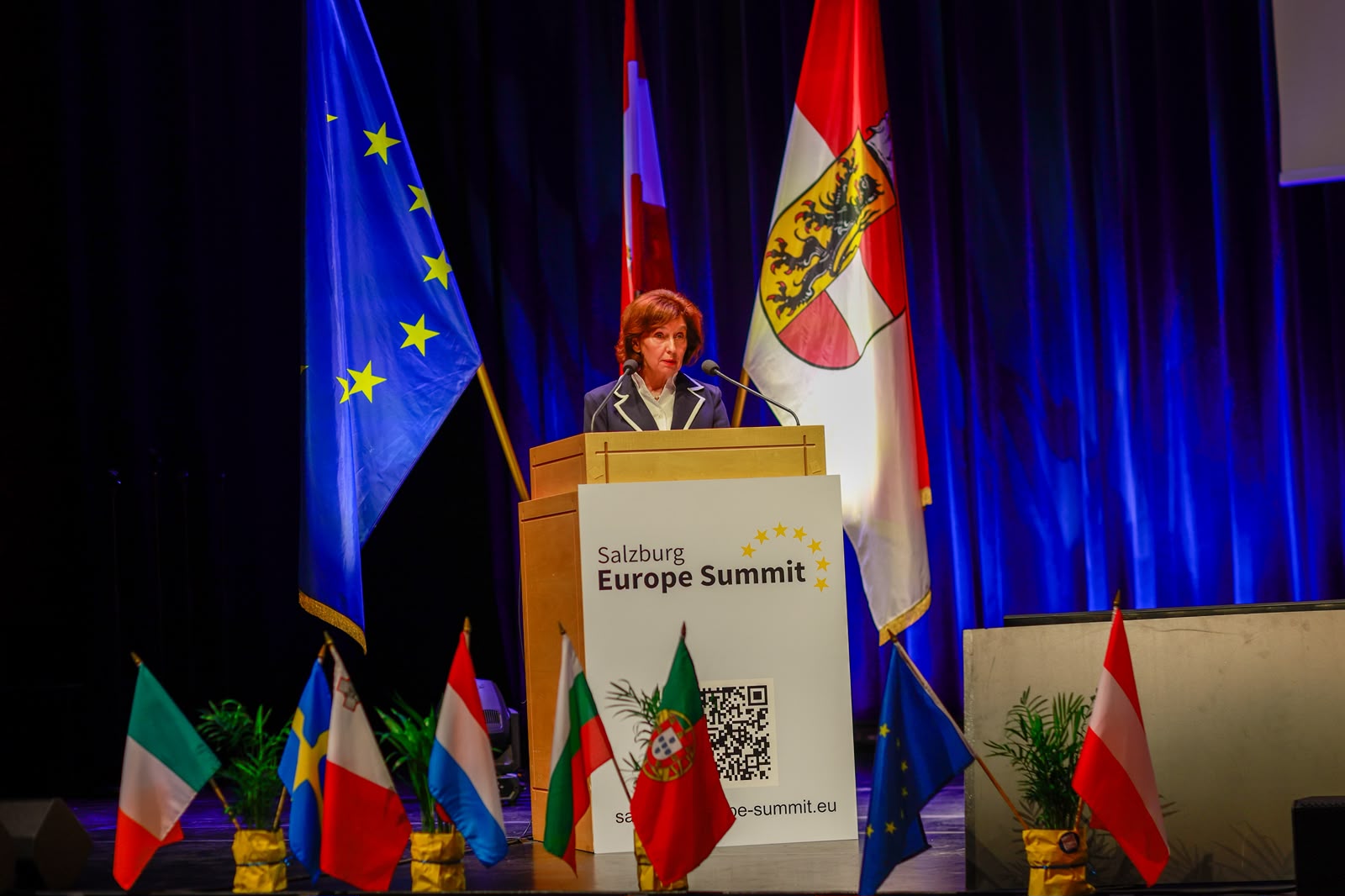
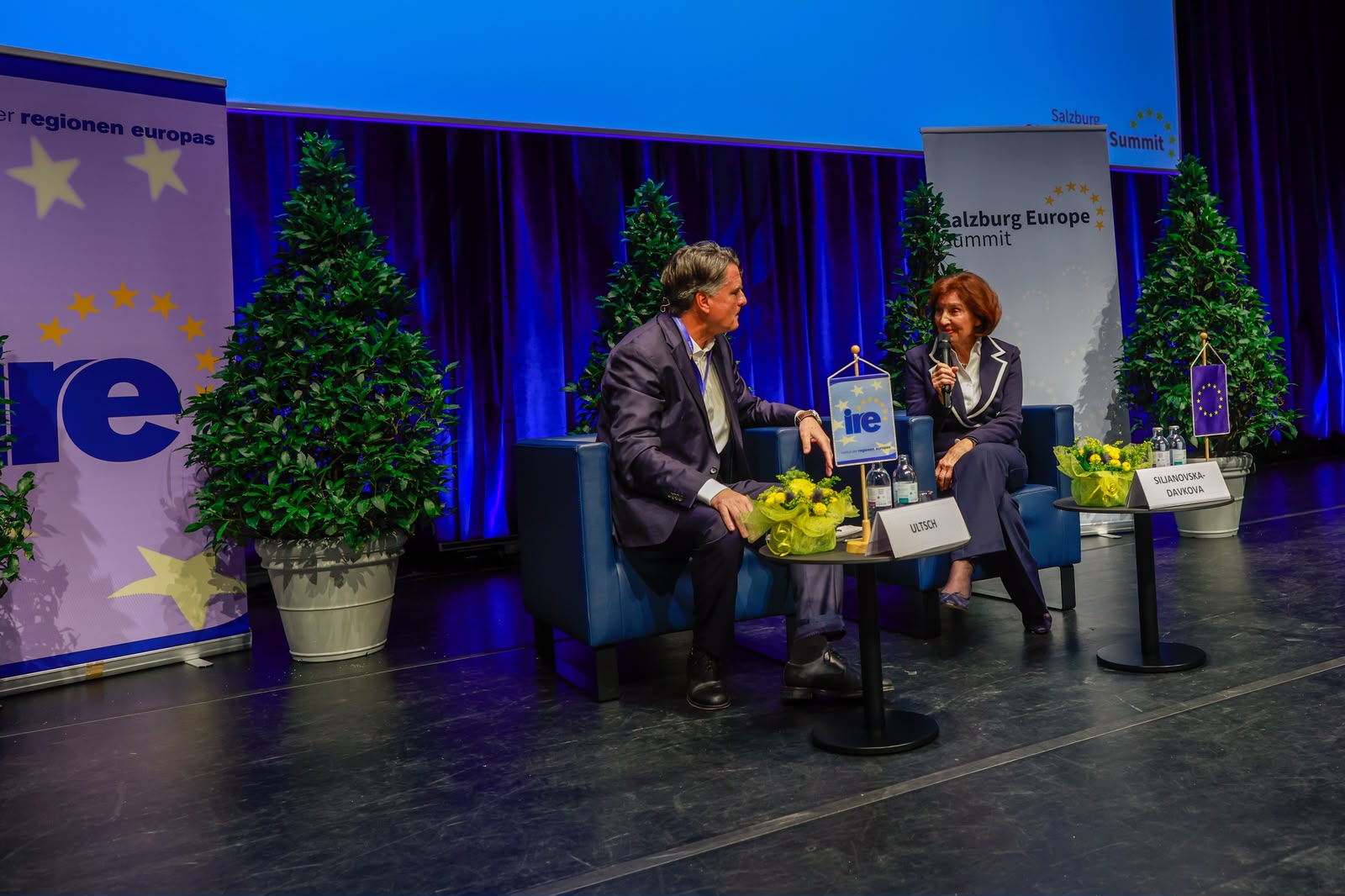
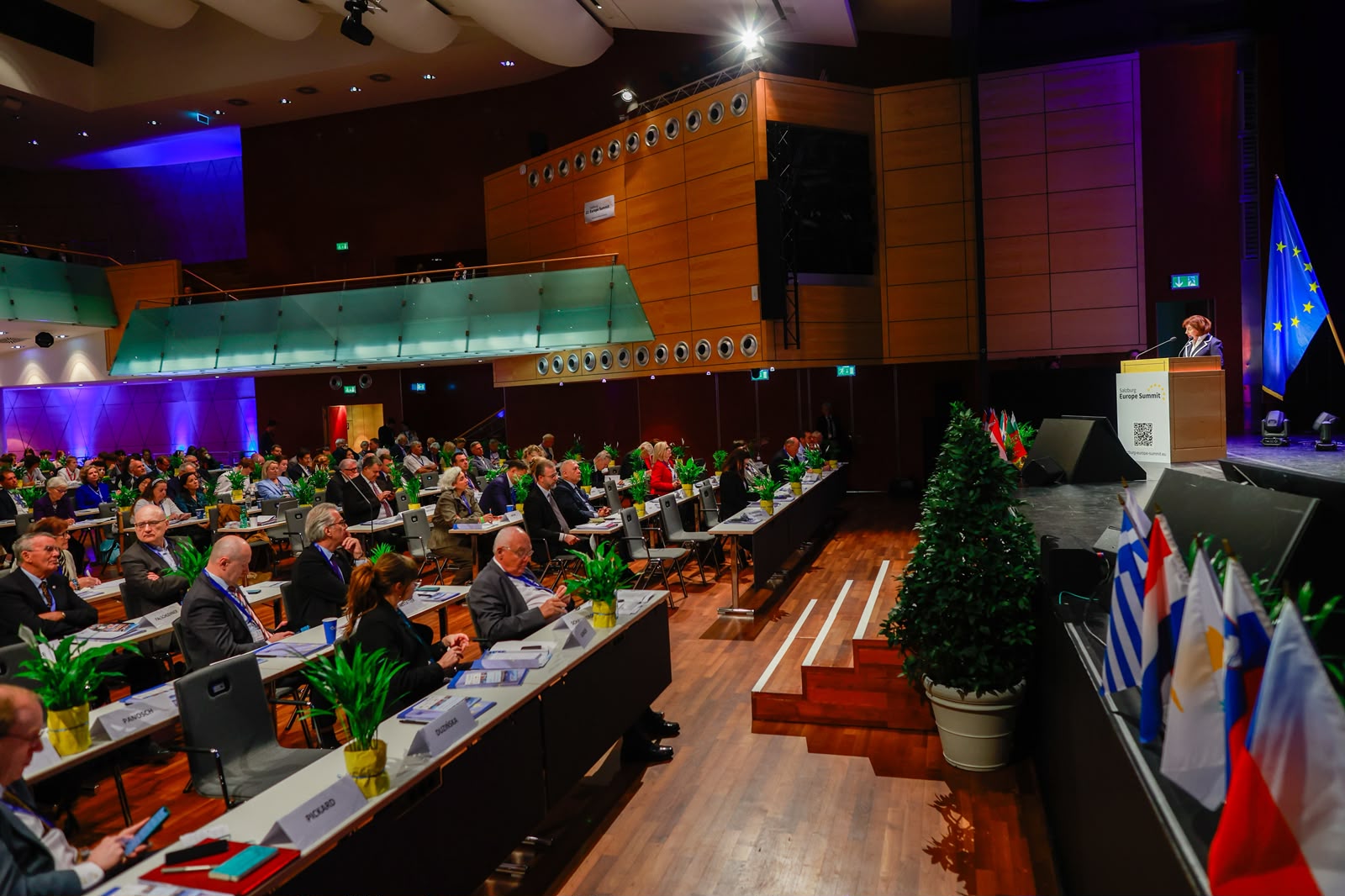
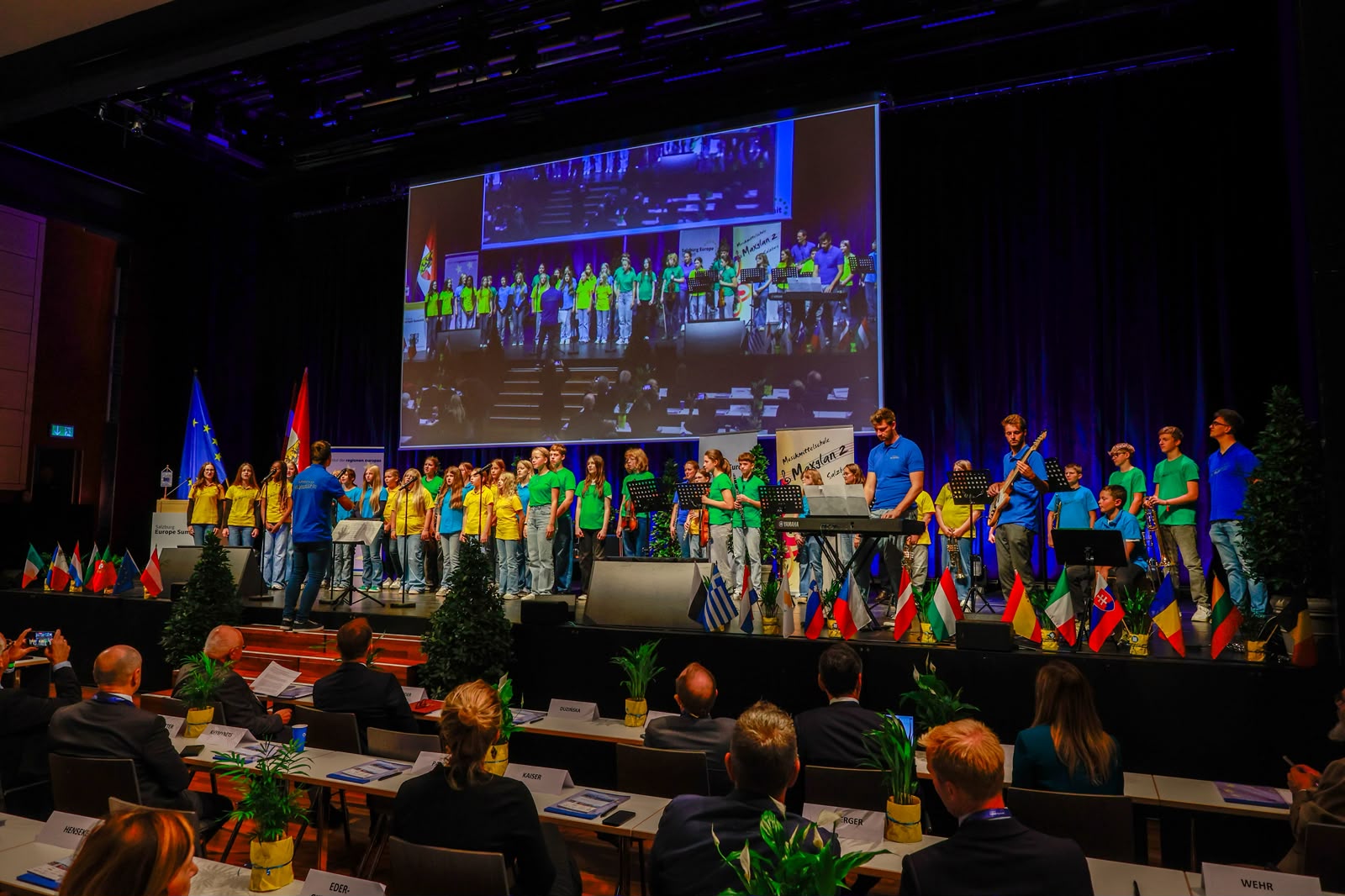
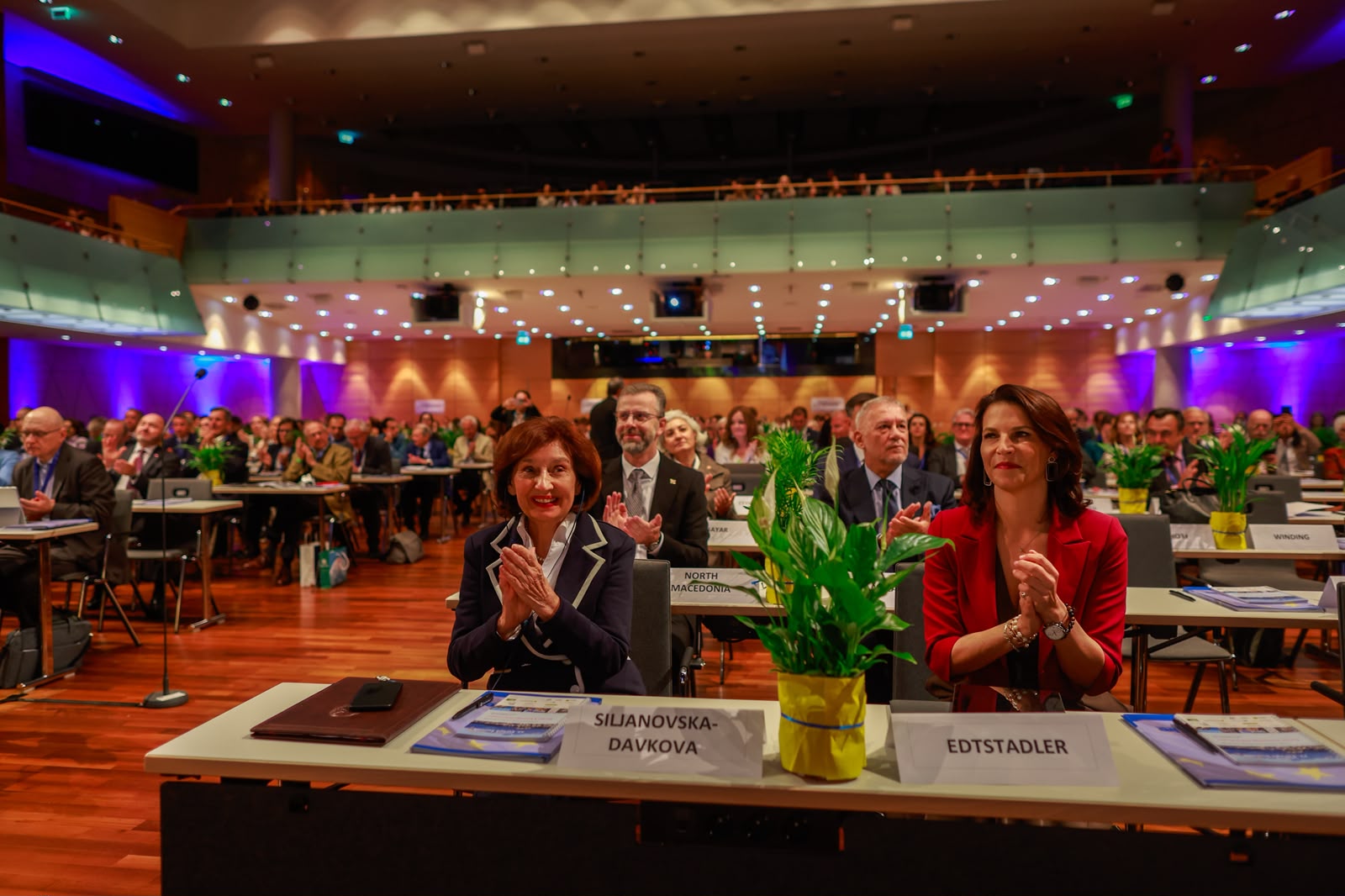
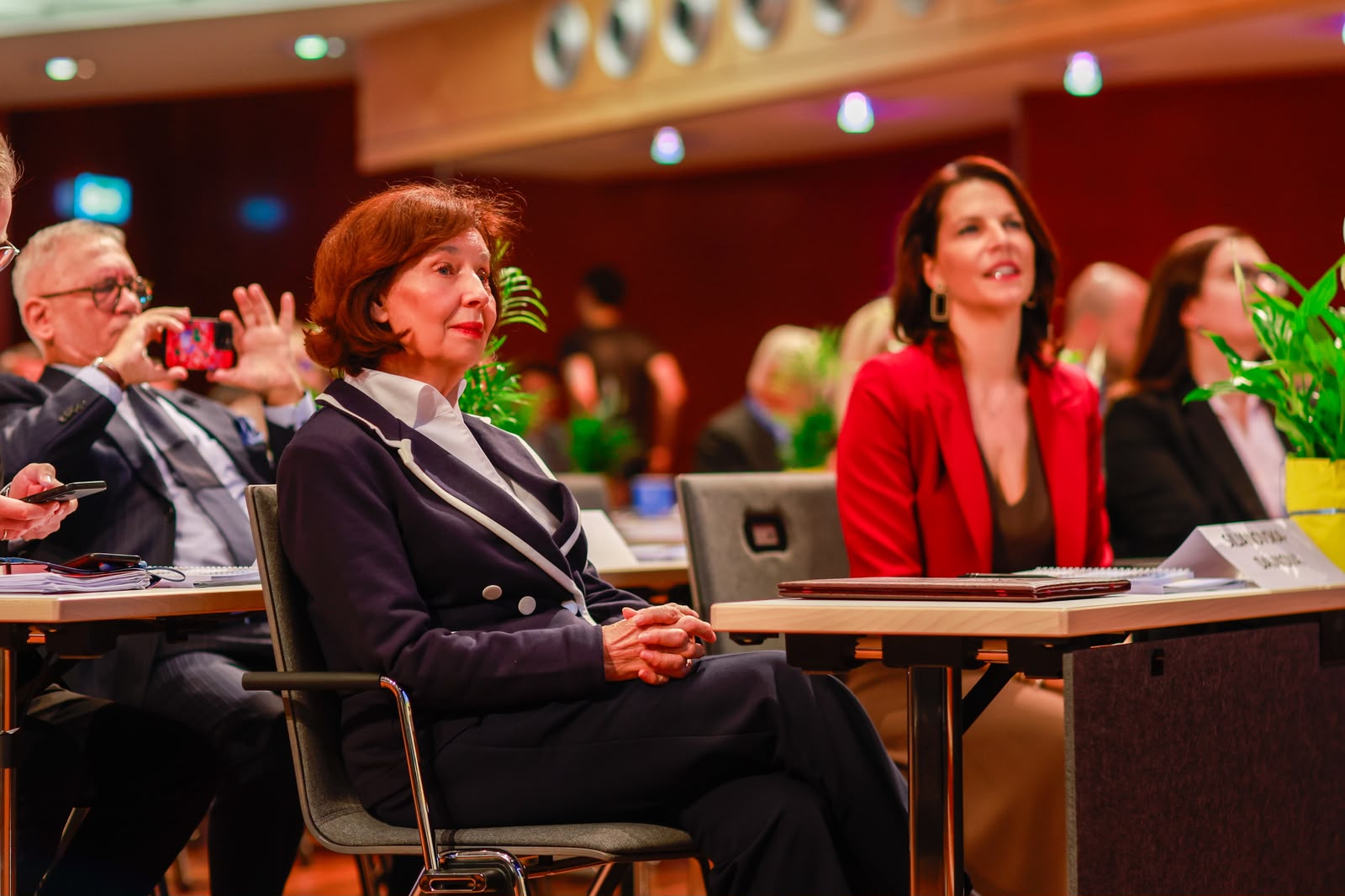
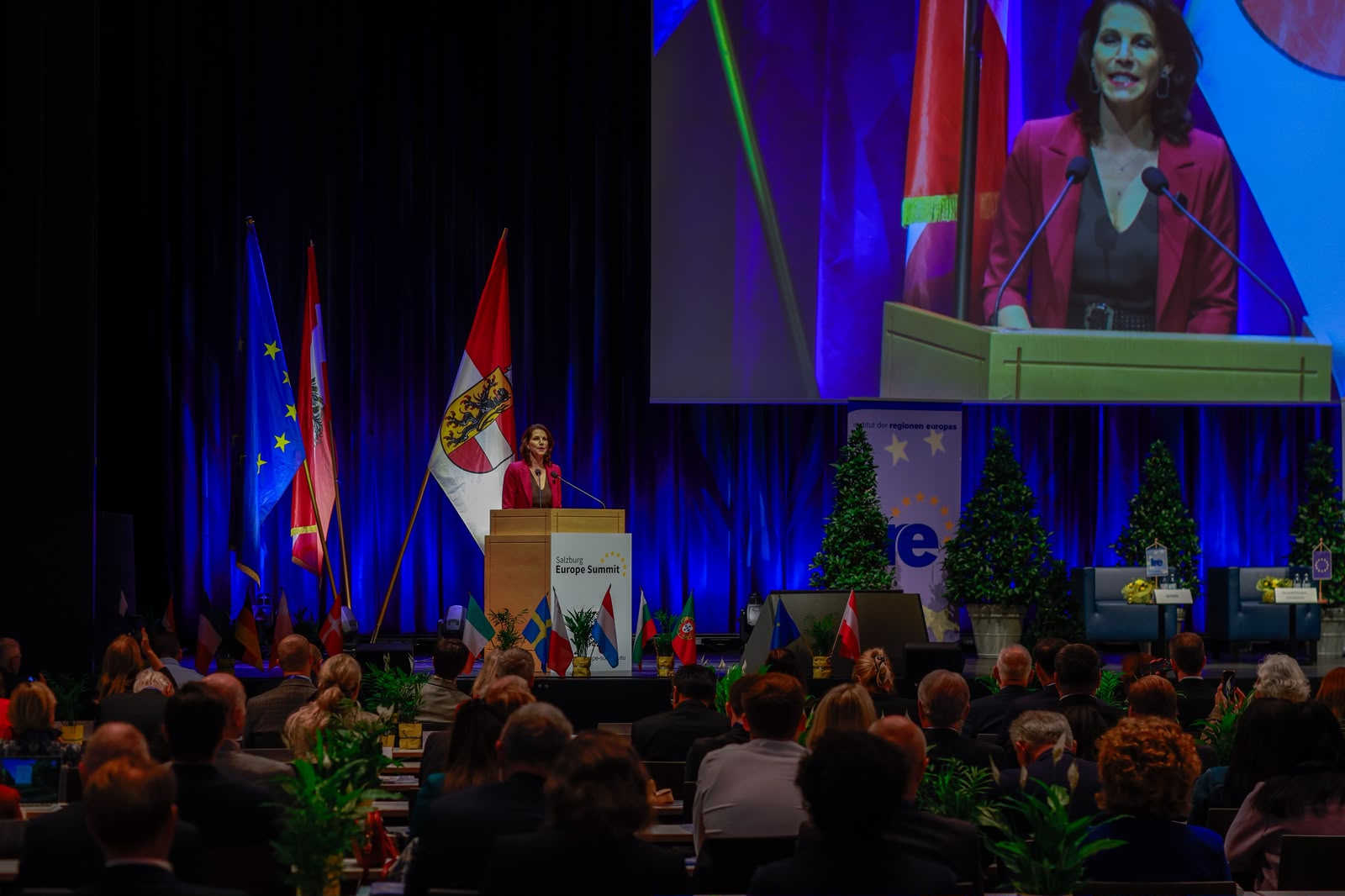
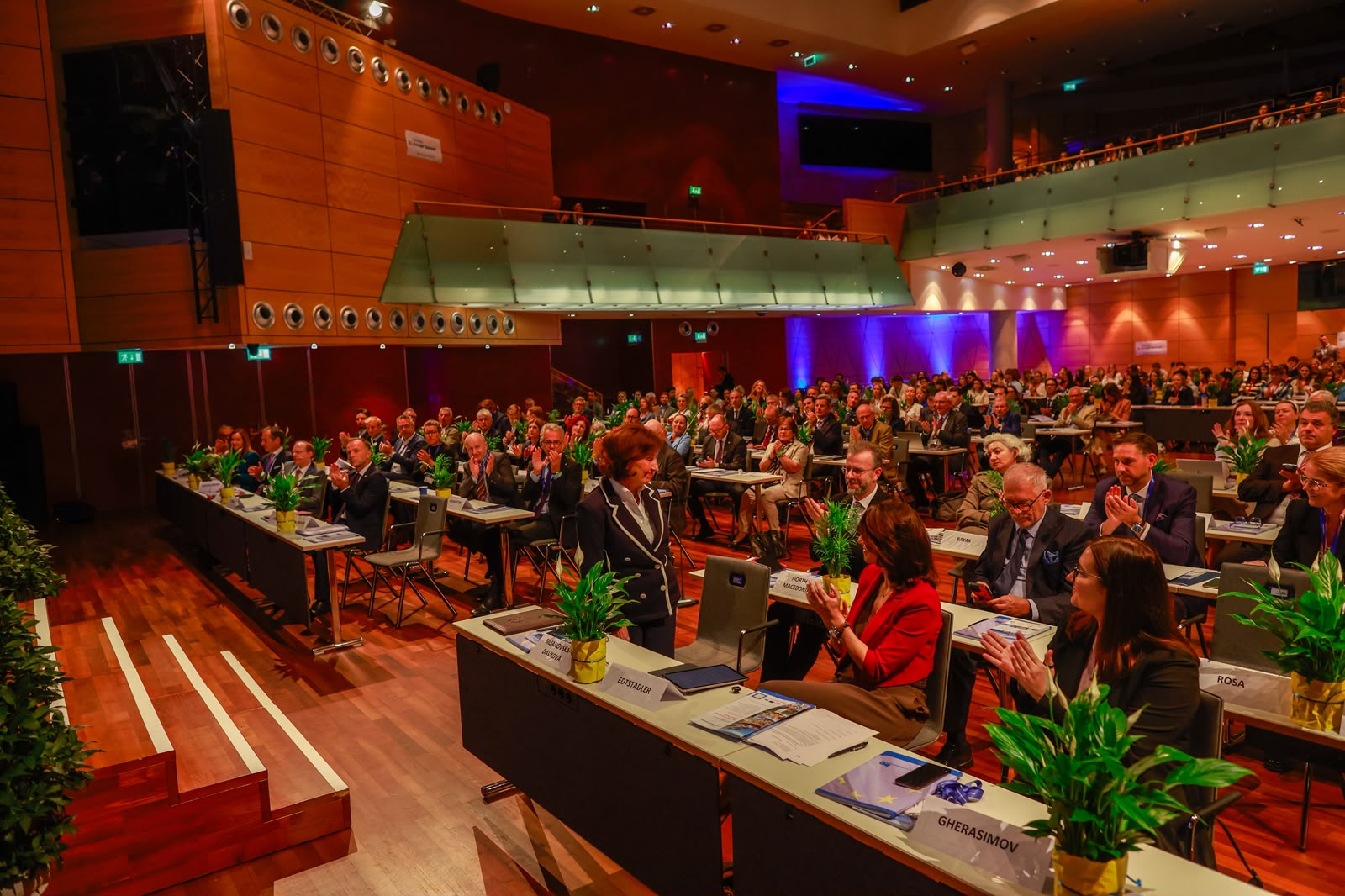
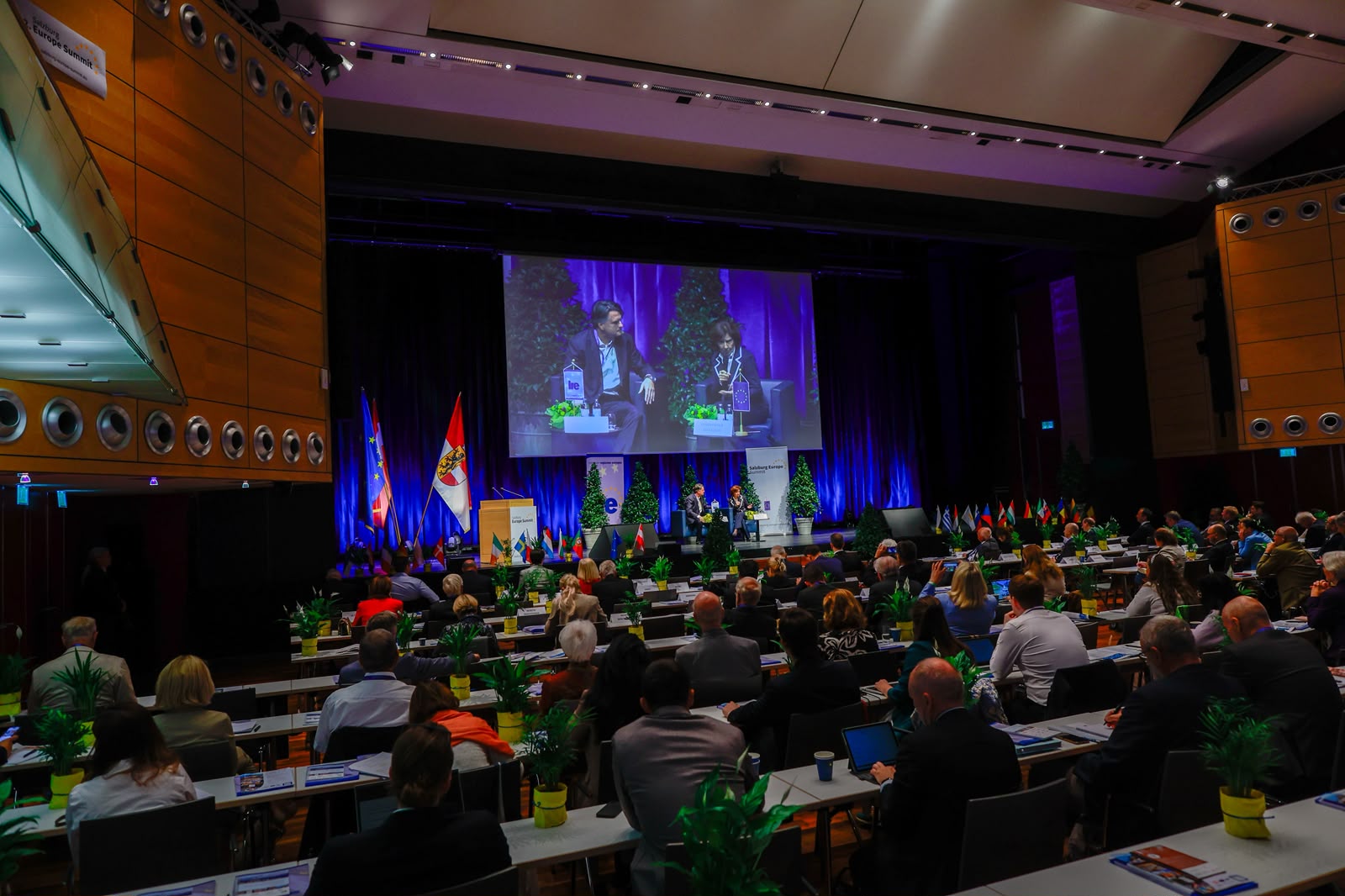
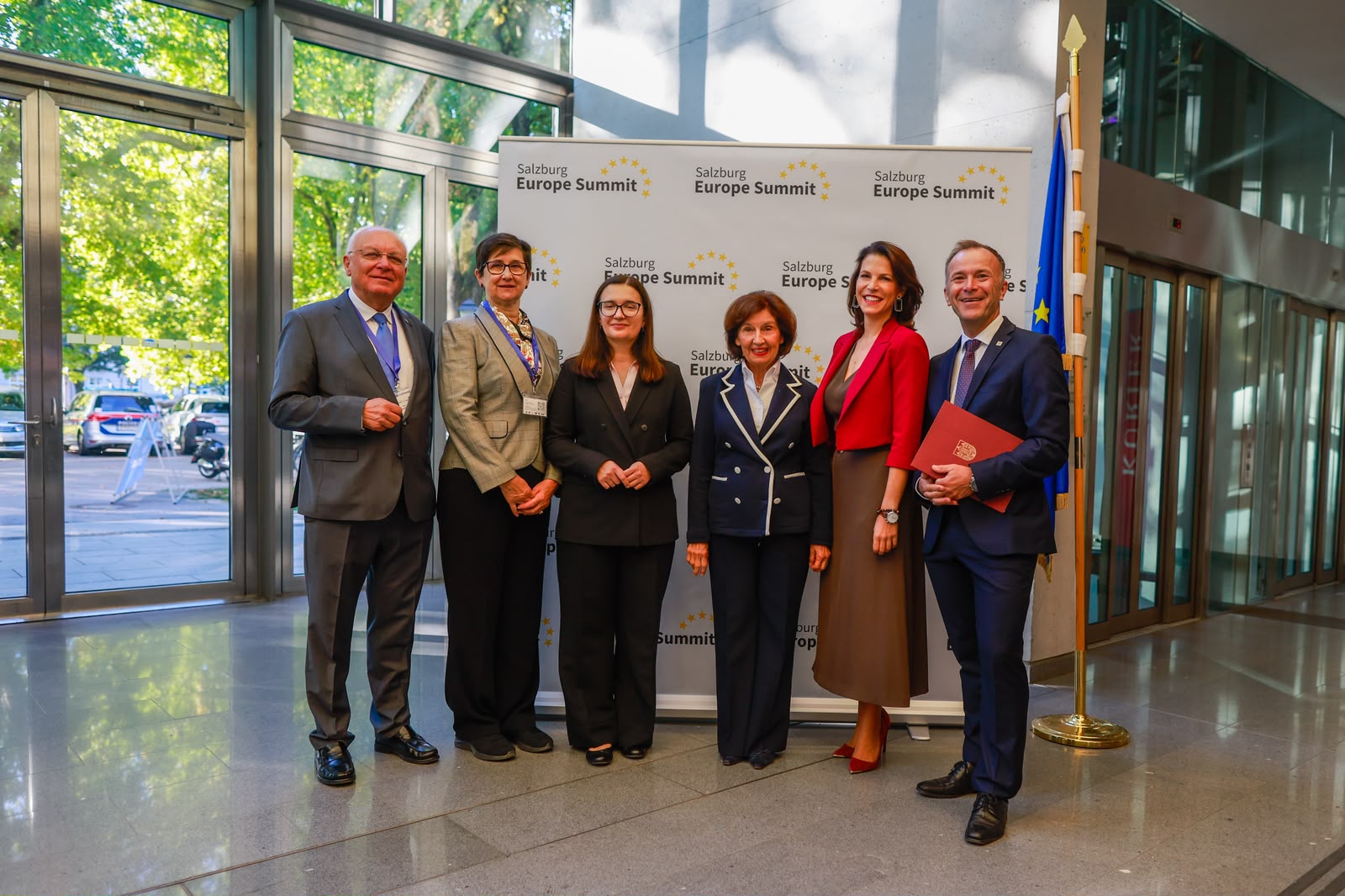
President Gordana Siljanovska-Davkova addressed the session titled “Is Europe (Still) a Global Player?” today at the 22nd Europe Summit in Salzburg.
She spoke about the future of the European project, the strategic challenges facing the European Union, and the need to accelerate the European integration of the Western Balkans as an issue over which the Union holds full control and has decisive power.
Reflecting on the country’s European path, the President noted that out of 35 years of independence, the country has spent 21 years as a candidate for European Union membership. She highlighted the 17 positive reports recommending start of negotiations, the high level of harmonization with the European legislation, and the 100% alignment with the Common Foreign and Security Policy, noting also that the country ranks among the most successful in implementing the European reforms and the Western Balkans Growth Plan.
She pointed out that no other European state has borne such a heavy burden on its integration path: the country changed its national flag and constitutional name and adopted 36 constitutional amendments, the majority of which were dictated from the outside. “Forcing a state to alter its internal legal structure in order to resolve a historical dispute raises serious questions regarding the consistency of European principles. Article 4 paragraph 2 of the EU Treaty obliges the Union to respect the equality of member states and their national identities, which are embedded in their fundamental political and constitutional structures. Yet, in our case, a constitutional amendment conditioned by a bilateral historical dispute is being presented as a test of our democratic capacity”, Siljanovska-Davkova said.
According to her, the heightened rhetoric demonstrates how quickly the region can regress when the European perspective becomes unclear. She pointed out that the only force capable of calming tensions in the Balkans and moving the region forward is a credible prospect of EU membership.
“While the Union declares its ambition to be a global power through offers of associate membership to overseas nations, by delaying its own enlargement, it effectively demonstrates powerlessness”, the President noted.
She emphasized that enlargement is not only a policy directed at candidate countries, but a test of the EU’s capacity to act strategically. “If it seeks greater geopolitical weight, Europe must be bolder and more consistent: less unpredictability, more meritocracy; less paternalism, more genuine partnership”, the President said.
In her view, rather than acting as a catalyst for reform, the enlargement process is increasingly becoming held hostage by bilateral disputes that fall outside the scope of the Copenhagen criteria.
“When progress ceases to depend on the reforms themselves, the process loses its credibility. This is no longer only a problem for the candidate countries; it has become an institutional issue for the EU itself”, Siljanovska-Davkova stated.
Addressing the issue of enlargement reform, the President highlighted 3 fundamental changes:
- First, the merit-based system must be safeguarded. If a country meets the objective criteria, another country must not be allowed to halt its technical progress over an issue that lies outside the European criteria.
- Second, membership must not create a two-tier Europe. While safeguard mechanisms may be legitimate, they must be objective, proportionate and time-bound. The goal of the reform cannot be to establish a permanent hierarchy among member states.
- Third, gradual integration can yield tangible benefits even prior to full membership, but only if it leads toward membership rather than serving as a permanent substitute for it. Ultimately, she concluded that enlargement reform is not a favor to the Western Balkans, but an investment in the geopolitical capacity of the European Union itself.
Below is the full text of President Siljanovska-Davkova’s address.
Distinguished Attendees,
Esteemed Excellencies,
Ladies and Gentlemen,
At the very beginning, let me express my great gratitude to our hosts from the Institute of the Regions of Europe and its President, Mr. Schausberger, to Governor Etstadler, and to Mayor Auinger for this Salzburg welcome.
According to an old Macedonian custom, we welcome our guests with bread and salt. And, as we know, the salt enhances flavor, preserves what is valuable from decay and awakens thirst. This Europe Summit in Salzburg – the City of Salt -does exactly that: it provides authentic flavor to key European debates, shields us from corrosive Euroscepticism and cynicism and fuels our thirst for the European idea.
“How we all loved Europe!” This is the exclamation of one of Salzburg’s most famous residents. I am not referring here to the musical genius Mozart, but to the giant in literature, Stefan Zweig. As one of the 20th century’s greatest cosmopolitans, Zweig viewed Europe not only as a continent, but as a civilization – a realm of culture, freedom and humanity. We are aware, however, that its prosperity also had a dark side: exploitation, exclusion and colonialism.
Yet, Zweig witnessed its collapse. Europe, which, prior to the two world wars, had never been stronger, wealthier or more self-confident, transformed within just a few years into a Europe of nationalism, trenches and fratricidal wars. He realized that the European tragedy did not occur because Europe lacked potential, but because nearly every European state pursued only its own interests regarding power and territorial expansion. When everyone believes they can gain more than, indeed at the expense of, others, Europe inevitably becomes a battlefield where people perish.
Zweig experienced this European suicide not merely as a collective catastrophe, but as a personal defeat. Ultimately, Europe was so devastated – both materially and in terms of its values – that he could not even conceive of its rebirth.
Nevertheless, it is precisely here that one of the greatest European turning points began. Some of his contemporaries – Adenauer, Monnet, Schuman, De Gasperi and de Gaulle – forged a different vision from those very ashes: a vision of Europe as a peace project.
I wonder: What would Zweig think if he could see the Europe of today? He would likely rejoice at achievements that surpass even his boldest imaginings. European Union leaders constantly remind us of these successes.
For instance, in his speech at the Cernobbio Forum in Italy, European Council President Antonio Costa noted that the European project stands as one of the greatest political achievements of modern times – spanning everything from economic and political integration to a single market connecting millions of people, and from the rule of law, human rights and democratic freedoms to unprecedented levels of social protection, well-being and living standards. Europe is not a continent of reckless billionaires, but a place where ordinary people can live without the fear of losing their jobs tomorrow. The Union has created an environment for development based on science, research and innovation. At the same time, it is striving to build a common foreign and security policy and to achieve greater strategic autonomy. Although the Union is not a military superpower, it is a superpower when it comes to lifestyle.
Still, there is a strategic dilemma behind this European strength. Europe faces dependencies regarding energy and raw materials, hybrid threats, migration pressures and the rise of extreme political movements. The war in Ukraine and the instability in the Middle East have coincided with a diminishing American role in the European security. In its quest to strike a balance between the welfare state, the demographic crisis and economic growth, Europe faces competition from powers that do not share its democratic standards. This rivalry also extends to the future of technology and artificial intelligence. And when Europe’s slow decision-making processes are added to the mix, the question arises: can the European Union truly achieve strategic autonomy if the key conditions for its security and stability still depend on factors beyond its control?
However, there is one crucial area, one pivotal issue over which the Union holds complete control and decisive power. And, still, it leaves the matter unresolved, like an open wound that threatens to fester. Here, I refer to the European Union’s Achille’’ heel: the integration of the Western Balkans.
Respected Attendees,
On September 8th – just 20 days ago – we celebrated 35 years of Macedonian independence. In 1991, we were the only republic of the former Yugoslavia to leave the federation peacefully and democratically, and one of only two to receive a positive opinion from the Badinter Commission regarding our recognition as a new state. The Council of Europe even highlighted the Macedonian Constitution as a model for restoration of democracy in Central and Eastern Europe.
Out of those 35 years, we have spent 21 as a candidate-country for European Union membership. With 17 positive reports recommending start of negotiations, a high level of harmonization with the European legislation and 100% alignment with the Common Foreign and Security Policy, we rank among the most successful nations in terms of European reforms and in terms of implementation of the Western Balkans Growth Plan.
But, instead of a merit-based assessment, we face double standards. No other European state has borne such a heavy burden on its path to integration: we changed our national flag and constitutional name, adopted 36 constitutional amendments, most of them dictated from the outside. Every concession spawned a new demand, and every compromise became a pretext for fresh blackmail. Compelling a state to alter its internal legal structure in order to resolve a historical dispute raises a serious question regarding the consistency of European principles. Article 4 paragraph 2 of the Treaty on European Union obliges the Union to respect the equality of Member States and their national identities, which are embedded in their fundamental political and constitutional structures. In our case, a constitutional amendment, conditioned by a bilateral historical dispute, is being presented as a test of our democratic capacity.
One might ask what is the connection between the integration of my country and the Western Balkans with the question: “Is Europe still a global player?” My answer would be: if the European Union aspires to be a geopolitical union, it must not leave my country and the Western Balkans region in a geopolitical vacuum.
Unfortunately, signals from Brussels increasingly reveal hesitation rather than determination. Do you know how many times the President of the European Commission, Ursula von der Leyen, mentioned the word “enlargement” in her latest State of the Union address? Not even once. Of course, she emphasized that the future of Ukraine, Moldova and the Western Balkans lies within the Union. Yet, she refrained from using the word “enlargement”.
Indeed, enlargement is the salt that gives flavor to democratic political culture, awakens the appetite for reform and provides protection against third-party pressures. But, as the biblical wisdom says: “If the salt loses its saltiness, how shall it be made salty?” How will the Union motivate us to reform, to cooperate and to remain resilient against third-party centers of influence without enlargement?
Therein lies the paradox. While the Union declares an ambition for global power through offers of associate membership to overseas states, by delaying its own enlargement, it effectively demonstrates powerlessness.
The question is simple. How can the European Union project influence in the Indo-Pacific or the Arctic if it cannot integrate a European region of barely 18 million inhabitants, surrounded by its own member states? Leaving the Western Balkans in a geopolitical gray zone means creating a strategic void precisely where the Union ought to be strongest. In chess, a grandmaster does not open new fronts while leaving their own king unprotected. Before expanding its horizons across the oceans, Europe must close the vacuum in its own backyard.
As early as 2022, Francis Fukuyama warned that the Western Balkans could once again become a dangerously unstable region. In a world shifting toward an unstable distribution of spheres of influence, our region is becoming a zone of clashing interests. Without a stronger and more decisive European Union, the Balkans remains a space where external powers will continue to test their strength.
Marta Kos herself cautioned that the European Union must not allow “Trojan horses” and that future members must be robust democracies. We agree. Yet, that is precisely why a credible membership perspective is needed. Dragging things out does not strengthen Europe. In the Balkans, a geopolitical vacuum never remains empty for long. The heightened rhetoric demonstrates how quickly the region can regress when the European perspective becomes unclear. The only force capable of calming tensions in the Balkans and moving us forward is a credible prospect of EU membership.
Esteemed Guests,
I learned that yesterday, within the framework of this Europe Summit, the 40th anniversary of Spain’s membership in the European Union was marked. Spain, along with Portugal and Greece, was part of Huntington’s “third wave” of democracy in the 1970s. When reviewing the membership applications of these three states to the European Community, the European Council demonstrated leadership and overcame the institutional skepticism of the European Commission and the European Parliament. Today, unfortunately, the situation regarding the Western Balkans – and my country in particular – is the reverse: while the European Commission and the European Parliament issue successive positive opinions, the European Council blocks progress due to bilateral disputes.
Even though proponents of enlargement demonstrate regional responsibility through “Slavkov 3”, the “Visegrad Group, the “Brdo-Brijuni Process”, the Berlin Process and the announced new Thessaloniki Agenda, even the most constructive initiatives still face the same structural obstacle: the national veto. Instead of acting as a catalyst for reform, the enlargement process is increasingly becoming held hostage by bilateral disputes that fall outside the scope of the Copenhagen criteria.
When progress does not depend on the reforms themselves, the process loses its credibility. This is no longer merely a problem for the candidate countries; it has become an institutional problem for the EU itself.
Hence the debate regarding unanimity. The European Parliament has called for decisions on opening and closing clusters and negotiating chapters to be made by a qualified majority, while the final decision on membership remains subject to unanimity. The logic is simple: every member state must protect its legitimate interests, but the accession process must not become an instrument for bilateral blockades.
Enlargement is not merely a policy towards candidate countries; it is a test of the EU’s capacity to act strategically. If Europe seeks greater geopolitical weight, it must be bolder and more consistent: less unpredictability and more meritocracy; less paternalism and more genuine partnership.
In this debate, we see three fundamental shifts.
First, the merit-based system must be safeguarded. If a country meets the objective criteria, another country must not be allowed to halt its technical progress over an issue unrelated to European criteria. Otherwise, the veto will simply shift from one stage to another.
Second, membership must not create a two-tier Europe. Safeguard mechanisms may be legitimate, but they must be objective, proportionate and time-bound. The goal of the reform cannot be to establish a permanent hierarchy among member-states.
Third, gradual integration can yield tangible benefits even before full membership but only if it leads to membership rather than serving as a permanent substitute for it. Austria and other member states are already advocating for ideas regarding gradual and sectoral integration precisely along these lines.
The future of the Western Balkans is not the only thing that depends on the outcome of this debate. Europe cannot be a global player if it fails to be a strategic player in its own backyard. It cannot seek geopolitical weight while allowing its own agenda to be blocked by bilateral disputes. Therefore, reforming the enlargement process is not merely a favor to the Western Balkans; it is an investment in the geopolitical capacity of the European Union itself. We have always been part of Europe – geographically, historically and culturally. It is high time we became part of it politically as well.
Thank you.