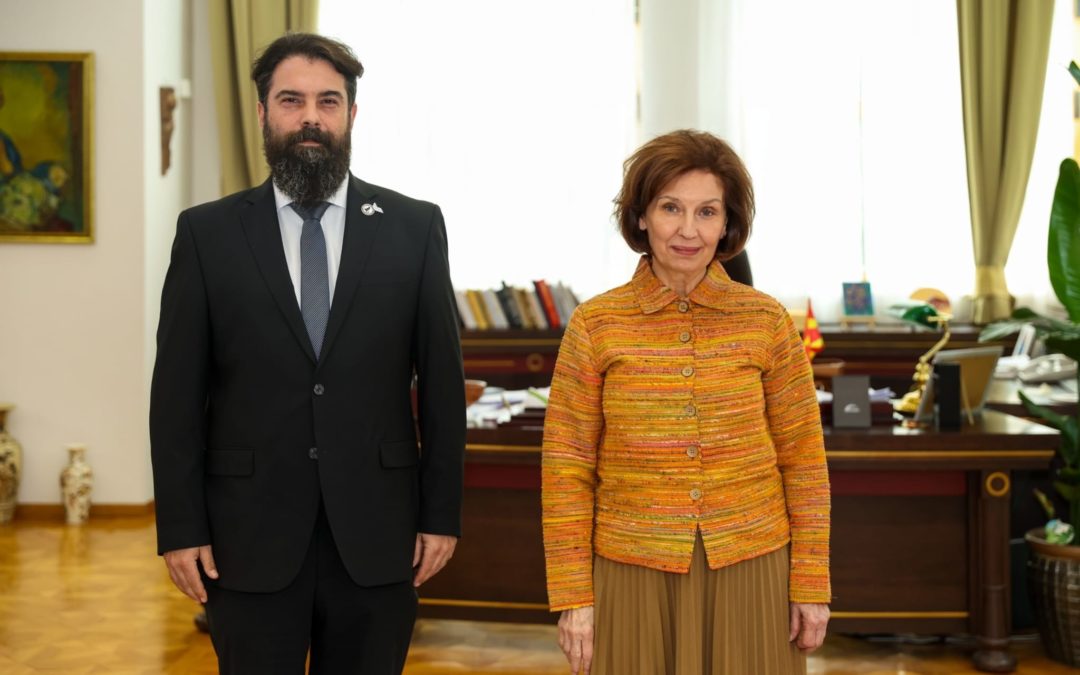
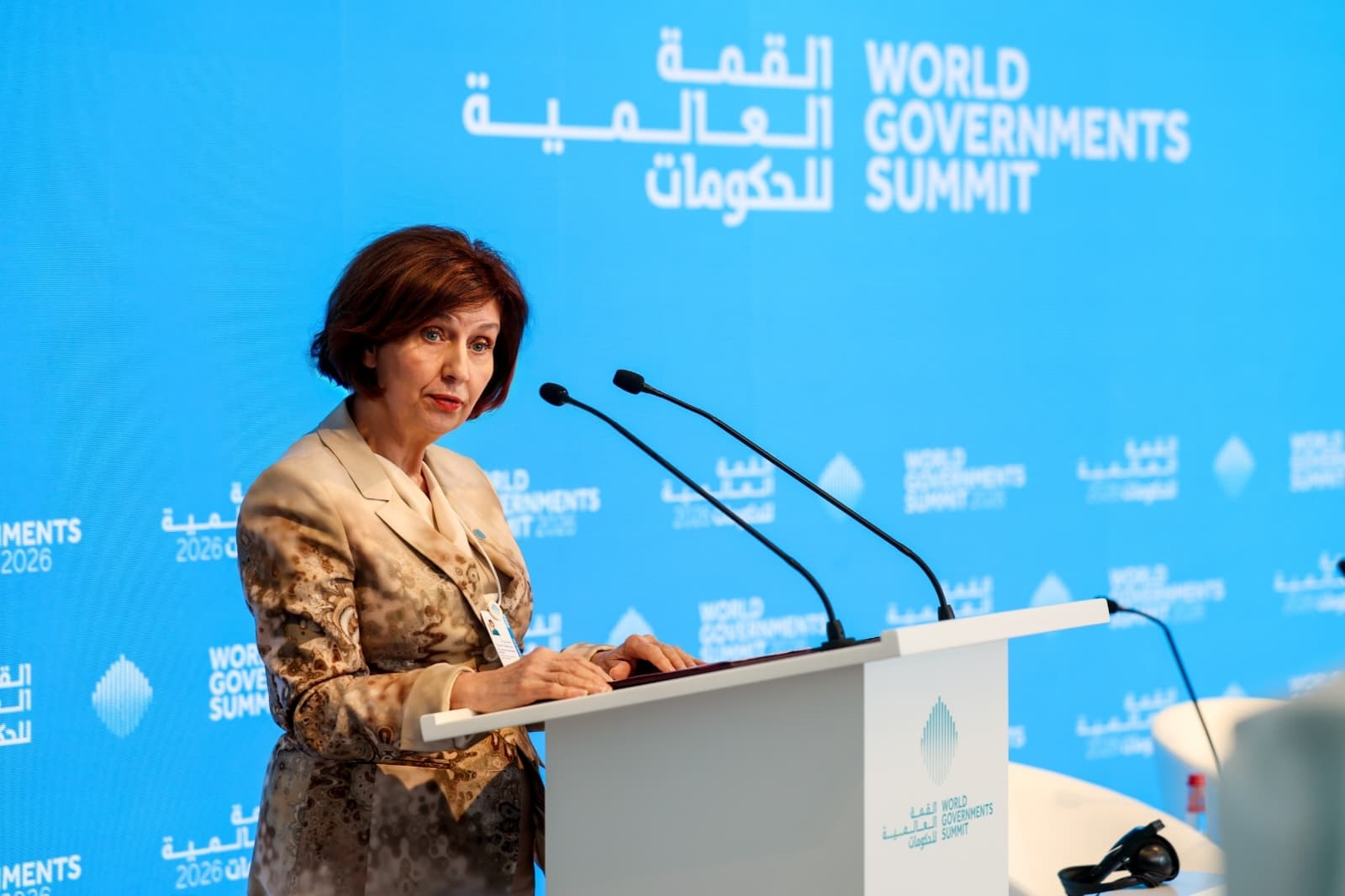
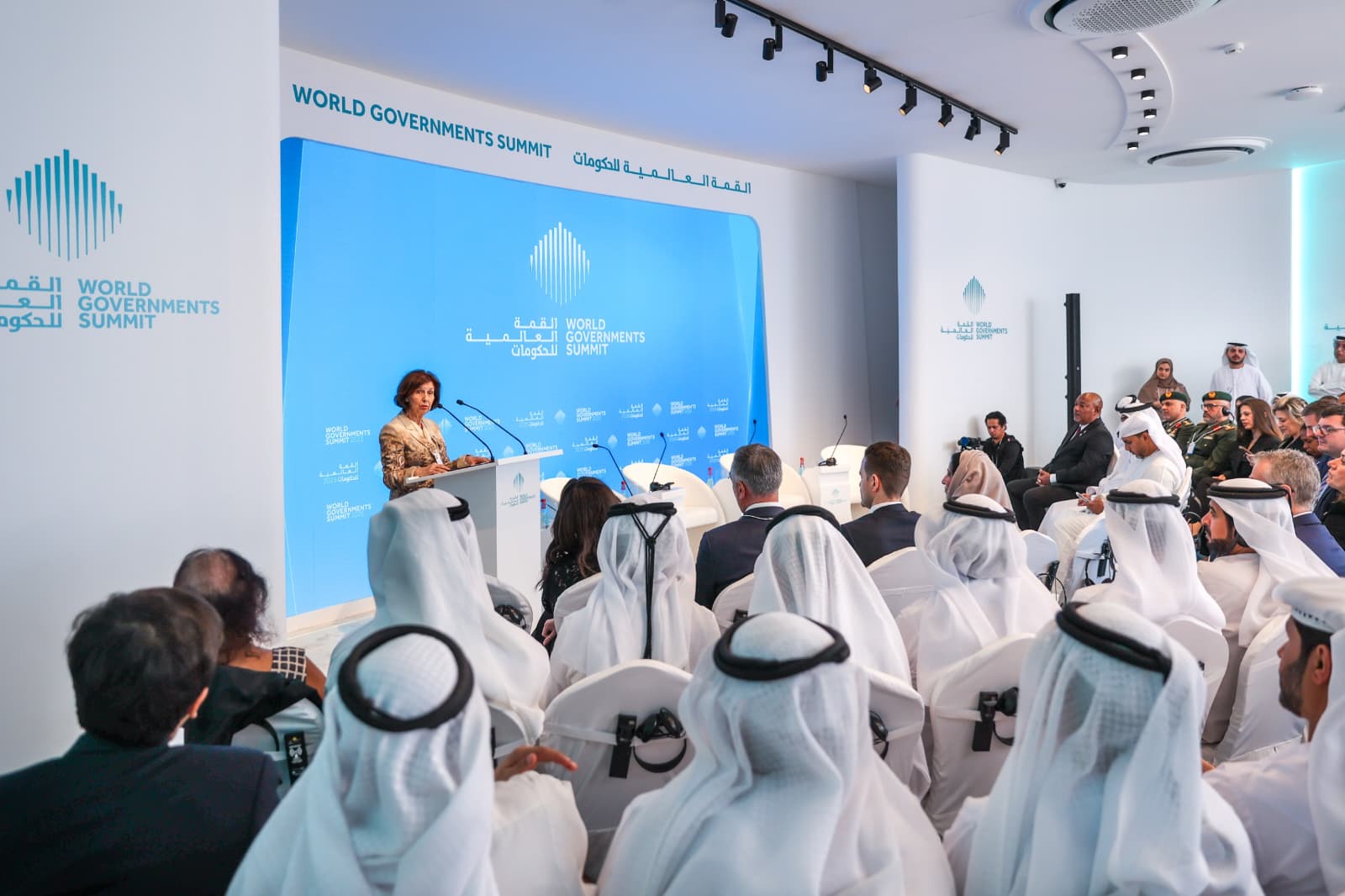
Regulation is not just about control, it is about creating a predictable space where social trust can grow, said President Gordana Siljanovska-Davkova in her address to the Global Forum on Government Regulation and Justice, as part of the World Government Summit in Dubai.
In her address on the topic “Legislation as an Enabler of the Rule of Law”, she pointed out that instead of relying on institutional illusionism and believing that a perfect law on paper is the end of the road, we need to focus on the hard work in the years ahead – to build institutions that breathe, that adapt and that belong to the people.
She presented the Macedonian case and pointed out that for 25 years after signing the Stabilization and Association Agreement with the European Union, the country has been formally and legally harmonizing with the European Union, with its institutions, rules and regulations, but despite that we are among the longest-standing candidates for full membership in the European Union.
However, the harmonization, according to the President, is not done only for the sake of Brussels, but also because the procedures are a guarantee of equality. When we harmonize our laws with European standards, we build a system in which the rules outlive the government, said the President, emphasizing that this is the difference between the rule of man and the rule of law.
She pointed out that Macedonian institutions remain inclusive and that the National Development Strategy 2024 ‒ 2044 helps us calibrate policies and laws.
Your Excellencies,
Ladies and gentlemen,
It is a privilege to be with you today on this Global Government Regulations Summit. For my country, this year of 2026 marks a double jubilee. We are celebrating 35 years of Macedonian independence. But we are also marking a bittersweet anniversary: 25 years since signing the Stabilization and Association Agreement with the European Union. For a quarter of a century, my country has been formally and legally aligning itself with the European Union, its institutions, rules, and regulations. I say bittersweet because, apart from Türkiye, we are the longest standing candidate in the waiting room for full membership.
Why have we spent 25 years harmonizing our laws? It is not just to please Brussels. It is because we understand the wisdom of Jean Monnet, the architect of Europe. He famously said that “Nothing is possible without men, but nothing lasts without institutions.”
We have learned that procedures are guarantee of equality. A procedure does not care if you are rich or poor. It does not care which political party is in power. When we align our laws with European standards, we are building a system where the rules survive the ruler. This is the difference between the rule of man and the rule of law.
This is exactly what Nobel laureates Daron Acemoglu and James Robinson call “inclusive institutions.” We are moving away from the “rule of man,” which is arbitrary and fragile, to the “rule of law,” which is consistent and durable. In order to bring predictability and prosperity, politics has to be within the law or under the law, not without the law.
However, regulation is not always a remedy. Think of regulation like a pendulum. If the pendulum swings too far to one side, we have too little regulation, leaving room for misuse of power. We saw this in the early years of transition across South Eastern Europe. But if the pendulum swings too far the other way, we choke our own future. We risk creating a paper reality where innovative ideas die under the weight of compliance. My country is the regional champion in harmonization with the European acquis. We constantly have to ask ourselves if we are importing solutions or just importing bureaucracy.
The challenge for all of us in 2026 is to find the balance. We need enough regulation to protect our values, but enough freedom to allow life to flourish.
Let me use an example from history. In 1936, Joseph Stalin introduced the Soviet Constitution. On paper, it was the most democratic document in the world. It promised universal voting, human rights, and equality. But in reality, it sent people to the gulags. There were no real checks and balances to enforce it.
Contrast that with the United Kingdom. They do not even have a written constitution, however, they have a rich constitutional tradition and developed constitutionalism. Many countries around the Commonwealth and the world are inspired by their Westminster democratic institutions.
Why is this so? I believe that is has to do with something I call legal or institutional illusionism.
Speaking as a university Professor of Constitutional Law, I know that drafting a constitution is one of the most important steps in creating a state. However, old democracies had a luxury that we did not afford. They had centuries to slowly grow their systems and develop their institutions and checks and balances. We, on the other hand, had to catch up fast. In a turbulent period, with the end of the Cold War and the violent breakup of Yugoslavia, we had little time to develop new models.
“You have to get on board the ship called Democracy in order to learn how to sail in democratic waters”, Giuseppe Di Palma wrote. And, that is what we did. Despite some shortcomings, we managed to develop a system. In 1996, the Council of Europe published an important publication entitled: “The Rebirth of Democracy: 12 Constitutions from Central and Eastern Europe.” Even then, the Macedonian Constitution was praised for its democratic, liberal solutions. After the Ohrid Framework Agreement, our constitutional solutions for protecting the rights of non-majority communities exceed the European average.
However, it is an illusion to believe that you can create an institution just by signing a piece of paper. You cannot simply import a democracy. Institutions are historical products. They are the building blocks of democracy, but they have to be built, not just declared.
We see this same illusion when we look at how governments actually work. Since the time of Walter Bagehot, political theorists have studied the relationship between the people who make the laws and the people who enforce them.
However, a political system cannot be brought just to its constitutional institutional framework. It is a living body. It is deeply and inseparably sewed with political culture, civil society, and particularly with the electoral and the party system.
It is a legal illusion to believe that having a perfect constitution means you have a perfect government. The exact same law can work perfectly in one country and fail completely in another. It can work today and fail tomorrow. According to O’Donnell and Schmitter, transition is over when abnormality is no longer a central characteristic of political life, when basic procedures and rules, or more precisely, the constitutional, economic, and political systems are established. Nevertheless, norms and institutions are not sufficient for democracy. Democracy grows “bottom-up” and civil society develops “from within”.
We are currently in the 35th year of that journey. This is why we cannot stop now. This is why we launched our National Development Strategy 2024-2044. By engaging over fourteen thousand citizens in broad, inclusive consultations from all sectors, and building a twenty-year plan, we are ensuring that our institutions remain inclusive regardless of the external pressures of a contested world. The Strategy helps us calibrate policies, laws and investment to the shifting needs. We realized that we cannot just write laws for the next election.
My message to this forum is simple. Regulation is not just about control. It is about creating a predictable space where social trust can grow.
Instead of relying on institutional illusionism and believing that a perfect law on paper is the end of the road, we should focus on the hard work in the years ahead. Let us build institutions that breathe, that adapt, and that belong to the people.
That is how we move from the waiting room of history to the workroom of the future.
Thank you.