Distinguished citizens,
Dear descendants of the Ilinden revolutionaries and the partisans,
Ilinden is a day of profound remembrance and commemoration of the struggle waged by many generations for an independent Macedonian state.
The First Session of ASNOM was neither a spontaneous nor an incidental event, but a carefully conceived democratic act of state-building, historically inspired by the traditions of the French Revolution and the Ilinden Uprising.
Veteran participants in the Ilinden Uprising – Panko Brashnarov, Dimitar Vlahov and Pavel Shatev – embodied, through ASNOM, the legacy and testament of Goce Delchev and the heroes of Ilinden.
Vladimir Polezhinovski, a young Doctor of Law from the Sorbonne, infused the Declaration on the Fundamental Rights of the Citizen of Democratic Macedonia with the spirit of the French Revolution of 1789, by which he had been profoundly inspired, drawing on the model of the French Declaration of the Rights of Man and of the Citizen. It is precisely for this reason that ASNOM’s founding state documents are conceptually closer to the Western democratic and liberal traditions than to the Eastern, dogmatic Soviet models.
Meanwhile, the charismatic tribune of the people, Metodija Andonov – Chento, to whom we pay tribute today, affirmed the Macedonian people’s right to self-determination. This principle subsequently became an integral part of the founding documents of the United Nations, as well as of the constitutions of the member republics of the Yugoslav Federation, including the 1974 Constitution of the Republic of Macedonia. Indeed, it was upon this constitutional foundation that, thirty-five years ago, on 8 September 1991, here in this square, we proclaimed a free, sovereign, and independent republic, based on the results of a democratically conducted referendum.
Let me also recall that the partisans and the delegates of ASNOM enshrined anti-fascism as an essential and enduring commitment of the Macedonian people and as one of the cornerstones of the Macedonian state. Our National Liberation Struggle was an authentic undertaking of historic proportions; Our freedom was not bestowed upon us by others; we liberated ourselves through the efforts of our 120,000-strong National Liberation Army. Therefore, we owe no one for the hard-won statehood we achieved. It is precisely for this reason that no one has the right to revise our national history, for every nation has the right to its own history.
We owe a debt to historical truth and to the generation of ASNOM, which secured freedom and the Macedonian republic through the ultimate sacrifice.
Regrettably, soon after our greatest historical victory, many of the founders of the modern Macedonian state were removed from the political stage. My generation learned about Metodija Andonov – Chento, the first President of the Presidium of ASNOM, only much later, and knew truly little about his life and the fate of those who shared his convictions.
It was only years later that we came to fully appreciate the life and legacy of Metodija Andonov – Chento, who was subjected to continuous persecution, imprisonment, and punishment, yet steadfastly endured every ordeal and remained unwavering in his Macedonian convictions throughout the years of the occupying regimes. This was the very reason for his immense esteem among the people and for the proposal made by Kuzman Josifovski – Pitu that he take an active role in the Macedonian National Liberation and Anti-Fascist War – first as a member of the General Staff and President of the Initiative Board for the convening of ASNOM, then as a delegate to AVNOJ, and ultimately as the holder of one of the highest offices, President of the Presidium of ASNOM.
His signature appears on the state-building decisions and resolutions through which ASNOM was established as the supreme legislative and executive authority; on the decision introducing the Macedonian language as the official language; on the proclamation of Ilinden as a national public holiday; on the establishment of state institutions and bodies; and on many other decisions of historic importance.
I have often asked myself how it came to pass that this Macedonian giant was not only removed from political life but also erased from history. Today, we know with certainty that, through his principled stance, consistency, and unwavering integrity, he earned powerful enemies among certain holders of authority – men who had until recently been his comrades-in-arms. Let me recall that, in a politically orchestrated trial, he was prosecuted and convicted for views and ideas that were identical to the decisions adopted at the First Session of ASNOM. I ask: Could Chento have been held criminally liable before a Macedonian people’s court for the very ideals proclaimed by ASNOM? Of course not; and yet the ruling political nomenclature and the subservient communist judiciary condemned him through a partisan verdict rather than in accordance with the Constitution and the law.
On 6 February 1956, seventy years ago, Chento wrote: “One thing you should know: when the French Revolution took place, all the great men perished, and a philosopher said: ‘The revolution devours its own children.'” And indeed, its first victims are the very best and the most capable. I often ask myself: What kind of state might we have built had the best among them remained and guided its course? Undoubtedly, they would have surrounded themselves with others of the same calibre.
Dear fellow citizens,
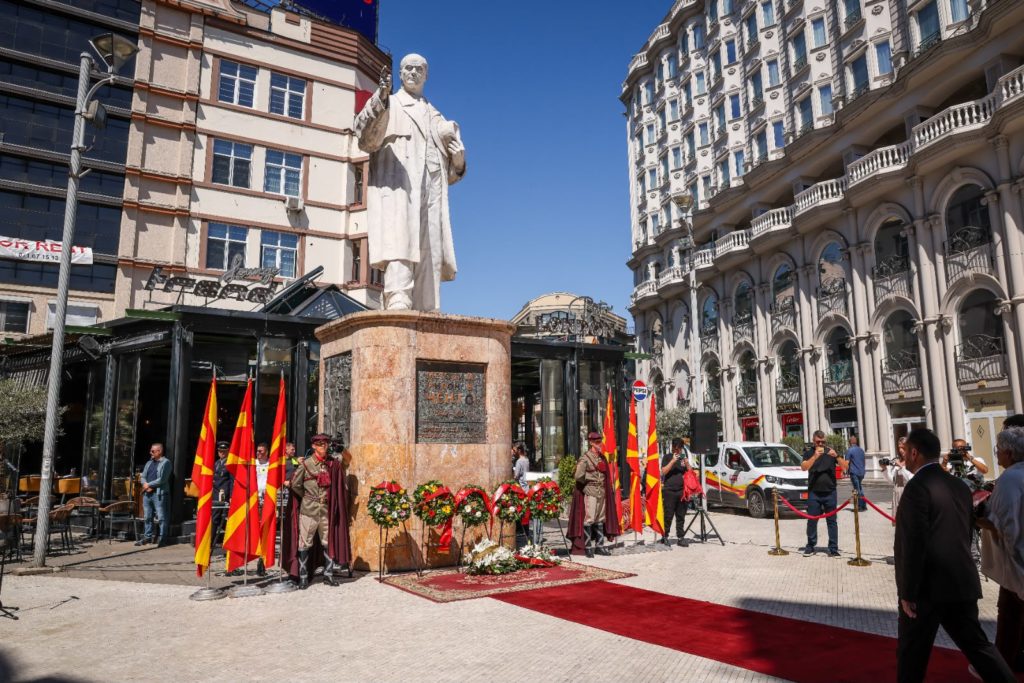
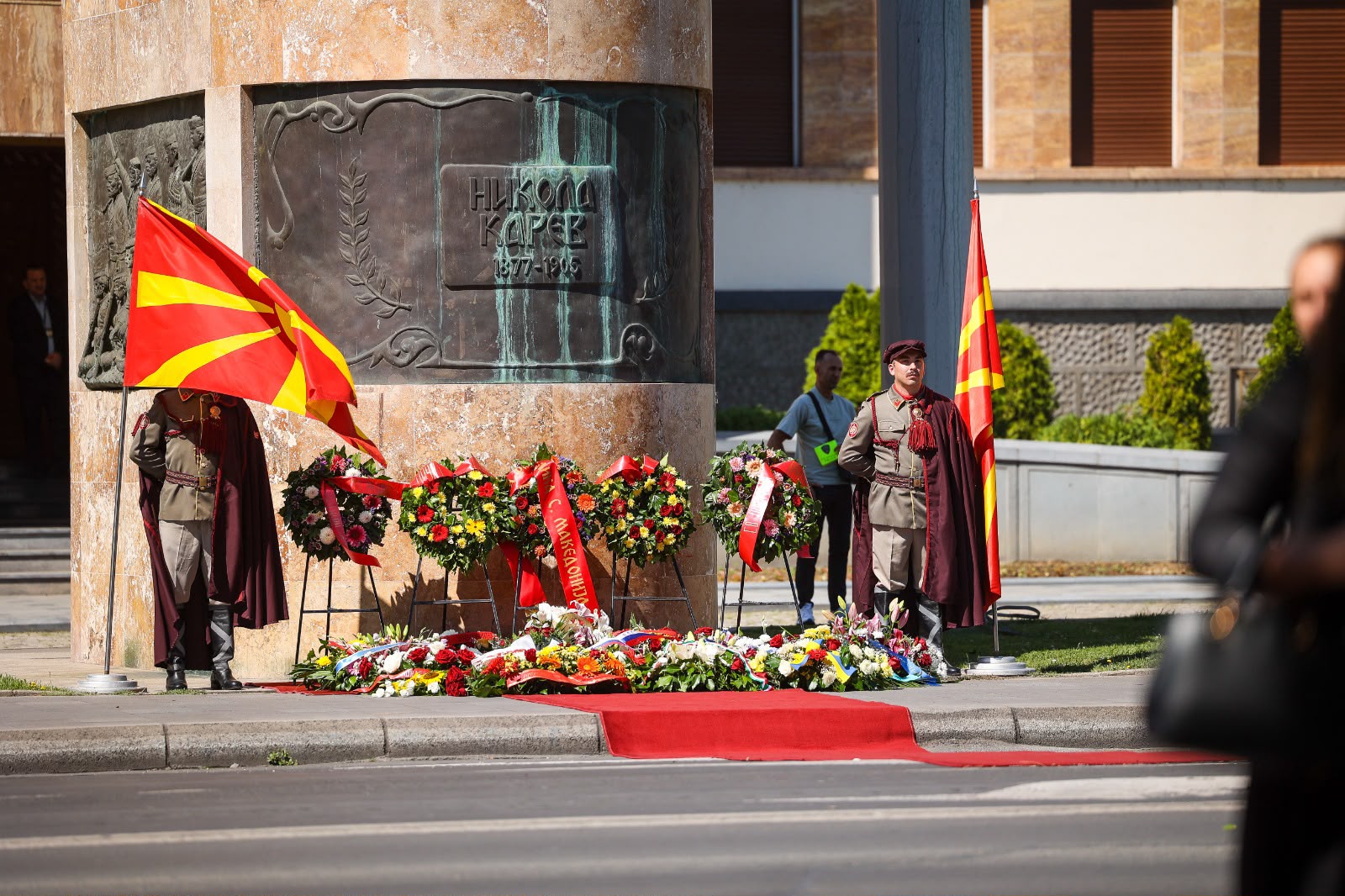
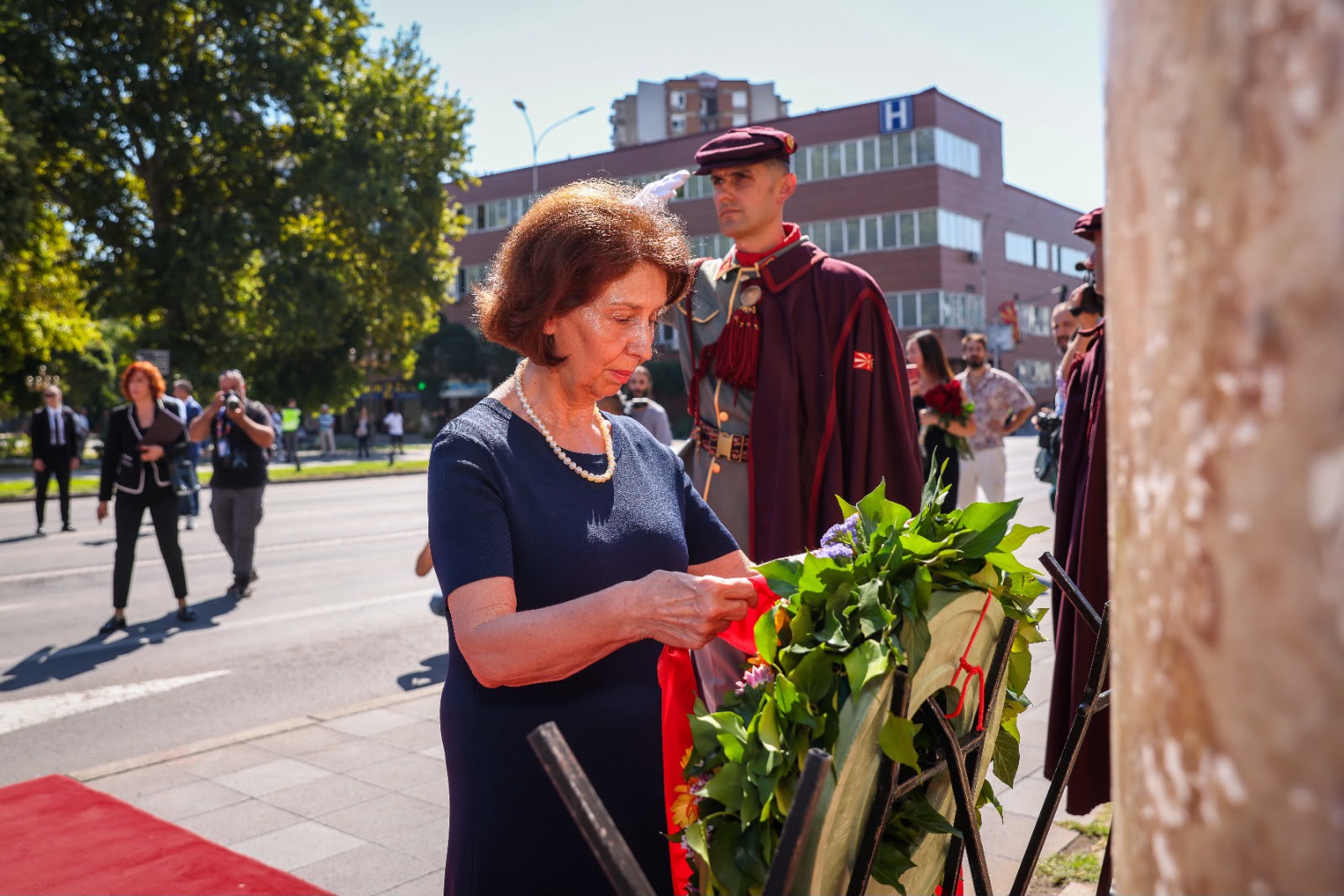
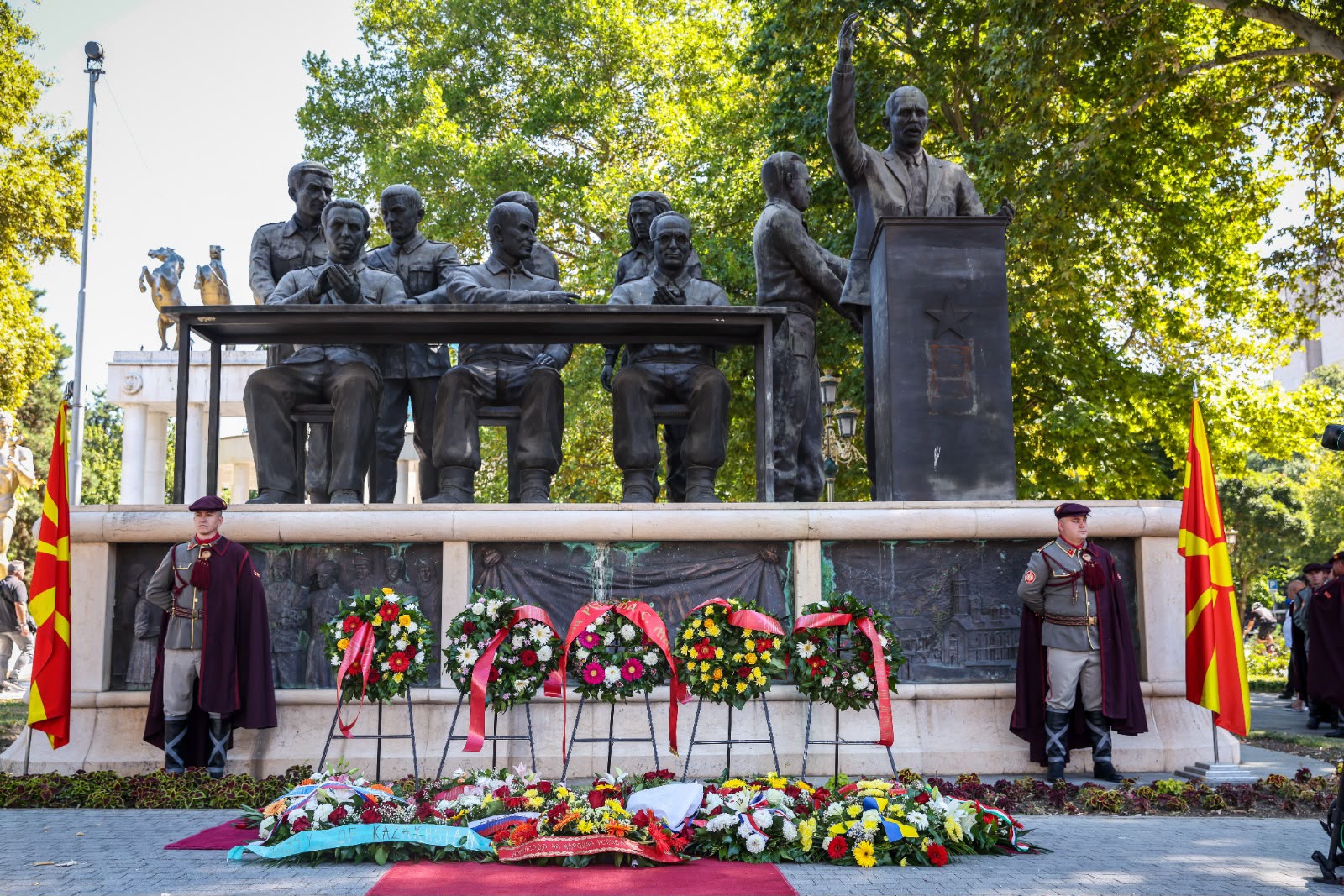
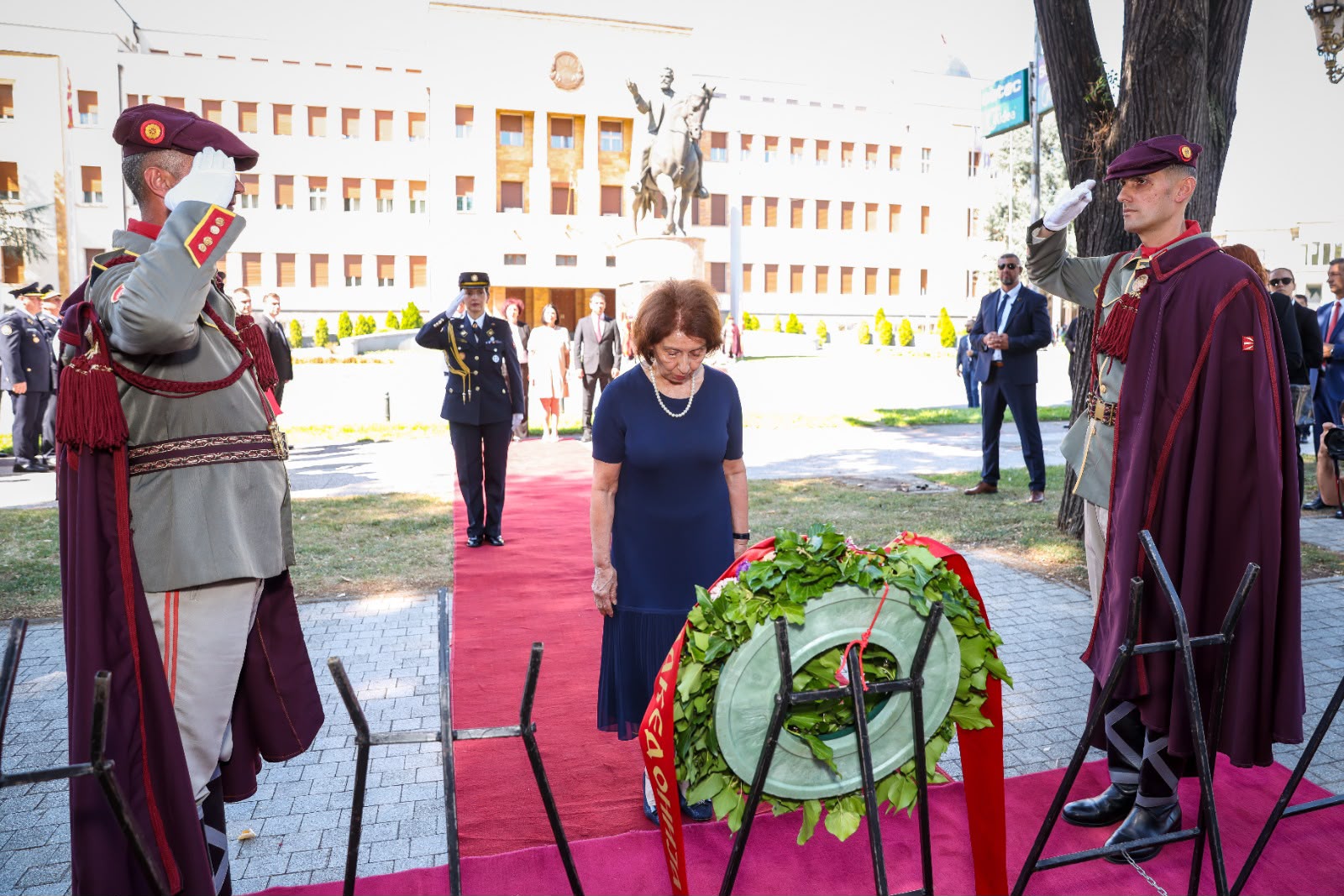
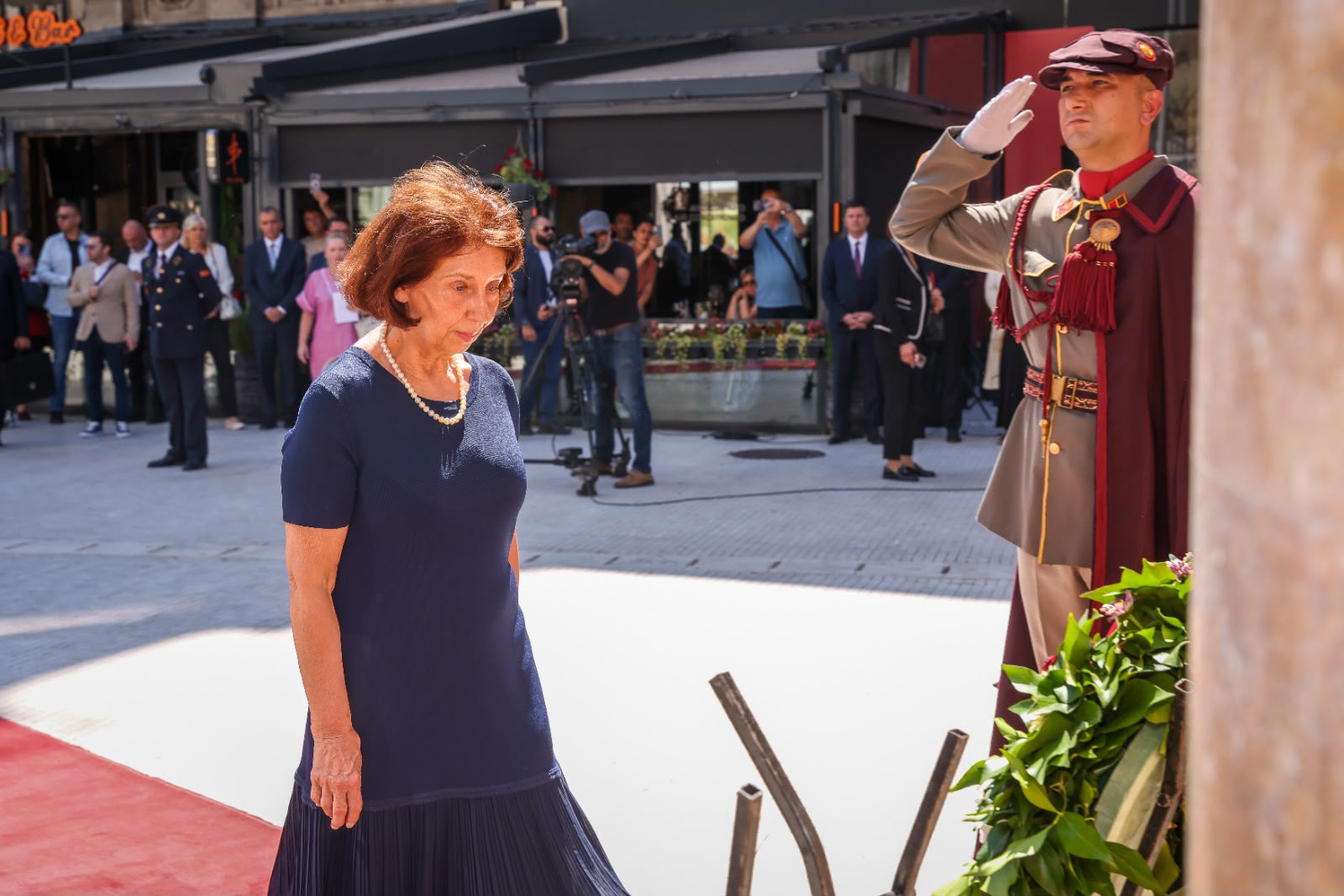
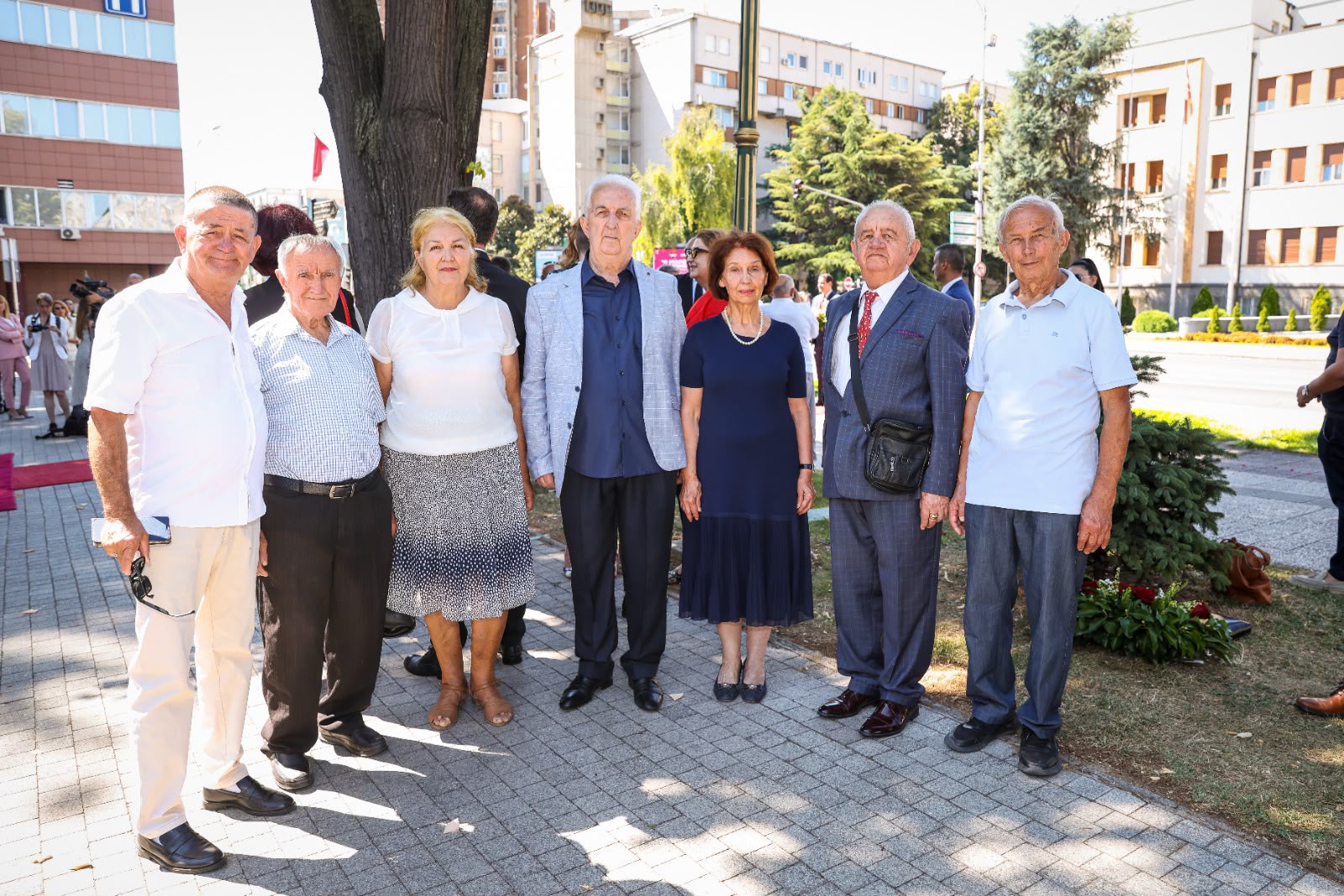
Today, gathered before the monument to one of Macedonia’s greatest sons, together with members of his family, I believe it is no coincidence that the sculptor chose to immortalize Metodija Andonov – Chento not in a uniform, but in civilian attire – as the first citizen of the new Macedonian republic, its first President.
While he holds his hat over the heart that beats for his homeland and his people, his outstretched finger reminds us of our generational duty to preserve and defend the freedom of our state “as the apple of our eye.”
And I firmly believe that our state is best safeguarded through a democratic political system and constitutional patriotism. As an unwavering Macedonian patriot and a committed democrat, Chento never departed from the principle of the Macedonian people’s right to self-determination, nor did he tolerate interference in the internal affairs of the Republic, including respect for its highest constitutional and legal acts by everyone, everywhere. Should we then remain hesitant when it comes to the founding documents of ASNOM and the numerous amendments made to the 1991 Constitution?
Certainly, peace and coexistence in a heterogeneous society are preserved by guaranteeing and protecting the rights of communities, but not at the expense of individual human rights if we are to remain a democracy.
ASNOM took full account of Macedonia’s multiethnic reality. Its Manifesto was addressed to all ethnic communities. Today, we take pride in the high standards of protection afforded to the minority rights of Albanians, Turks, Vlachs, Serbs, Roma, Bosniaks, and other communities. Whether explicitly mentioned or not in the introductory part of the Constitution, commonly referred to as the Preamble, all citizens of Macedonia enjoy the same rights and bear the same obligations towards the state, as set out in its normative provisions.
A state is also preserved by investing in its young people. It was the young who fought for freedom and built the state. Nearly half of the delegates to ASNOM were under the age of thirty. Regrettably, today many of our most promising young people are leaving the country in search of a decent place to live. Some, as a consequence of the stalled European integration process, have even sought passports of other European Union Member States. It is our duty to fight corruption and organized crime, as well as particracy and pollution. Only when knowledge, merit and achievement become more important than party membership and personal connections will our young people choose to remain here – to live, to work, and to raise their families at home.
A state is also defended through a wise and prudent foreign policy. One of Chento’s greatest “offences” was his pro-Western orientation. Like many of the delegates to ASNOM, he advocated a clear separation of powers, guaranteed human rights, and a market economy. Even while imprisoned, he was reproached for studying English, French and German instead of reading Marx, Engels, and Lenin. Our path, like Chento’s, is one of a firm commitment to Europe.
We recognize that every candidate country is expected to make compromises in aligning its legislation and institutions with the acquis and in resolving various bilateral or regional issues. Our experience, however, is unique. It has been marked by an unending succession of demands that challenge and undermine our sovereign right to self-determination. Yet the fact remains that it is not only we who lose as a result of the blockage of our European integration process; those who obstruct it lose as well.
A state is strengthened through national reconciliation. Chento was criticized for his willingness to reconcile with those who had until recently been his political opponents, provided they stood together on the same Macedonian course. If we want our country to be a decent place to live, we must overcome our divisions and learn to speak with one voice on matters of national interest. We need this today more than ever before.
Dear fellow citizens,
Addressing the Third Session of ASNOM, Metodija Andonov – Chento declared: “By serving the good of our people, we serve the good of the state. What our people have entrusted to us; we must secure for all time. Only in this way can we move forward in progress…”. His words remain our enduring obligation.
Happy Ilinden!
May the Macedonian Republic endure for generations to come!